Why I Can’t Celebrate Kwanzaa
Kwanzaa is now far bigger than its founder. But I can't forget that Ron Karenga helped murder Black Panther militants and his other heinous crimes.
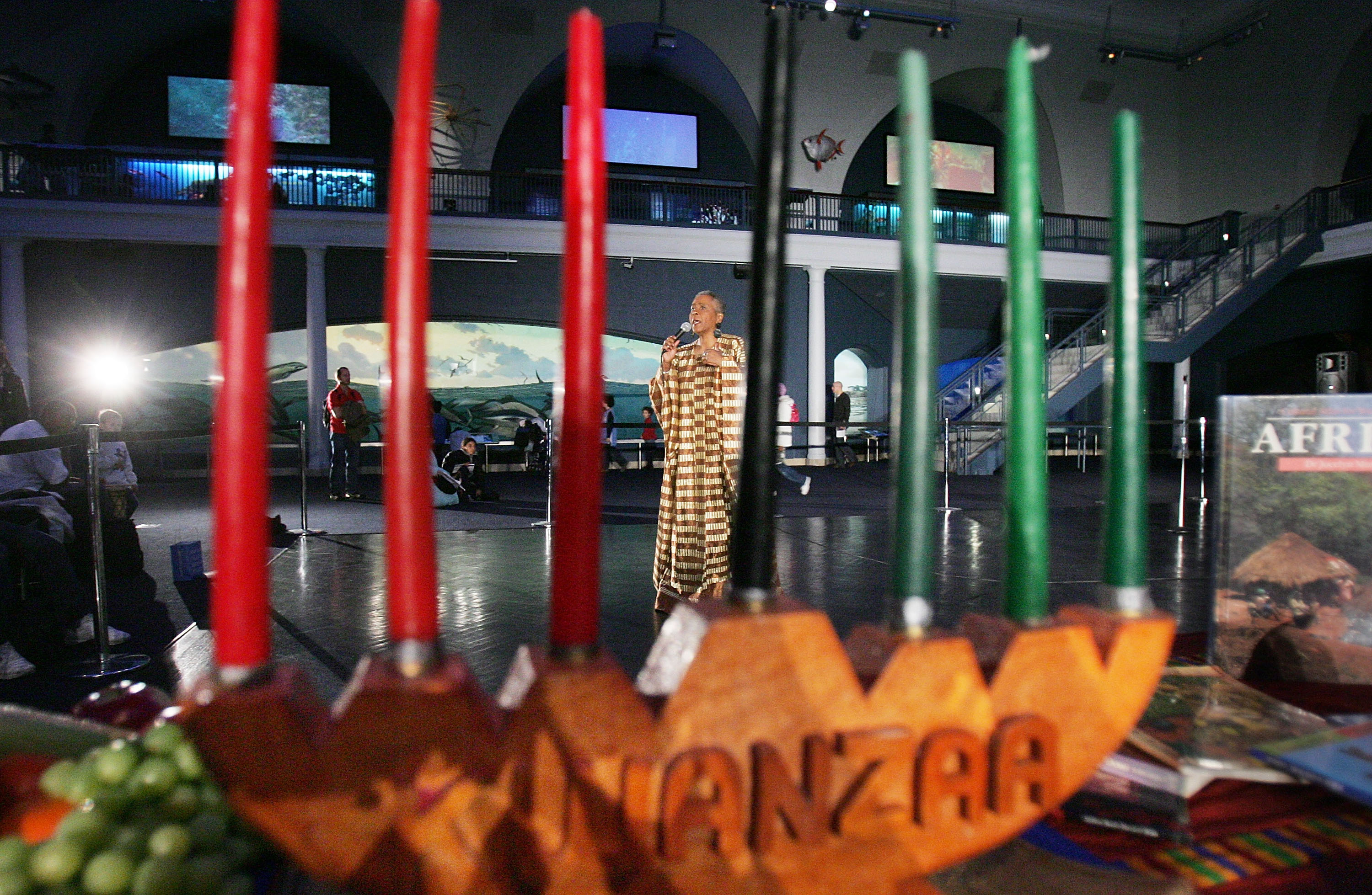
The “Kwanzaa 2004: We Are Family” festival at the American Museum of Natural History December 22, 2004 in New York City. Mario Tama / Getty
I don’t do Kwanzaa. I just don’t. I never have, and the very thought of it evokes some difficult memories and feelings for me.
It’s not the holiday’s religious trappings or its Afro-syncretic fusion of Jewish menorahs, Swahili words, Kemetic, Christian and other rituals. I understand people do have a perfect human right to adopt or make up the cultural and religious practices that suit them. Rastafarianism, Voudon, Santería, and Candomblé all borrow from multiple traditions, as does Islam from Judaism and Christianity, and Christianity from Judaism, Greek and Roman sources, and so on. So I have no quarrel whatsoever with those who celebrate and find value in Kwanzaa.
But for many of us who took part in or were simply aware of the Black Panther Party in the late sixties and early seventies, the Kwanzaa holiday is inseparable from the career and persona of its inventor, Ron Karenga, now a professor in California. Back in the day, Karenga headed up an organization called US. As a tool of COINTELPRO, the federal counterintelligence program directed at movement organizations, Karenga’s US organization murdered two leading members of the Black Panther Party in Los Angeles, Alprentice “Bunchy” Carter and John Huggins, and two more in San Diego, Sylvester Bell and John Savage.