The Ford Foundation’s Reform From Above in Ocean Hill-Brownsville
Black activists might have initiated the fight for community control in Ocean Hill-Brownsville in 1968. But the Ford Foundation not only played a key role in the idea’s conception; they shaped its execution according to elite, liberal aims.
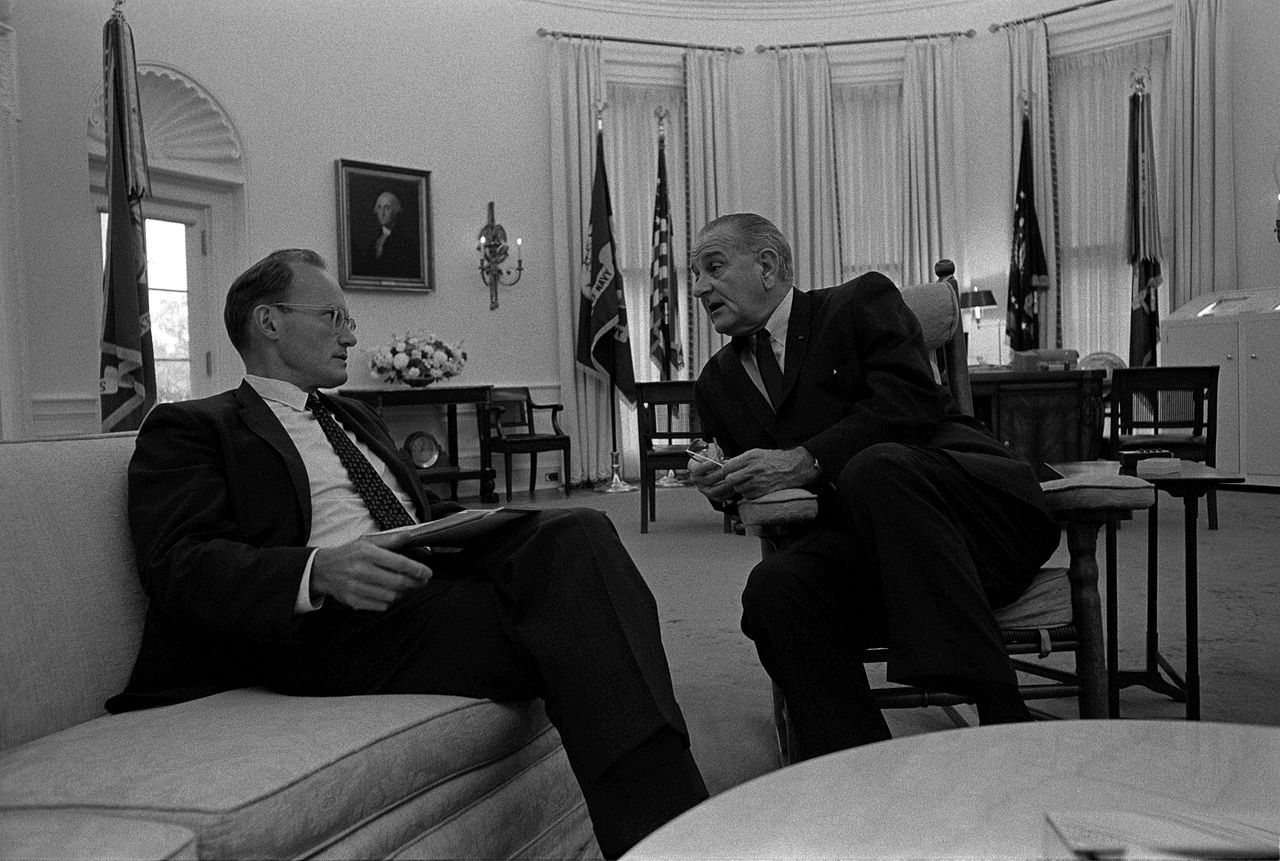
President Lyndon B. Johnson meets with McGeorge Bundy, August 23, 1967.LBJ Library
Chronicles of the New York City schools crisis of the late 1960s usually frame the story as a battle among the obvious stakeholders in public education: students and their parents, the United Federation of Teachers (UFT) and its membership, and the Board of Education and its administrators. But there was another, private player with no obvious connection to the schools whose interference in the struggle over community control and decentralization would no less shape its outcome than those who did.
The Ford Foundation, at the time the world’s largest philanthropy, took an active role in New York’s schools, intervening as what its officers called a catalytic “change agent” to induce system reform by supporting the call for community control and decentralization. Specifically, Foundation president McGeorge Bundy played a key mediating role in the first volley of the community control movement: the high-profile black activism against the appointment of a white principal at the all black and Puerto Rican Intermediate School (IS) 201 in East Harlem.
Then Bundy was appointed by Mayor John Lindsay to be the chair and driving force of the Mayor’s Advisory Panel on Decentralization. Through those auspices, he and a staff of Ford Foundation officers and consultants working out of the Foundation’s offices were the masterminds behind the city’s plan to break up New York’s behemoth school system into smaller units. Finally, and most controversially, the Ford Foundation played a primary role in the choice and creation of — as well as devising the plans and providing the only nonessential operating funds for — the three demonstration school districts (Ocean Hill-Brownsville, IS 201, and Two Bridges in the Lower East Side of Manhattan) that comprised the community control experiment.