Lenin’s The State and Revolution
The definitive essay on Lenin's classic pamphlet.
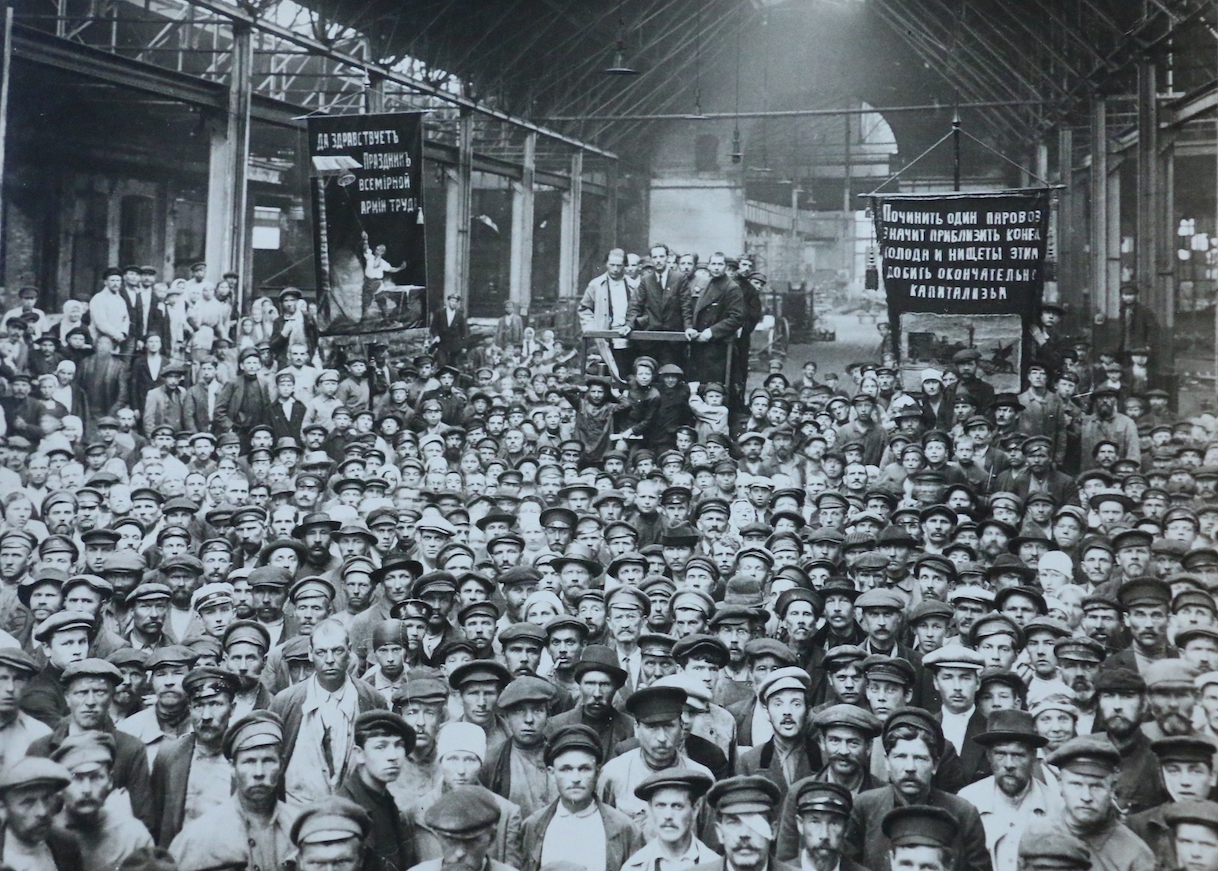
A meeting of workers in Petrograd, July 1920. Wikimedia Commons
The State and Revolution is rightly regarded as one of Lenin’s most important works. It addresses itself to questions of the utmost importance for socialist theory and practice, none of which have lost any of their relevance — rather the reverse. And as a statement of the Marxist theory of the state, both before and particularly after the conquest of power, it has, because it was written by Lenin, enjoyed an exceptionally authoritative status for successive generations of socialists, never more so than in recent years, since its spirit and substance can so readily be invoked against the hyper-bureaucratic experience of Russian-type regimes, and against official Communist parties as well. In short, here, for intrinsic and circumstantial reasons, is indeed one of the “sacred texts” of Marxist thought.
“Sacred texts,” however, are alien to the spirit of Marxism, or at least should be; and this is itself sufficient reason for submitting The State and Revolution to critical analysis. But there is also another and more specific reason for undertaking such an analysis, namely that this work of Lenin is commonly held, within the Marxist tradition, to provide a theoretical and indeed a practical solution to the all-important question of the socialist exercise of power.
My own reading of it suggests, for what it is worth, a rather different conclusion: this is that The State and Revolution, far from resolving the problems with which it is concerned, only serves to underline their complexity, and to emphasize something which the experience of more than half a century has in any case richly — and tragically — served to confirm, namely that the exercise of socialist power remains the Achilles’ heel of Marxism. This is why, in a year which will witness so much legitimate celebration of Lenin’s genius and achievements, a critical appraisal of The State and Revolution may not come amiss. For it is only by probing the gaps in the argument which it puts forward that the discussion of issues which are fundamental to the socialist project may be advanced.