Democrats and Their Promises
Of course Democratic candidates will claim to support progressive policies. Don't assume they're telling the truth.
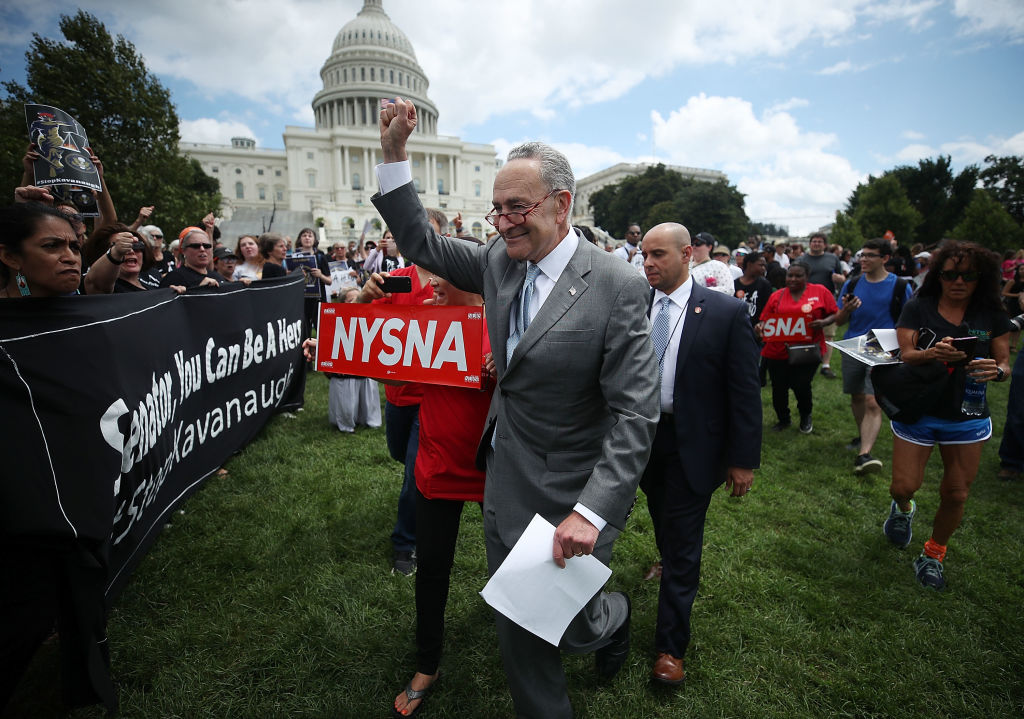
Senate minority leader Charles Schumer joins activist groups in speaking out against Supreme Court nominee Brett Kavanaugh, at the US Capitol on August 1, 2018 in Washington DC. Mark Wilson / Getty
Never Believe Democrats’ Policy Promises
The Intercept had a nice scoop last week based on leaked internal documents from the Healthcare Leadership Council (HLC), the industry’s anti-single-payer lobbying machine. It seems the HLC has been having private one-on-one meetings with Democratic primary candidates to suss out their positions on health reform, and in some cases — brace yourself — what the candidates are telling the lobbyists behind closed doors doesn’t line up with what they’ve been telling voters.
The case in point showcased in the Intercept story was Hawaii lieutenant governor Doug Chin, now running for Congress, who met with the HLC last February:
Chin indicated to the Healthcare Leadership Council that he supports its position that the “best way to achieve the lowest prices for Medicare beneficiaries in the Medicare Part D program is through the current process of private sector negotiation,” according to his dossier.
As it stands now, the Medicare law, authored under the influence of the drug lobby, prevents the agency from using its collective bargaining power to negotiate lower prices for pharmaceuticals as part a benefit program known as Part D. Progressive health care activists have agitated for the government to become directly involved in negotiations. Public Citizen, a watchdog group, claims that allowing Medicare to negotiate for lower-priced drugs could save $15 billion per year from the program’s budget.
Drug industry groups like the Healthcare Leadership Council — which is funded by pharma giants Amgen, Johnson & Johnson, Merck, Pfizer, Novartis, Novo Nordisk, and Bristol-Myers Squibb — have opposed the negotiation route.
Chin’s claim, according to the Healthcare Leadership Council documents, that he supports the industry-friendly status quo contrasts sharply with what he has said in public. In July, he told local news website Civil Beat that he supports “steps like empowering the federal government to negotiate lower prescription drug prices for Medicare beneficiaries.