Barcelona, a Beacon By the Sea
With far-right forces on the rise across Europe, Ada Colau’s progressive administration in Barcelona shows how local government can be a base of resistance.
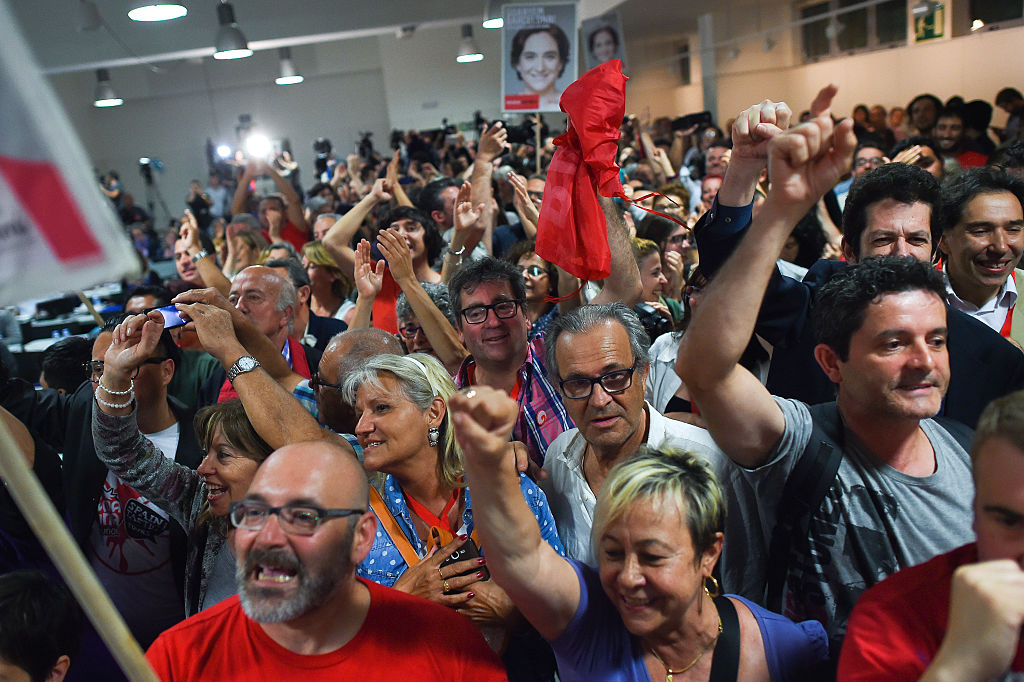
Barcelona en Comu supporters celebrate after the party won municipal elections on May 24, 2015 in Barcelona. (David Ramos/Getty Images)
The sudden change in Spain’s government at the start of June, with socialist Pedro Sánchez replacing conservative Mariano Rajoy as prime minister, has drawn fresh attention to the country. Since the emergence of the 15M (Indignados) protests in 2011, which inspired similar “square movements” such as Occupy Wall Street, Spain has become a laboratory of post-crisis politics. Hit hard by the financial crash, from 2011 to 2014 it saw an impressive series of anti-austerity mobilizations, which paved the way for the creation of the left-wing populist party Podemos. At the same time, a series of innovative local coalitions have emerged to challenge the traditional parties, reaching power in such major cities as Madrid, Cádiz, Valencia, Zaragoza, and Barcelona.
Barcelona en Comú (Barcelona in Common), an electoral force built by social-movement organizers and led by globally renowned housing activist Ada Colau, has now been governing Barcelona for three years. Colau’s administration has doubtless faced a particularly difficult political conjuncture, dominated by the conflict over Catalonia’s independence.
Yet Barcelona en Comú has stacked up an impressive record in policy areas such as housing, gender equality, social policy, refugee rights, and environmental questions. In a Europe dominated by a renewed neoliberal offensive and the rise of far-right forces, it is no exaggeration to call Barcelona an island of hope for radical and progressive politics.