Richard Pipes, Prosecutor of the Russian Revolution
Relentless anticommunism defined the late Richard Pipes as more propagandist than historian.
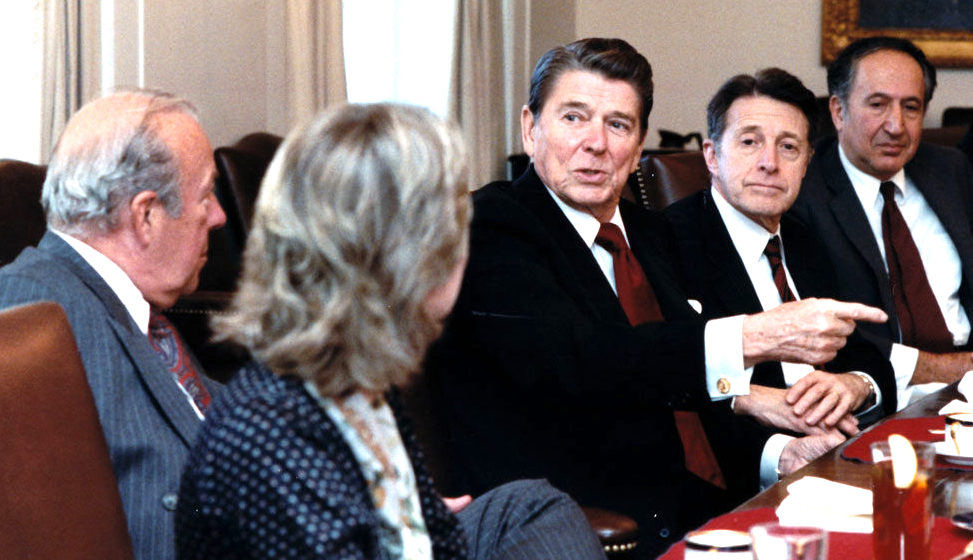
Richard Pipes (far right) with (from right) Secretary of Defense Casper Weinberger, US president Ronald Reagan, and Secretary of State George Shultz, November 1985.
Richard Pipes, the most prolific of a generation of anticommunist cold warriors, has died. Author of twenty-seven books, Pipes was also a nuclear weapons consultant to the Central Intelligence Agency and a National Security Council advisor to Ronald Reagan.
In Vixi: Memoirs of a Non-Belonger, Pipes attempted to portray himself as a nonconformist outsider. But the reality of his career was quite different. Harvard, where he was a graduate student and then professor, was the preeminent anticommunist Cold War think tank with a level of ideological conformity that mirrored its state-sponsored Soviet counterpart. Cold warriors moved easily between intelligence jobs and academic posts. The head of Harvard Russian Research Center, Abram Bergson, worked for the Office of Strategic Services (the precursor to the CIA) and the center supported the FBI’s hunt for subversives.
The Cold War “enlists everyone and calls upon everyone to assume his part” and “the historian is no freer from this obligation than the physicist,” implored the head of the American Historical Association. Pipes was more than willing to do his part. In one of his first books, Social Democracy and the St. Petersburg Labor Movement, 1885–1897, Pipes made the astonishing summation that workers were so uninterested in socialism that a frustrated Lenin later developed the “un-Marxist” and “Blanquist” theory of “revolution from above” by intellectuals that would later guide Bolshevik practice.