On the Front Lines of the Populism Wars
Left populism might be working in practice — but does it work in theory? A review of Chantal Mouffe’s latest salvo in the “populism wars.”
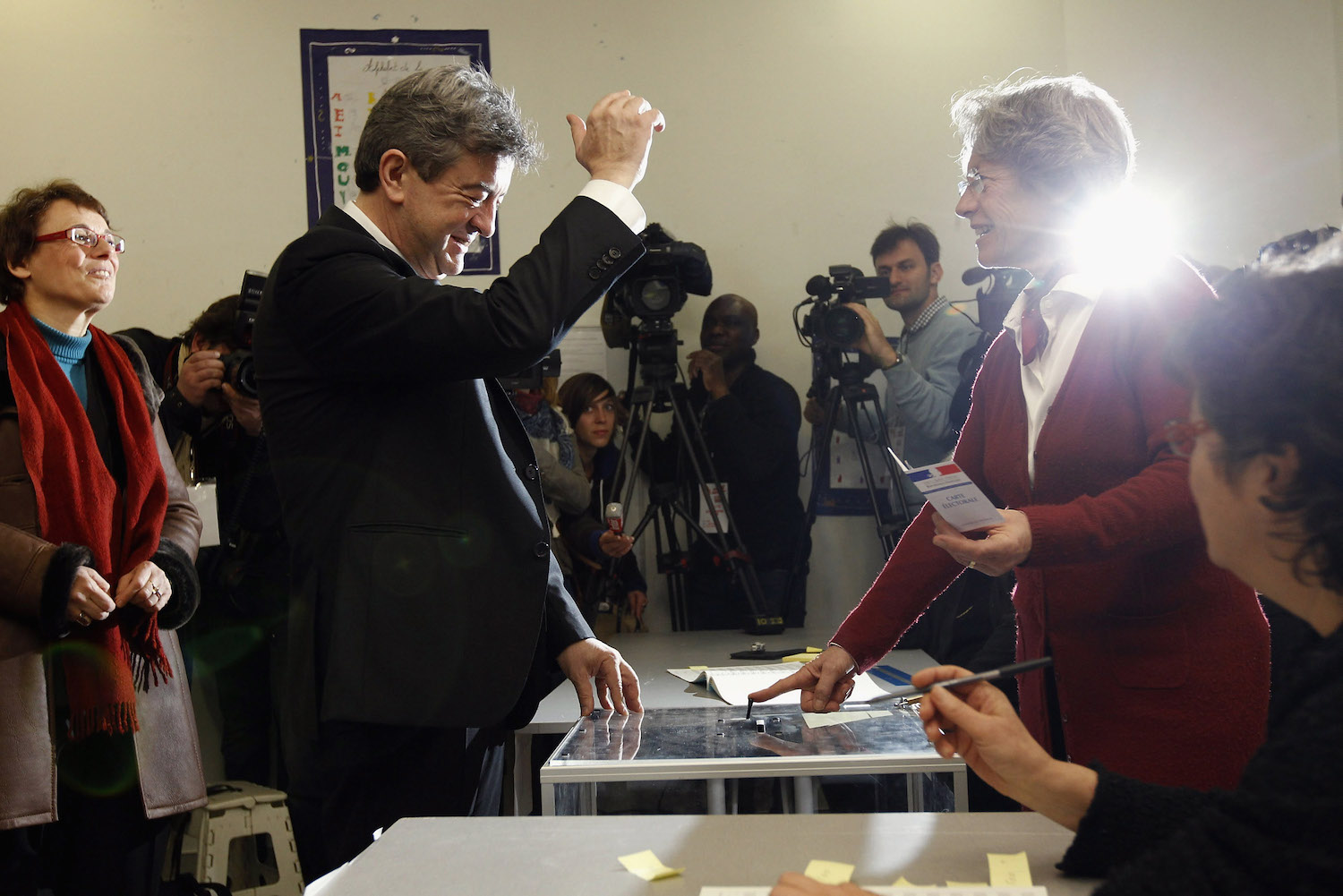
Jean-Luc Mélenchon votes during the first round of the 2012 French presidential election on April 22, 2012 in Paris, France. Pool / Getty
“I’m a populist — no doubt about that.”
So said French presidential candidate Jean-Luc Mélenchon in September 2010, towards the end of a long interview with the French weekly L’Express. Although at the time the quip was intended to scandalize public opinion, Mélenchon’s statement undoubtedly proved prescient for the European left as a whole. European leftists have steadily been making up their minds about the “p-word” — long associated with marauding masses and postmodern pogroms — and are now embracing their own “left populisms.” In October 2017, for example, Mélenchon himself saw no more need for squeamishness. “I think,” he now declared, “that left populism is the only way forward for the Left.”
Mélenchon’s pronouncements were made in a debate with the Belgian political theorist Chantal Mouffe, organized in the aftermath of the French presidential elections. He was also among those singled out for explicit thanks in the acknowledgements of Mouffe’s latest book, For a Left Populism, which offers a summary of her recent thinking on the topic. Like Mélenchon, Mouffe sees no reason to be shy about her sympathies. Somewhere towards the end of her book, she confesses that “it is to be expected that my left populist strategy will be denounced by the sectors of the left who keep reducing politics to the contradiction of capital/labour” and “attribute a . . . privilege to the working class” — here conveniently “presented as the vehicle for the socialist revolution.” Such objections, she claims, are as old as her work itself. ‘There is no point in answering them,” Mouffe writes, “since they proceed from the very conception of politics against which I have been arguing.”