The Empire and the Election
Whatever the outcome of today's Venezuelan election, the US has neither the right nor the moral standing to intervene.
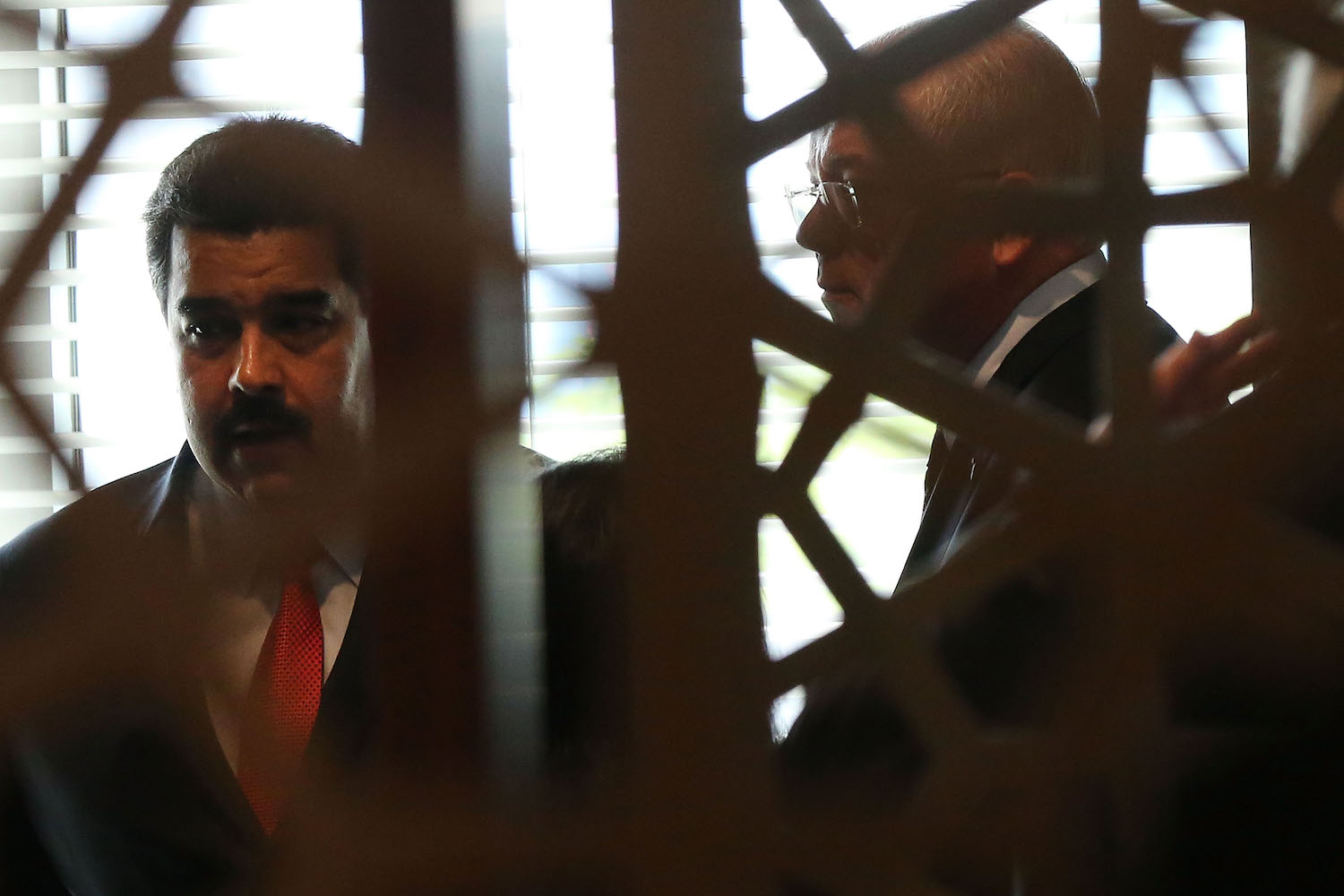
Venezuelan president Nicolás Maduro prepares to speak to the media at the United Nations headquarters in New York on July 28, 2015. Spencer Platt / Getty
Today, Venezuelans will go to the polls to elect the country’s next president. In the United States, the election has been widely condemned as a sham. While there are good reasons to be highly critical of the election, calling it a sham is a dangerously misleading simplification of a complex and dynamic reality. Most importantly, this stance ignores the very real possibility that the opposition could have won the election, and the fact that this is unlikely to happen not because of government fraud, but due to the hardline opposition’s myopic decision to boycott the election. The sham election narrative is dangerous because it plays into the US government’s and hardline opposition’s longstanding pursuit of (violent) regime change, a ridiculous and illegal strategy that has contributed to Venezuela’s profound woes, as have highly inept government policies.
Before delving into the befuddling and exasperating internal dynamics of Venezuela’s Sunday election, it is important to highlight the international context within which the election takes place. As Alexander Main has detailed, both Donald Trump and former Secretary of State Rex Tillerson have made recent statements that are supportive of the idea of removing Venezuelan president Nicolás Maduro from office through a military coup. Roger Noriega openly advocated this stance in a recent New York Times editorial. As Main points out, “this is an insane debate to be having.”
It is also worth pointing out that, as has long been the case, Venezuela is being held to a different standard than other countries in Latin America. While the US government, mainstream pundits, and journalists fall over themselves to condemn Venezuela’s “undemocratic” ways, the same outrage is not shown to countries such as Brazil, Honduras, Mexico, and Colombia. In August 2016, Brazil’s democratically elected president, Dilma Rousseff, was removed from office in what observers call a “parliamentary coup.” And just a month ago former Brazilian president Luiz Inácio Lula da Silva was imprisoned on highly dubious charges. At the time of his arrest, Lula had a significant lead in polls for this year’s presidential election. His imprisonment will almost certainly bar Lula from running. Washington has not only failed to condemn these egregious violations of democratic norms, but has embraced Brazil’s illegitimate president Michel Temer. Other recent examples of the US double standard in Latin America are the recognition of Honduras’s fraudulent November 2017 election and a failure to condemn the recent deaths of dozens of politicians and civic leaders in Mexico and Colombia. Not coincidentally, all four of these countries are generally staunch US allies led by right-wing governments.