Notes on Italy’s Election
After yesterday's Italian election, the old is dying and something superficially different but not altogether new has been born.
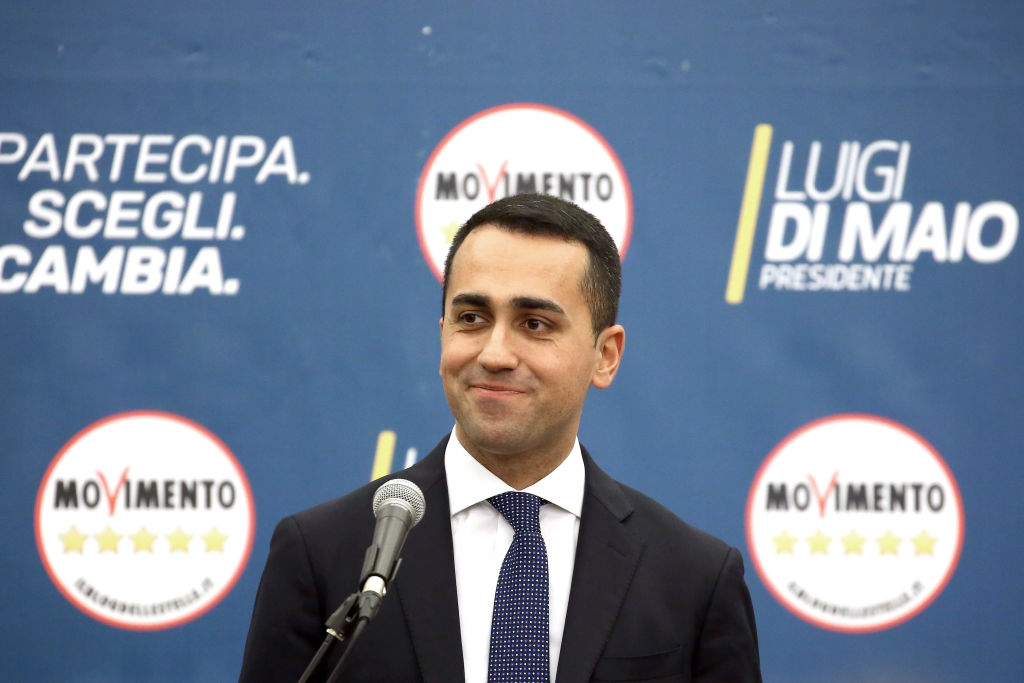
Five Star Movement candidate premier Luigi Di Maio attends a press conference at the party headquarter on March 5, 2018 in Rome, Italy.Franco Origlia / Getty
The Italian election results, which produced a hung parliament, are surprising but not exactly shocking. While the campaign was mostly lifeless, the Five Star Movement (M5S) achieved far greater support than expected. It won around 31 percent of votes, rather than the mid to high twenties suggested by pollsters. As widely forecast, the right-wing coalition proved the largest single bloc, with the extra poison that the hard-right Lega (18 percent) for the first time surpassed Silvio Berlusconi’s Forza Italia (14 percent). Their electoral pact (including two smaller parties) failed to secure a majority of seats and now risks a split.
This historic shift of power within the Right — the now-nationwide Lega secured four times more votes than in 2013, while Berlusconi’s party is weaker than ever — marks a further collapse of what is loosely called the “center.” Not only did Forza Italia fall behind, but Matteo Renzi’s Democrats, who hit 40 percent at the 2014 European elections, here collapsed below 20 percent. The decline of the parties who have ruled Italy since the early 1990s is notably expressed in the impossibility of forming a grand coalition, even if other liberal and center-left forces are included. Parties which achieved 70 percent of the vote in 2008 were this Sunday below 34 percent.
The turnout did, as forecast, reach a fresh low, but was only slightly down on 2013 at around 72 percent. One possible explanation is that pollsters underestimated the youth turnout; this would also help explain why the insurgent parties outperformed their polling figures, while the Democrats and Forza Italia suffered. In the period since the 2008 crisis, the M5S has been particularly able to appeal to younger voters hit by unemployment and precarity, and partly for this reason governed by stronger anti-establishment and Eurosceptic sentiments. They were evidently unimpressed by the outgoing Democrat-led government’s celebration of tiny shoots of economic recovery, with over a third of young people unemployed.