Off the Map
People with disabilities who rely on local public transit are getting squeezed between gentrification and austerity.
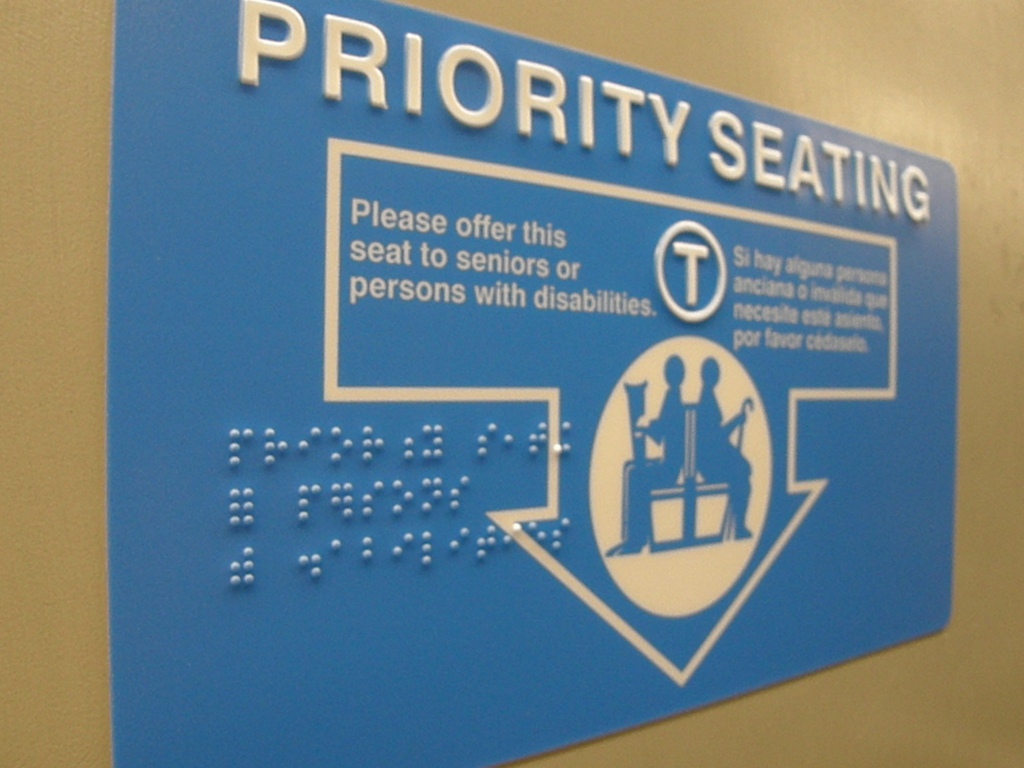
Priority seating sign on Boston public transit, February 2, 2008.Dan4th Nicholas / Flickr
In rankings of the US’s best urban public transportation systems, Washington, D.C., San Francisco, Boston, and New York usually hover at the top. At the bottom are smaller and poorer cities like Buffalo, Cleveland, Omaha, and Oklahoma City. The overall takeaway is no surprise: well-resourced cities have better public transit systems than their more economically distressed counterparts.
For people with physical disabilities, this poses a dilemma. Because many disabilities preclude walking long distances and/or driving, and because accessible private transportation options are often expensive, access to public transport is critical for many disabled people to get around. But the cities that are most financially equipped to build and maintain fast, time-reliable public transit systems are those with great clusters of wealth, high-salaried work, and high-octane economic activity in general. And today, an American city with those characteristics is also guaranteed to be gentrifying and aggressively displacing less affluent residents. Since disability is strongly correlated with poverty — as both a cause and consequence of financial hardship — this means that many disabled people increasingly can’t live in the cities that would best accommodate them.
San Francisco and D.C. have the money for ramps, elevators, and other accessibility infrastructure. The problem is that people who use that infrastructure increasingly don’t have the money for San Francisco and D.C. This situation — in which the people who most need public transit are the least likely to have access to it — stems from a set of neoliberal structures and policies that have left cities more subservient to capital than ever.