The Roots of the Egyptian Crisis
Egypt’s current crisis highlights the flawed foundations of its post-revolutionary state. But liberal nostalgia for the days of the monarchy is equally misplaced.
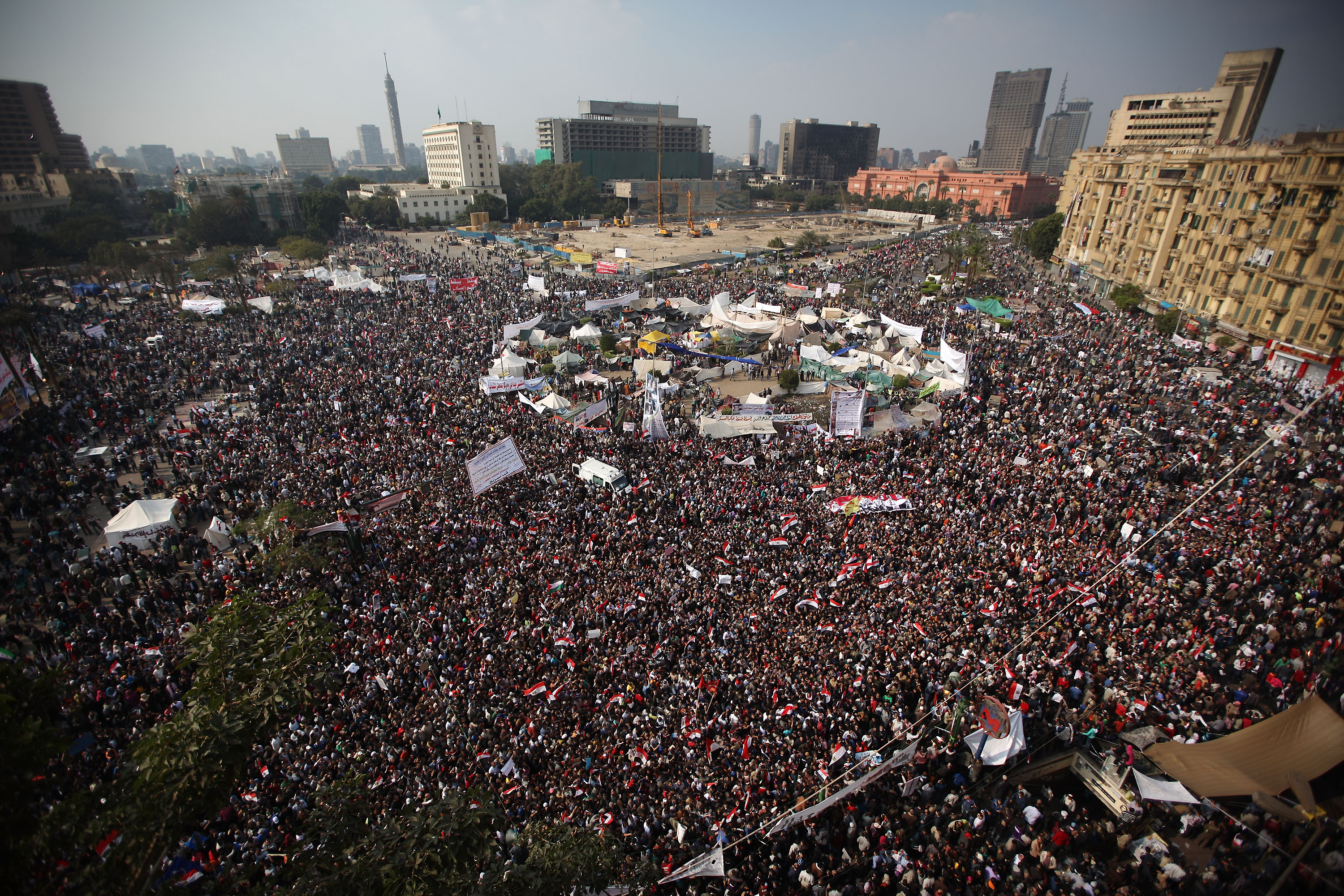
Protesters gather in Tahrir Square for a mass rally on November 25, 2011 in Cairo, Egypt. (Peter Macdiarmid / Getty Images)
Mohamed Bouazizi, a long-suffering and dispossessed farmer turned street vendor, immolated himself in protest on December 17, 2010. His desperate act ignited a popular movement that ousted Tunisian president Zine El Abidine Ben Ali a month later and sparked demonstrations in Algeria, Jordan, Morocco, Oman, and Yemen. On January 25, 2011, huge numbers of Egyptians began occupying Cairo’s Tahrir Square and other urban spaces throughout the country.
Egypt’s central role in Arab politics and culture for much of the twentieth century rendered it pivotal in determining the political significance of these movements against autocracy and economic inequality. On February 11, newly appointed Egyptian vice-president Omar Suleiman — better known as former director of the General Intelligence Directorate and as “torturer in chief” for his management of Egypt’s participation in the George W. Bush-era extrajudicial rendition program — announced that President Hosni Mubarak had resigned and that the Supreme Council of the Armed Forces would “run the affairs of the country.” Meanwhile, beyond Egypt, protests continued and developed into mass uprisings in Yemen, Bahrain, Libya, Syria, and on a smaller scale, Morocco.
By mid-2011, Robert Springborg, a well-informed, veteran Egypt-watcher and political scientist, concluded that, “The Arab Spring of 2011 may . . . be more akin to [Europe’s] 1848 failed revolutions than to the democratic transitions set in motion by the crumbling of the Soviet Union in 1989.”