Beyond the Liberal Voting Rights Agenda
We should expand voting rights to advance democracy — not just the Democratic Party.
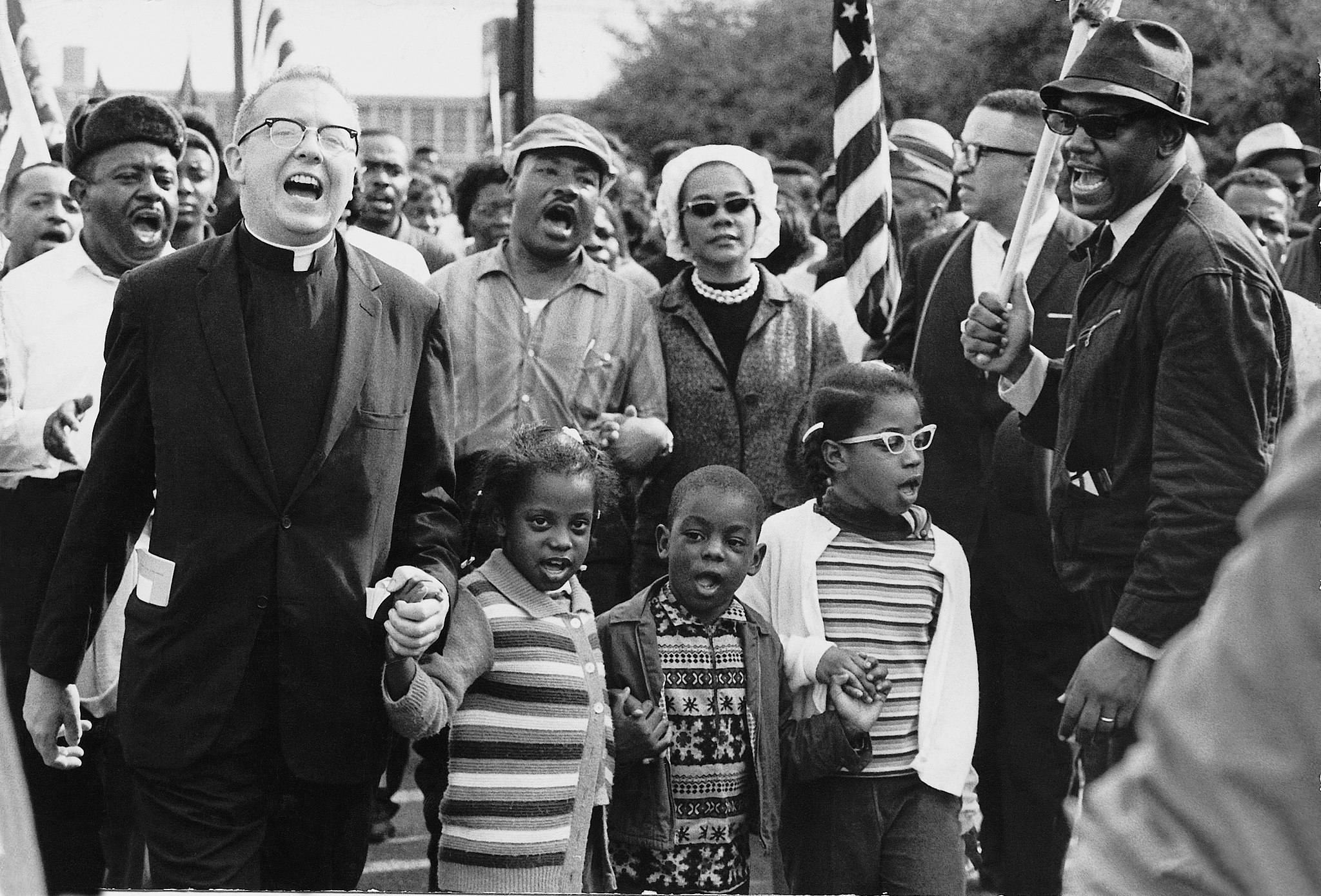
Ralph Abernathy and his wife Juanita Abernathy walk with Dr Martin Luther King and Coretta Scott King on the front line of a march from Selma to Montgomery for the right to vote, 1965.Abernathy Family Photos / Wikimedia
The last few years have seen liberals intensify their focus on voting rights — and with good reason. In 2013 the Supreme Court stripped away protections that had been offered under the Voting Rights Act since 1965, and fourteen states responded by installing new voter restrictions. While hardly the only contributing factor to Trump’s 2016 victory, these measures may have had a crucial effect in swing states. Meanwhile, Republicans have stepped up their efforts to gerrymander state and federal legislative districts, reducing political competition even further. In the wake of the election, voting rights protections have become a top priority for liberal advocacy organizations and super PACs.
Of course liberals, with their Democratic Party loyalties, have a vested interest in targeting certain types of political repression. Strict voter ID laws, for example, are designed specifically to disenfranchise sections of the Democratic Party’s voter base: young people, people of color, and the poor, all of whom are less likely to hold a valid driver’s license. That helps explain why Republicans tend to support such laws while Democrats generally oppose them. (In fact, a recent study found that “Democrats who were told that [voter ID laws] will reduce Republican turnout were statistically indistinguishable from Republicans in terms of support for [voter ID laws].”) As for gerrymandering, in recent years it’s been wielded mainly against Democrats by Republican state legislatures — but in earlier eras, the opposite was the case, with little complaint from Democrats.
The liberal focus on voting rights may be self-interested, but it’s also to the good. The project of wresting control of society from capitalist elites hinges on the ability of concerted majorities to control the state — and that requires that everyone be able to participate in the democratic process on equal terms. But we can’t be satisfied with liberals’ limited efforts on this front. The American political system is rife with hidden and not-so-hidden mechanisms designed to limit popular power. Most of these go ignored by Democrats.