The Legacy of Taft-Hartley
Seventy years ago, the Taft-Hartley Act ushered in “right-to-work” laws and imposed draconian restrictions on workers' rights. The labor movement still hasn’t recovered.
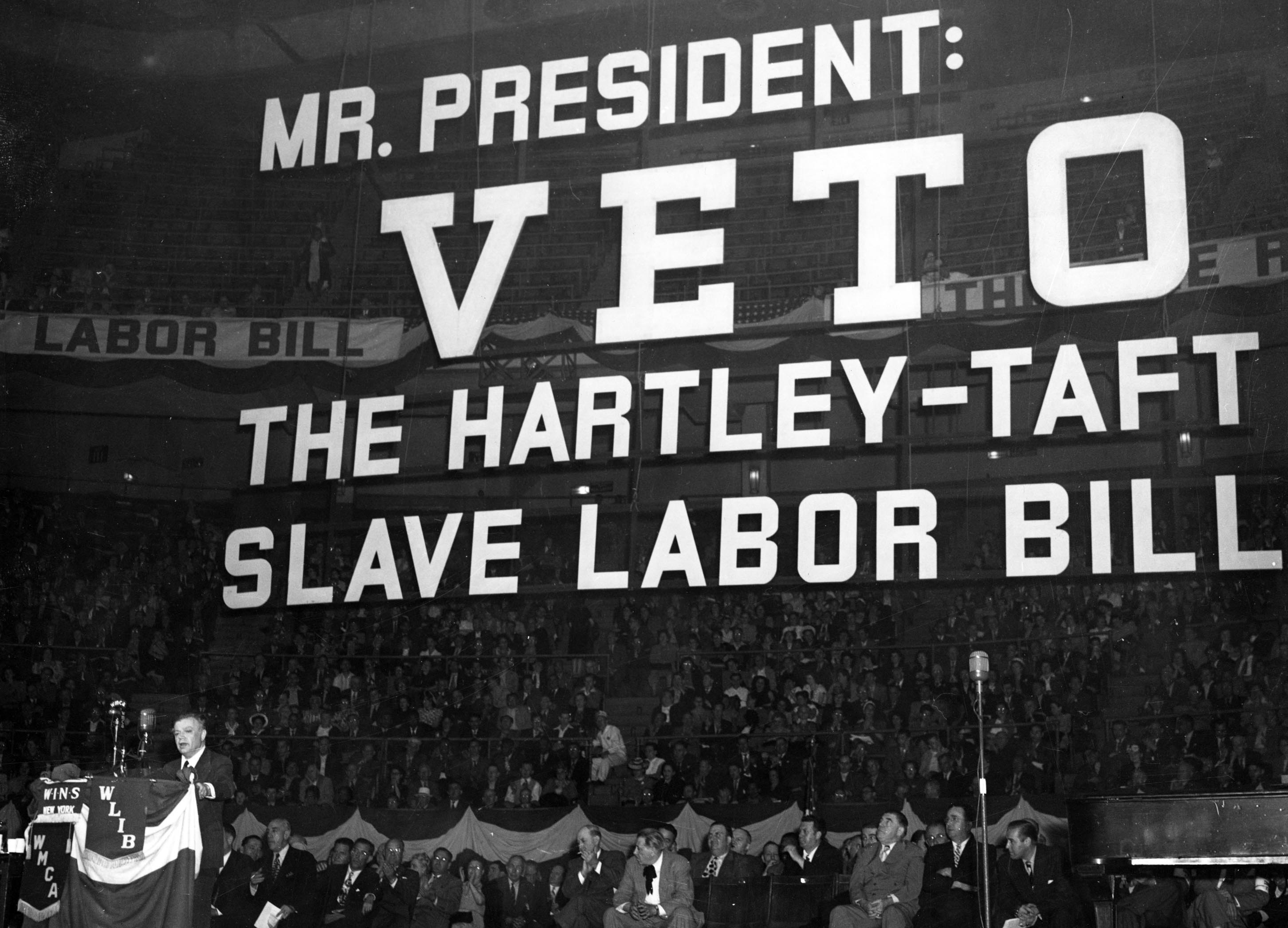
Labor leader David Dubinsky gives a speech against the Taft-Hartley bill on May 4, 1947. Kheel Center / Flickr
The current assault on workers’ rights and labor standards is unrelenting. Federal labor policy has been undermined by the Trump administration’s deregulatory fever and deference to low-road employer interests. In the states, the corporate-inspired attack on public sector unionism has spread from Wisconsin to Iowa and beyond. In January, the Supreme Court will hear arguments in Janus vs AFSCME, whose decision will almost certainly allow anti-union public employees to opt out of paying dues and, therefore, evade the costs of negotiating and administering collective bargaining contracts.
But while the ferocity and pace of this legislative and administrative assault is new, its motives and logic are not. Recent efforts to undermine the democratic and associational rights of public sector workers echo and mimic attacks on private sector workers that began seventy years ago, with the passage of the Taft-Hartley Act in June 1947.
The Law
Taft-Hartley capped a tumultuous decade and a half in US labor relations and labor law.