The Final Conquest
Hurricane Maria as the latest battle in a 500 year war.
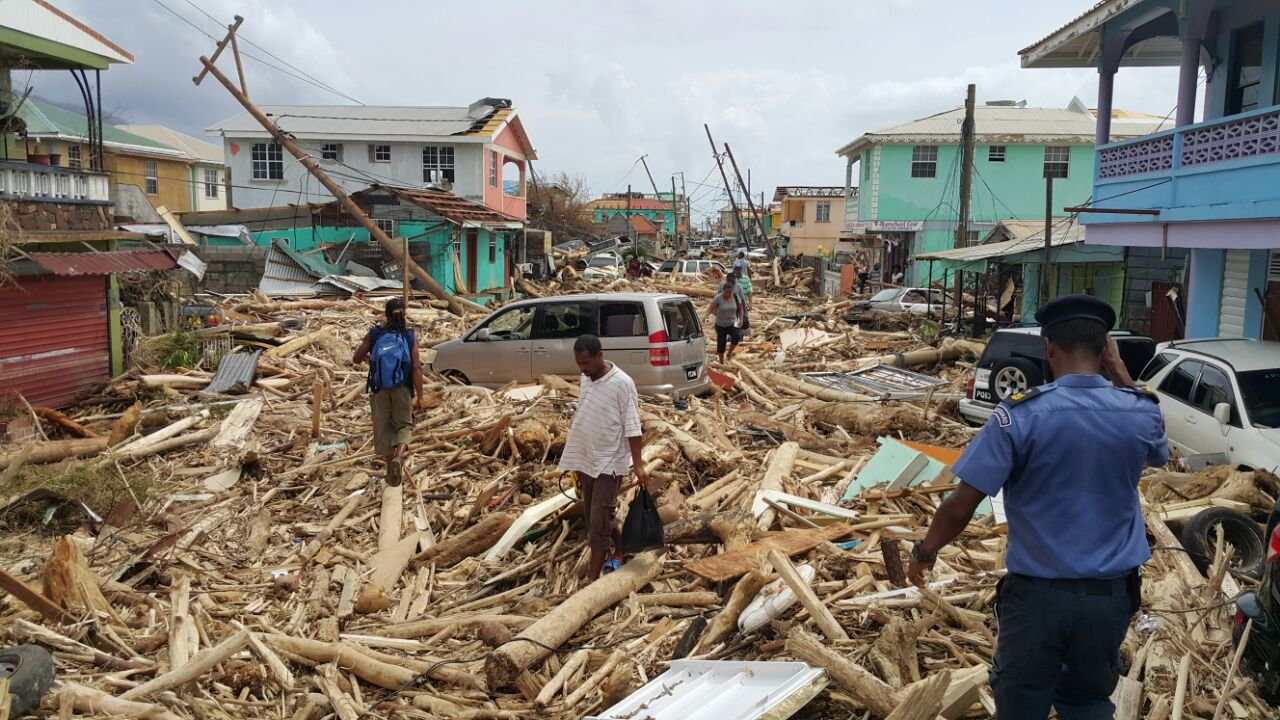
Residents take stock of the damage caused by Hurricane Maria in Roseau, Dominica, on September 20, 2017.AFP / Getty Images
I visited Dominica in early August this year. Back then, it was still an emerald island. The shores rising out of the sea were, as ever, covered by impossibly green woods. On the slopes of the mountains, trees and plants jostled for space and stretched towards the sun, as though they were on the verge of leaving the ground and soaring into the sky, so that the whole place seemed to be bursting with green. But it was not monochrome: every peak and ravine, every valley and grove had its own shade, intersected by some nuance of blue or turquoise — Dominica claimed to have 365 rivers, one for each day of the year. It was the most densely forested country in the Caribbean. No other island in the region is so rugged and mountainous. From this base sprouted a history unlike that of any other Caribbean nation — all the way up to the night of September 18, when Hurricane Maria razed everything that stood on the island of Dominica to the ground.
Europe made landfall on Columbus’s second journey. The fleet couldn’t find a place to anchor on the jagged coast, but Columbus swiftly baptized the island after the weekday when he saw it — Dominica, “the day of the lord,” Sunday in Latin. Back home in Europe, the chronicler of the journey reported: “Dominica is remarkable for the beauty of its mountains and the amenity of its verdure and must be seen to be believed.” Columbus himself is said to have — ominously — crumpled up a piece of paper to convey the exceptional irregularity of the terrain.
Here, the Spaniards failed to dislodge the indigenous population. While the “Indians” were exterminated throughout the Caribbean, the so-called Caribs, more appropriately referred to as the Kalinago people — whose reputation the Spaniards succeeded in tarnishing with the false accusation of cannibalism — stayed safe in the luxuriant mountains. Settlers avoided the island for fear of poisoned arrows suddenly showered upon them.