Guardians of Property
Throughout history, the Right has cared more about preserving private property than about promoting democracy.
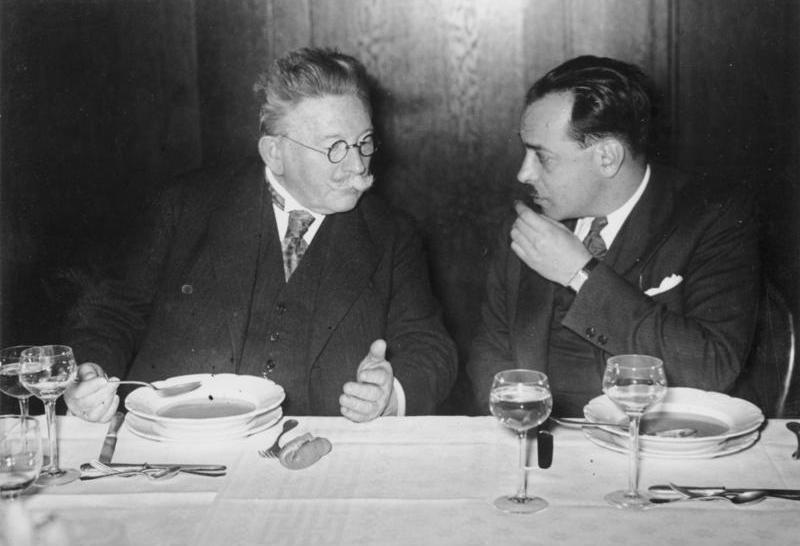
German businessman and politician Alfred Hugenberg (left) in December 1932. Wikimedia Commons
Daniel Ziblatt’s new book, Conservative Parties and the Birth of Democracy, couldn’t be more timely, which explains why it’s gotten far more attention in the popular press than most scholarly works of political science and academic history.
Ziblatt argues that conservative political parties determine whether or not a state enjoys stable democratization or whether reaction from the Right’s most die-hard ideologues ultimately undoes those gains. In choosing whether to accept democracy, conservative “political entrepreneurs” assess whether their party and their control over it is well-organized enough to survive and thrive in an environment in which political power extends beyond old-regime elites.
To prove this point, Ziblatt contrasts the British and German experiences between the late nineteenth century and World War II. By his account, the United Kingdom’s Conservative Party became a mass-membership organization in the 1870s and 1880s, which allowed it to hold back Northern Irish Unionism’s threat to the whole constitutional order between 1910 and 1914. Ultimately, the Tories’ mass base helped them usher in Britain’s twentieth-century political order when, in 1922, they abandoned the coalition supporting Lloyd George’s postwar government and strode confidently into the future as the sole capitalist party facing off against a fully normalized Labour Party.