Which Side Are They On?
The Israel Anti-Boycott Act criminalizes a tactic used by some of history's great protest leaders.
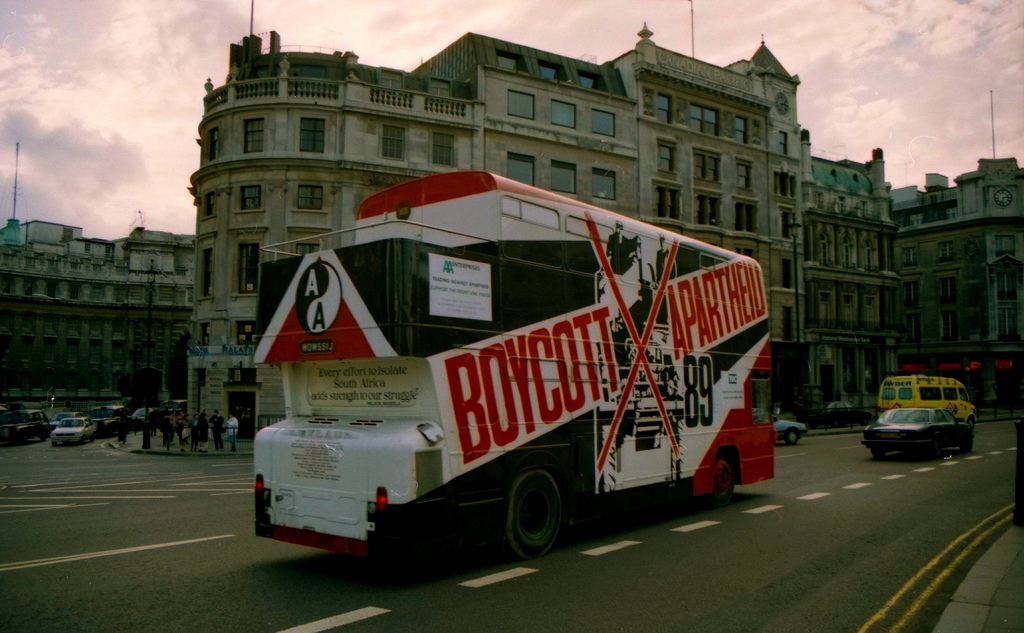
Boycott Apartheid bus, London, 1989.R Barraez D’Lucca / Flickr
Moral Majesty
The South African boycott movement is the ur-example of the power of boycotting often brought up in relation to Israel. Though that boycott movement now tends to be thought of as largely a Western invention, like the Boycott, Divestment, Sanctions (BDS) campaign’s push by Palestinians, it was advocated and supported by South African anti-apartheid campaigners.
As outlined by Christabel Gurney, an Anti-Apartheid Movement (AAM) activist who edited the movement’s newsletter in the 1970s, the boycott movement began domestically after the South African government had banned other forms of public resistance, with campaigners boycotting local bus companies, goods made by firms supporting the pro-apartheid National Party, and potatoes grown on farms using forced labor. At its annual conference in 1958, the African National Congress declared that “the economic boycott is going to be one of the major political weapons in the country.”
Following this declaration, the ANC looked to international support for its boycott. In 1959, in a report on fighting segregationist laws restricting the movement of people, it declared that “when our purchasing power is combined with that of sympathetic organizations overseas, we wield a devastating weapon.”