In Defense of Busing
Busing wasn't an experiment imposed by elites; it was part of a grassroots movement demanding quality education for all.
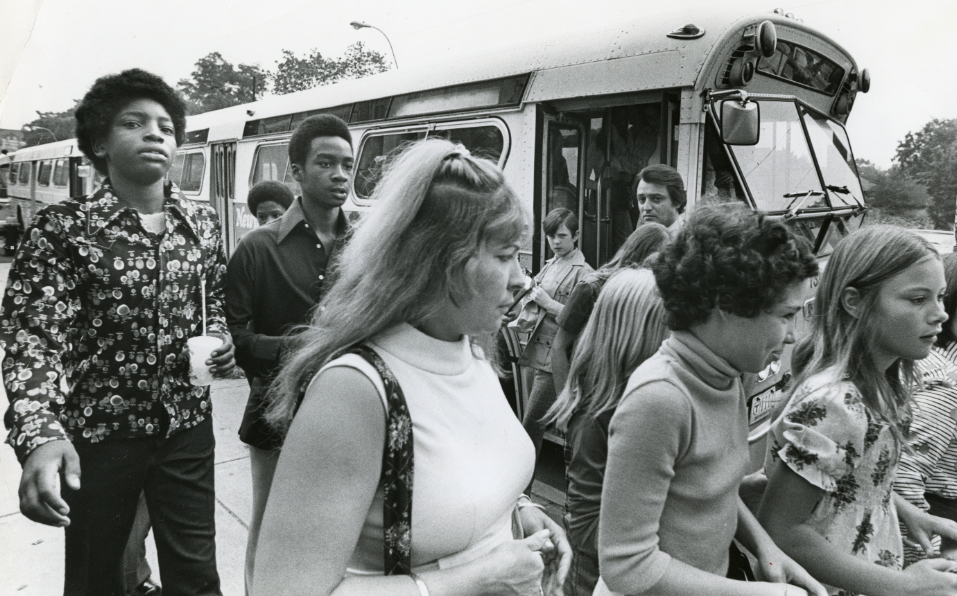
Buses carrying students arrive at the Curley School in Jamaica Plain, Boston on September 12, 1974. Library of Congress
In September 2014, on the fortieth anniversary of the court decision ordering school desegregation, the Boston Herald published an op-ed by Ray Flynn, the former mayor and South Boston representative. Flynn described the busing that followed as an “ugly” time when “city government [lost] control over our schools” and “parents [lost] a voice” in choosing their children’s educational futures.
“The injustice to parents was ignored by ‘elites’ during this horrendously flawed and insensitive process,” he wrote. “I knew many of these parents. They were fine, decent and concerned mothers and fathers who were not racists or haters as they were sometimes described in the media.”
Flynn’s lamentations neatly encapsulated the conventional view of the busing program: that it was a failed experiment in social engineering, foisted on white working-class Bostonians by liberal-minded elites.