The Socialist Running for Congress in South Florida
Florida’s 25th Congressional District is currently represented by Jared Moskowitz, one of the most conservative members of the Democratic caucus. Socialist candidate Oliver Larkin is hoping to change that.
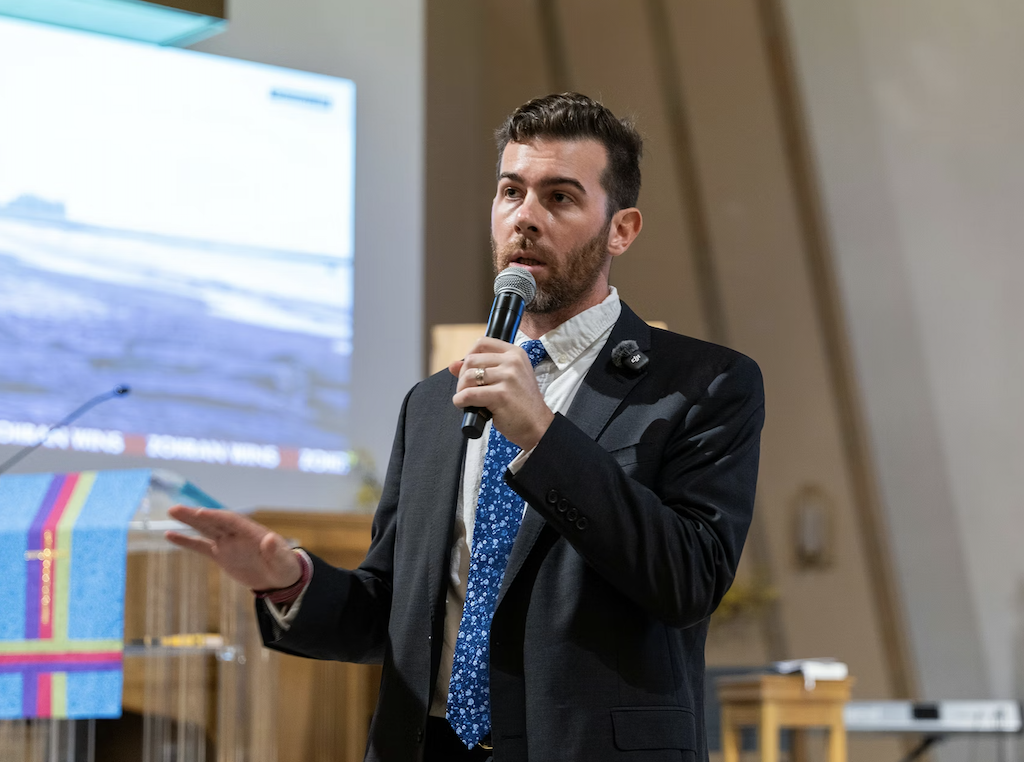
In the Miami metro area, socialist Oliver Larkin is challenging centrist Democrat Jared Moskowitz for his seat in Congress. (Oliver Larkin for Congress)
- Interview by
- Jordan Bollag
When Jamaal Bowman and Cori Bush lost their congressional seats in 2024, the number of Democratic Socialists of America (DSA)–affiliated members in the House of Representatives shrunk to two: Alexandria Ocasio-Cortez (D-NY) and Rashida Tlaib (D-MI). But in the wake of Zohran Mamdani’s stunning election as New York City mayor, and hoping to ride a wave of renewed anti-Trump sentiment, a new crop of DSA candidates is running for Congress this year.
That includes Claire Valdez and Darializa Avila Chevalier in socialists’ electoral stronghold New York City, as well as Chris Rabb in Philadelphia. The first candidate national DSA endorsed this election cycle, however, was Oliver Larkin, who is running to represent Florida’s Twenty-Fifth Congressional District in the House of Representatives.
Larkin, who got his start in politics volunteering for Bernie Sanders’s 2016 presidential campaign, is running in the Democratic primary against Jared Moskowitz, a stridently pro-Israel Democrat who has supported Donald Trump’s war on Iran and Elon Musk’s Department of Government Efficiency (DOGE). Jacobin recently talked to Larkin about why he became a socialist, how Democrats have failed working-class voters, and the role he envisions himself playing on Capitol Hill should he win.
Jordan Bollag
How did you first get involved in politics? How did you become a socialist and active DSA member?
Oliver Larkin
I got involved in politics when I was graduating from college and burdened by a great deal of student loan debt. I had some family members experiencing compounding health care crises that were not covered by health insurance. I was also working for the federal minimum wage of $7.25 an hour as a line cook.
Seeing Rick Scott get reelected in 2014 as Florida governor really shocked my system. After he was denying climate change and barring public officials from even using that term, I decided that I needed to get more involved, and that I was going to tune in to the 2016 presidential campaign.
Working forty, fifty, sixty hours a week over a hot grill for minimum wage, I saw Bernie Sanders speak on the Senate floor about the influence of money in politics, the need for a $15 an hour minimum wage, and free college tuition. That resonated with me and made a connection with policies that would have a direct material effect on my life. Those policies would mean more money in my pocket when I went to work. They would mean less of a debt burden from my education.
That direct connection motivated me to quit my job as a line cook and drive to New Hampshire to volunteer for the Sanders campaign. I ended up getting hired as paid staff and traveling the country, going to six different states to organize and lead voter turnout efforts.
When that campaign was over, I went to the political advertising agency that the Sanders campaign used, Revolution Messaging. I was laid off, rehired, and then helped organize a union at that workplace with the NewsGuild–Communication Workers of America. I was on the forefront of this labor agitation and union organizing effort within the Democratic Party that has built into the unionization of the Bernie 2020 campaign, of the Biden–Harris campaign in 2024, of the Democratic National Committee, of the Democratic Congressional Campaign Committee, and many advertising agencies and nonprofits.
I’ve felt that the Democratic Party needs to do more to reorient itself as the party of labor, as the party of the working class, and the party that stands up to Wall Street and the corporations rather than cozying up to them. When I saw the bottom fall out of the Florida Democratic Party, I was not willing to let Jared Moskowitz go a second consecutive election with no primary opposition.
I wanted to be the candidate that I’ve waited for so long to see in South Florida — someone with the Bernie Sanders message of fighting for the working class, challenging the entrenched interests of the Democratic Party, challenging the two-party system, and moving our economy toward a form of democratic socialism.
Jordan Bollag
What are the main issues that you’re running on in this campaign?
Oliver Larkin
The main through lines on campaign policy that voters really appreciate: It’s the Medicare for All message. It’s $25 an hour. It’s abolishing and prosecuting Immigration and Customs Enforcement (ICE). There is a very significant immigrant community in our district, about 30 percent born outside the United States.
It’s also been taking this American Israel Public Affairs Committee (AIPAC) opposition and extrapolating that from Palestine to now this war with Iran — and just being antiwar broadly, because we’re seeing that the United States has for more than two years supported Israel’s genocide in Gaza and the apartheid in the West Bank. Now the US military is directly involved in this war with Iran, and my opponent, Jared Moskowitz, is one of the most prominent Democrats to give Donald Trump a blank check for that war.
It connects with the cost-of-living crisis. Every dollar we’re spending dropping bombs on girls’ schools in Minab or assisting the Israel Defense Forces (IDF) as they’re bombing hospitals in Gaza — that’s money that we’re divesting from our health care, our housing, our education.
Jordan Bollag
You’re running against Jared Moskowitz, who seems like one of the most right-wing politicians in the Democratic Party.
Oliver Larkin
He sits on the House Armed Services Committee and is buying Lockheed Martin stock. Moskowitz has purchased Lockheed Martin stock four times when it has been advantageous, when there have been increases to the Pentagon budget. When Trump launched strikes on Iran on a Friday, the Monday morning after those strikes, Lockheed stock hit an all-time high on the stock market.
So we have Jared Moskowitz personally profiting from these decisions, and he has sought war with Iran and confrontation with Iran for some time. Prior to this war, and prior to the bombing of the Fordow Uranium Enrichment Plant there last year, Moskowitz was going on Fox News and describing himself as to the right of J. D. Vance and Steve Witkoff, and more aligned with Lindsey Graham and Tom Cotton. In the months leading up to the current military operation, he was going on right-wing podcasts and saying that Marco Rubio was leading Trump in the right direction on Iran, and that he was concerned that Vance was too much of an isolationist.
Moskowitz is willing to go much further than most Democrats, who, by the way, also support what Trump is doing to some degree. We’ve seen Democrats beyond just Moskowitz opposing the war powers resolution that [Ro] Khanna and [Thomas] Massie introduced. [Josh] Gottheimer introduced a watered-down version. We saw Gregory Meeks punt on bringing another resolution to the floor, despite the fact that Republicans Warren Davidson of Ohio, Thomas Massie of Kentucky, and Nancy Mace of South Carolina had indicated they would be willing to support a bipartisan assertion of the House’s congressional war powers.
Jordan Bollag
You’ve talked on the campaign about some issues that we really don’t hear discussed much, including changing the undemocratic nature of the US Constitution; you’ve talked about completing the project of Reconstruction. How do you balance these radical-sounding structural demands with messaging on the bread-and-butter economic issues that working-class people are concerned with?
Oliver Larkin
What we might have described as radical in terms of reforming the Constitution is really a sentiment that is very common in our district. People know at a fundamental level that when twice within our lifetimes a president has been elected without the majority of the popular vote — in 2016 and 2020 — when we have the real extremism and radicalism of the far right stacking the federal judiciary with Federalist Society judicial nominees, people understand that there is a need to fundamentally reform democracy in order for it to be more responsive to the cost-of-living concerns that we have.
As an example of that, Democrats lost themselves in the minutiae of the Senate parliamentarian and the filibuster rule, which is not actually present in the Constitution. These arcane structures were the excuse when Kyrsten Sinema gave the thumbs down on the $15 an hour minimum wage, which was a core campaign promise not only of Joe Biden but of Raphael Warnock and Jon Ossoff, the two Democratic Senate candidates in Georgia in that runoff election the day before January 6. The promise of addressing the cost-of-living crisis during the COVID-19 pandemic was subsumed by the Democratic Party’s deference to these undemocratic structures.
We’re seeing these fights over gerrymandering and redistricting, people understand that their voice is getting more and more diminished in Congress and being replaced by dark money, billionaire and corporate PAC money, AIPAC, AI, and crypto money.
People know that we need to get off this seesaw between the Democratic and Republican Parties passing power back and forth because neither can enact the policy agenda that they desire given the constraints of the filibuster, of gridlock, and of congressional apportionment in the House of Representatives. There’s a lot of structural change that needs to take place, and that is how we can have government be more responsive to the material and economic needs of the working class.
Were it not for more than 60 percent of Floridians supporting a $15 an hour minimum wage, even if it was 59 percent, it would have failed under our constitutional ballot threshold of 60 percent. We need to get to a place where the majority can actually rule in this country and we no longer have minoritarian rule in so many forms, be it through the constitutional ballot referendum, gerrymandering in Tallahassee, or the denial of fair and equal representation in Washington. These all get in the way of having the needs and desires of the working-class majority reflected in federal policy.
Jordan Bollag
Many people are holding out hope that the Democrats just need to win the midterms this year and then the presidency in 2028. But we had a Democratic trifecta government during the beginning of the Biden administration, and it still led us to where we are today with Trump, after the failure of that agenda to get passed. What do you think Democrats could have done differently or could do differently next time?
Oliver Larkin
What I think Democrats could have done differently last time around was using the bully pulpit of Congress, of the presidency, the way that Trump does. When Trump wants to enact his agenda, he uses the bully pulpit of the presidency to apply public pressure on Republicans in the House or Senate with whom he disagrees.
That is not something that Joe Biden was willing to do when it came to Kyrsten Sinema or Joe Manchin wanting to split up the Build Back Better plan. What ended up happening was Biden acceded to Sinema and Manchin’s demands. They split up that key piece of legislation that contained the Biden campaign promises of $15 an hour, universal childcare, paid family and medical leave, and universal kindergarten and pre-K from the bipartisan infrastructure bill.
These were policies that Biden was not ultimately willing to fight for against members of his own party. The Democratic Party for so long has been unwilling to be critical of its right-leaning conservative members. They bite their tongue because of perceived electability when ultimately, it is those members who they restrain themselves from critiquing who tank the party’s agenda.
We cannot have Jared Moskowitz be the next Manchin or Sinema or John Fetterman, who is now oftentimes supporting the Republican Party position. Moskowitz was the first Democrat in Congress to join Elon Musk’s Department of Government Efficiency Caucus and give that initiative bipartisan credibility, which was then used to void collective bargaining agreements with government workers, lay off tens of thousands of government workers, destroy entire federal government agencies, and access the data of people’s personal information in government servers.
It is not in the Democratic Party’s interest to have members like that who are going to accede to the far right. It’s the same with supporting the Laken Riley Act and supporting ICE; it is also biting his tongue with Ron DeSantis, because Moskowitz has been politically beholden to him for political appointments.
Progressives can leverage our power to get more material concessions from Democratic Party leadership by showing that there is an electoral cost for members who are more willing to work with the Right than they are with the Left. That is a central tension in the Democratic Party, and unless we change this dynamic, we will see under the next Democratic presidential administration, and when there are Democratic majorities in the House and Senate, that there will be another Kyrsten Sinema or Joe Manchin — the same way there was a Joe Lieberman before them, and the same way there is now a John Fetterman and a Jared Moskowitz.
We need progressives to run in primaries to challenge these members, but we also need different leadership at the head of the Democratic Party. That’s why I’m not a supporter of Hakeem Jeffries to be the next Democratic House speaker — because he is much more willing to go along with the conservative wing of the party and saves his criticism for the progressive left when the focus should be on opposing the fascist right.
Jordan Bollag
You’re running in the Democratic primary while being very critical of the Democratic Party. How do you view your relationship to the Democrats, and how do you explain that to voters?
Oliver Larkin
I’m not going to be the Democrat who is turning around and voting against the immigrant community or taking the rights of our trans neighbors away in defense bills. That’s what Moskowitz has been doing.
We are the campaign and I am the candidate that is going to stand up and fight for the values that the Democratic Party professes to have. I’m the one who is going to be unapologetic in fighting for Medicare for All because I do not take corporate PAC money. Voters trust me because I reject the corrupting influence of corporate donations.
Voters want new energy. The Florida Democratic Party is very unpopular here. In our district, which includes Broward and Palm Beach County, some of the highest Democratic voter registration in the state of Florida, we’ve seen a collapse. This used to be a seat that Democrats won comfortably by ten or fifteen points. But Moskowitz has moved so far to the right. It’s no wonder Democrats here are demobilized and feel betrayed by the party.
Our campaign represents a vision that people all across the country want to see, which is a Democratic Party that unapologetically stands up and fights back against Trump, against DeSantis, against Musk, and against the House Republicans that are giving Trump everything he wants.
Jordan Bollag
You were DSA’s first nationally endorsed congressional candidate this cycle. You’ve also been endorsed by your local chapter, Broward County DSA, and nearby chapters like Miami DSA. What has your relationship with DSA looked like? What do you think it will look like if you get to Congress?
Oliver Larkin
We are excited to have the support of our comrades across the country with the national DSA endorsement. This [campaign] is a chapter project principally of the Broward County DSA, of which I’m a member.
I’ve been a DSA member since 2020. I’ve identified as a democratic socialist since at least 2015, when I first started following Bernie Sanders in the early stages of his presidential campaign. DSA is my political home. It’s the organization that I see as having the policy prescription to address the multitude of crises that our country is facing, from health care to housing to energy and climate, public transportation, the crisis of democracy, and ensuring that in this country where workers deserve more, workers can have more. We can have the right to health care, housing, education, and union protections on the job.
When we talk about our campaign being a project of our Broward DSA chapter, my campaign manager is cochair of Broward DSA. Our field director is a member of Broward DSA. Our communications team is made up of members of Broward DSA. Our electoral working group is turning out volunteers from our chapter for our weekend canvasses and phone banks. We have DSA members from Palm Beach, Miami, and Orlando coming to join us on our canvases.
We are running a campaign with unapologetic messaging on democratic socialism, and voters have responded with hope and optimism because they see candidates like Zohran Mamdani in New York City as members of our organization who are changing the way that the Democratic Party does politics. We want to show that South Florida is a part of the country where this message will resonate, because the majority of South Floridians are working-class. The majority of South Floridians are facing extreme pressure from the affordability crisis.
In that environment, people are very receptive to a message that contrasts with this out-of-control capitalist economy where we’ve produced the greatest levels of income and wealth inequality in at least a century.
Jordan Bollag
You’ve talked about creating a socialist caucus in Congress, which doesn’t currently exist. Why is that important?
Oliver Larkin
We’ve seen from the very slim House majorities that Democrats had in the first two years of the Biden administration that just two or three or four committed ideological members can have profound leverage in influencing congressional legislation. With the Congressional Progressive Caucus having grown in size and influence to take a big-tent approach and accept many members who take money from the Zionist lobby and so forth, there needs to be a greater level of ideological cohesion — especially when it comes to maneuvering on the legislative level to reflect our priorities in this upcoming House majority.
With a few committed members, including Representative Rashida Tlaib, Representative Alexandria Ocasio-Cortez, hopefully Representative Cori Bush if she’s able to win office again, and Claire Valdez and Melat Kiros and Hartzell Gray and many of the other locally endorsed DSA candidates across the country, we can exert real influence at the legislative level. I’m excited that our campaign has already begun running on a unified slate with other DSA candidates. We recently had a virtual live stream rally to oppose Trump’s war with Iran; we had DSA candidates from across the country there, including Melat and Hartzell and Claire and Darializa Avila Chevalier.
We need candidates on the Left who stand up to the party establishment and against the neoliberalism that has failed the working class for decades. It’s the reason that Trump won in 2016, but it’s also the reason that Bernie Sanders and democratic socialism has such renewed appeal. People see that this capitalist economy does not serve working-class interests — it serves the billionaire class and the corporations.
Jordan Bollag
Another DSA member, Richie Floyd, was elected to the St Petersburg City Council in 2021; he was Florida’s first elected socialist in one hundred years. Would you be the first socialist elected to federal office in Florida?
Oliver Larkin
To my knowledge, I’m the first endorsed candidate for federal office of the Democratic Socialists of America in Florida. I’ve had the pleasure of getting to know Richie, who is currently running again, and I’m very glad to support his campaign from afar. He comes from a background of running as a DSA cadre candidate and bringing that grassroots energy and organizing infrastructure to wield political power, so I have looked to him for inspiration.
I believe we could be the first democratic socialist campaign to run and win in a purple district. A victory in this district would show that the DSA message is viable across the country.
Running as an anti-Zionist in a district with one of the ten highest proportions of Jewish Americans in the country, it would disprove narratives from AIPAC, Democratic Majority for Israel, and the United Democracy Project that there is unwavering support for Israel among the Jewish population. What we have seen in our canvassing is that people of every background are horrified by the way that Israel is conducting this genocide and expanding apartheid.
Jordan Bollag
How do you see the role of socialists in elected office?
Oliver Larkin
I view the role of a socialist in office as a megaphone for the working class, a tribune of the people who are willing to speak the hard truths in the halls of power who typically do not get a voice on the floor of the US Congress.
I see my role as one where I must be willing to agitate, to be an organizer in office, to be willing to protest, to put my body and reputation on the line — the way democratic socialist Cori Bush did when she slept on the Capitol steps while seeking a moratorium on evictions during the pandemic. Or how Zohran Mamdani went on a hunger strike with New York City taxi drivers to win debt relief.
There’s going to be an element of legislating and of seeking compromise with other elements in the Democratic Party to pass legislation to reduce harm and to mitigate the right-wing assault on working people. But the imperative for a democratic socialist in office is to challenge the system, to speak out against US empire, and to speak to the better world that we can have under a different system.