Postliberals Don’t Understand What’s Wrong With America
Frustrated with the state of America, some on the Right have come to embrace postliberalism, an ideology that seeks to invigorate conservative politics by rejecting equality.
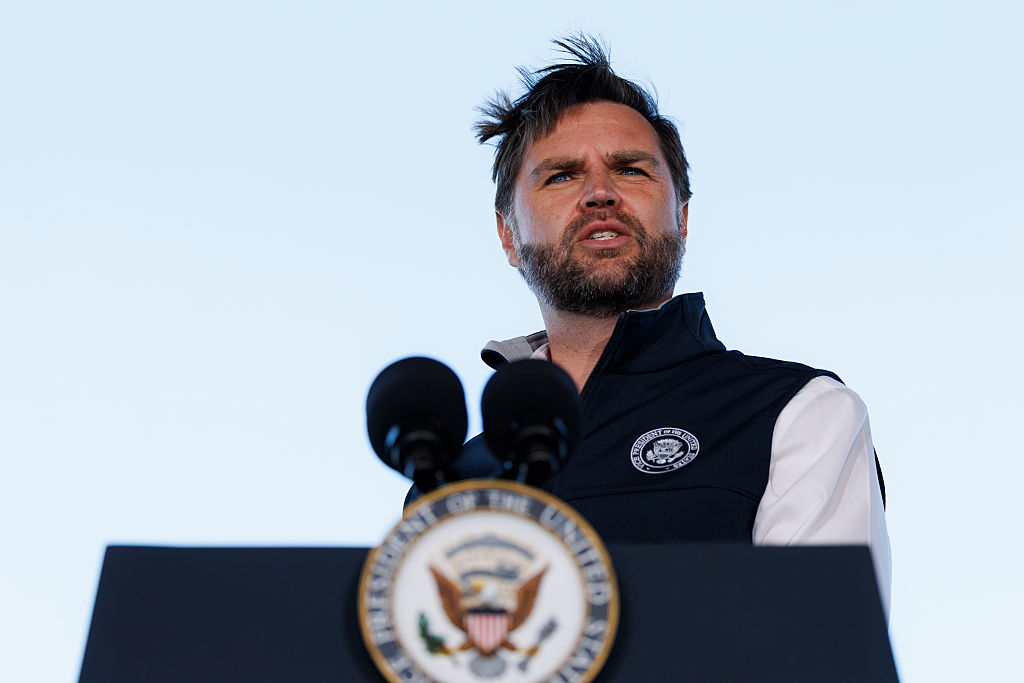
Under the Trump administration, an assortment of conservative and far-right organizations are currently in the process of mapping out the path to a reactionary future. Among these groups, the most intellectually sophisticated tradition is postliberalism. (Brett Carlsen / Getty Images)
The Right is often unsure what time it wants to live in. And I’m not just talking about how online conservatives wax nostalgic about 1990s memorabilia as though a classic Pizza Hut is their Proustian madeleine, a symbol of everything woke took from them.
In his 2009 essay “Progress and Memory: Making Whole Our Historical Sense,” self-described postliberal Patrick Deneen described progressives as myopically oriented to the future, liberals to the present, and reactionaries to the nostalgic past. Only conservatives were capable of restoring the “temporal continuity” between past, present, and future.
Flash-forward a few years later, and Deneen has replaced soothing metaphors of continuity and healing with calls for regime change, the title of his 2023 book, and assertions that what America needs is something “far more revolutionary” than even overthrowing the government. One is reminded of Corey Robin’s insightful observation in The Reactionary Mind that no matter how much conservatives speak of the past and the present, their politics is always oriented toward the future.
For the Right, the present is corrupt and debased; the recent past, with its permissive attitudes around race and sexuality, is responsible for today’s criminal decadence; only the future can offer a new beginning.
Under the Trump administration, an assortment of conservative and far-right organizations are currently in the process of mapping out the path to this reactionary future. Among these groups, the most intellectually sophisticated tradition, spearheaded by academics like Deneen and Adrian Vermeule at Harvard, is postliberalism.
Postliberals long for the kind of establishment respectability that used to be integral to the Right’s image before groypers like Nick Fuentes, who reject the idea of multiracial democracy, slinked their tentacles into the movement. This desire to accommodate themselves to power sits uncomfortably with postliberals’ self-described “revolutionary” politics. But this isn’t the only thing confused about their self-image. While postliberals claim to espouse a philosophy for moving beyond liberalism, the truth is that their project is an attempt to regress to what preceded it.
The Postliberal Silence on Inequality
Two new books, Post-Liberalism by Matt Sleat and Against Post-Liberalism: ‘Why Family, Faith and Flag’ is a Dead End for the Left by Paul Kelly, join a growing literature intended to introduce and critique postliberalism from a liberal-left standpoint. That Sleat and Kelly’s books were published by Polity within months of one another, and that each author’s book offers praise of the other, suggests that something like an intellectual movement has emerged to counter the Right’s own project. Both books convey a growing sense that postliberalism is a serious enough phenomenon that it can’t simply be dismissed as pathological or explained away as a symptom of neoliberal decline by progressive academics. Postliberalism warrants careful analysis and rebuttal as a coherent set of ideas and arguments.
While the subject matter of the two books overlap, they read very differently. Kelly, a professor of political theory and former pro-director of the London School of Economics, brings a more sweeping and international approach to his analysis and critique. It is perhaps too sweeping — in 185 pages, Against Post-Liberalism sets itself the task of mapping distinct strands of postliberalism across the Atlantic and developing a robust response to their arguments.
Kelly’s book discusses the “three faces” of postliberalism: national populism, common-good communitarianism, and common-good absolutism. Both American postliberals like Deneen and Anglo counterparts like English conservative Matthew Goodwin “are revolutionaries in a way that, surprisingly, mirrors the experience of twentieth century Marxism. Indeed, at times Deneen plays up that role with his provocative notion of a post-liberal regime change.” Kelly argues postliberals’ political agenda is nothing less than the “revolutionary replacement of liberalism as the prevailing ideology of our society.”
Some on the Left might be quick to dismiss comparisons with the Marxist tradition. But for Kelly, this is misguided. Deneen and Goodwin’s is a reactionary revolution — a counterrevolution, in the language of right-wing influencers like Chris Rufo. What this means is that the revolution they have in mind is at the level of culture rather than economics. Deneen and Goodwin make no bones about the fact that what the former calls an “aristopopulist” uprising by postliberals will mean the replacement of a vulgar liberal elite with an apparently virtuous conservative aristocracy.
Adrian Vermeule is even more candid. In Common Good Constitutionalism, he describes democracy itself as having “no special privilege” in his ideal society. A “democracy . . . may or may not be oriented to the common good; one has to see whether it is, and the answer will depend upon circumstances.” But if democratic masses decide they don’t like cultural conservatism, Vermeule believes they can be forced to adopt it. Perhaps they’ll come to thank right-wing authoritarians for being forced to be unfree.
This unabashed acceptance of elite rule and coercion bleeds into the postliberals’ economic program, according to Kelly. Or, as he reads it, their lack of one. He chastises the postliberals for being minimally attentive to the deepening inequality that is characteristic of our epoch. Drawing on the liberal philosopher John Rawls, he claims the postliberals “appear quite happy with a structurally unequal society, as long as the ruling elite is not the current one.” But, Kelly insists, inequality “demands an answer, and that is as unforthcoming in the case of the post-liberals as it is in the case of the neoliberals.” By contrast, “Rawls and other liberal egalitarians try to address that challenge.”
I think Kelly is broadly right to direct this charge against the postliberals, who are often so fixated on defining elitism in cultural terms that they are even more distant from bread-and-butter concerns than neoliberals, who at least pretend to care about them. But Kelly’s analysis would be strengthened by a more nuanced engagement with postliberals who do genuinely seem to care about equality. This includes Deneen to an extent and writers like founding Compact magazine editor Sohrab Ahmari. Giving more attention to these points would provide richer insights into how a more anti-capitalist right, by no means an anomaly in history, might develop in the future.
Postliberals and Postmodernity
Matt Sleat’s Post-Liberalism is in many respects the stronger of the two books, although it lacks the breadth and clear agonistic perspective of Kelly’s transnational liberal egalitarianism. However, it makes up for this shortcoming through its keen-eyed focus on a few core antagonists. Mercurial figures like Ahmari and broader right-of-center movements like Yoram Hazony’s national conservatives cameo in Sleat’s story. But it’s Patrick Deneen and Adrian Vermeule who are presented as the best and chief representatives of the postliberal movement, and the core of Sleat’s book is a careful presentation and analysis of their arguments and work.
Familiarity breeds affection as often as contempt, and sometimes even affection out of pitying contempt. That is very much the case in Post-Liberalism. Sleat runs through many of the familiar objections to postliberal philosophy, plenty of which are accurate. The postliberals often wildly misconstrue the history of liberal thought, interpreting the ideology’s core value to be libertine “autonomy” from moral and natural constraints.
In reality, central liberal thinkers like John Locke, Immanuel Kant, and many others have always insisted that freedom must conform to an often demanding natural or universal law. Sleat wryly notes that “if post-liberals are right about what liberalism is, then we must draw the bizarre conclusion that there have been no liberals. The more appropriate inference would be that the post-liberal understanding of liberalism cannot be right.” Looked at historically, the postliberals take the very undialectical line that liberalism means secularism and consequently the negation of all values.
But there is a long tradition within Anglophone political thought, spearheaded by the philosopher Charles Taylor, which recognizes that liberalism itself emerged out of Christian ethics and metaphysics that can be traced all the way back to Augustine. In this respect, someone like Friedrich Nietzsche is right to see in liberalism, and other political ideologies like socialism, a pronounced continuation of the Christian yearning for a world of equals free of domination.
Why this need to misconstrue the liberal tradition? Speculating slightly, Sleat hypothesizes the postliberals badly misrepresent and homogenize liberalism for strategic rather than intellectual reasons. This is at least somewhat ironic given their consistent complaint about conservatives being demonized by liberals who refuse to take right-wing thought seriously. While often true, practicing what you preach isn’t just wise advice for the religious. Misconstruing liberalism
serves the strategic purpose of working to convince post-liberals’ audience that it is liberalism per se that has failed, and hence liberalism itself that needs replacing. Not some variant of liberalism, one interpretation of liberal ideas among myriad others, but liberalism itself.
As a critique of the postliberal tradition, Sleat’s arguments are highly plausible. In his 2005 book, Democratic Faith, Deneen offered one of the more thoughtful conservative critiques of liberal and progressive thinkers. He notes that the core belief in equality is admirable when grounded in a shared recognition of human weakness and frailty. But liberals and progressives from John Stuart Mill to Leon Trotsky were often not content with that. They instead projected enormous perfectionist ambitions onto a democratic and egalitarian society, dreaming of creating morally perfect human beings. This commitment to nuance and depth has been gradually shed by Deneen the more angry and postliberal he has become. This is suggestive of the strategic retreat from complexity Sleat describes.
But Sleat is too deep and careful a thinker to rest with an easy win like this. What makes his book distinctive is its willingness to acknowledge the valid longing for community and higher ideals that motivates postliberalism — and to chastise liberals for failing to live up to these ideals. In the conclusion to Post-Liberalism, Sleat presents the “social liberals” of the late nineteenth and early twentieth centuries as representing a road not taken by the perversion of neoliberalism. The social liberals were far more emphatic about the importance of the common good, recognized the interconnectedness of human beings, and sought to build economic and social structures that would be solidaristic while retaining space for individual expression.
Social liberalism, or liberal socialism if you prefer, does indeed seem like the answer to liberal’s woes. Sleat remains unsure whether liberals will take this road, writing that “thus far liberals have shown little in the way of imagination or ambition” in responding to postliberalism. A better attitude is to “ask what they have to lose — if the answer were not so obvious.”
A World Lived in the Head
One of the assumptions that unify postliberals is their tendency to equate liberalism and modernity. But modernity, Sleat reminds us, includes developments such as “capitalism, individualism, secularism, pluralism, urbanization and a confidence in political and technological progress underpinned by the instrumentalization of nature inherent in the new science.” And yet the postliberals not only conflate liberalism with modernity in a remarkably undialectical fashion — they refuse to accept that the modernity that they revile emerged out of the premodern ways of life for which they are so nostalgic.
From a Marxist perspective, it’s hard not to read the weaknesses of postliberalism as being symptomatic of what Lauren Field has called the “ideas first” worldview of the contemporary right. In other words, they are old-fashioned idealists. These are figures for whom “beliefs make the world in a more than metaphysical sense.” It is a species of idealism in which the ideology of liberalism obtains immense explanatory importance as the locus of all our ills. According to this outlook, a straight line can be charted from Francis Bacon’s early empiricism to RuPaul’s Drag Race.
The virtue of this worldview is that it allows intellectuals to inflate their significance. Vermeule, for example, can fantasize that a small cadre of dedicated Catholic integralists can take control of the American state while he considers himself a realist because he read Carl Schmitt in the original Nazi.
These conceptual confusions are not unrelated to the moral failings of postliberalism. It is not always that case that idealism leads to conservatism and far-right politics. There is something clearly true about the Danish philosopher Søren Kierkegaard’s claim that truth is subjectivity and purity of heart is to authentically will one thing. This speaks to the inward dimension of life that is exceptionally precious.
Yet a relentless idealism often turns to a prideful sense of elevated difference. This is what the American theologian Reinhold Niebuhr, in The Children of Light and the Children of Darkness, called the
pathetic and true expression of man’s incapacity to comprehend his own finiteness and to achieve full consciousness of the particular and unique quality of his own modes of life. This is the root of his pride; of his tendency to make his own standards the final norms of existence and to judge others for failure to conform to them.
This vice is one of the perennial temptations of conservatism, and why it so often has been described wrongly as little more than man’s oldest quest for a superior moral justification for selfishness. It is not selfishness but pride and vanity that are its failing; pride born of fixating on what divides and elevates some individuals rather than what we share in common.
In Cosmic Connections, Charles Taylor argues that the ethics of modernity is superior to the hierarchical ethics of premodernity. Unlike the ancient and medieval worldview, the modern outlook requires moving away from tribalism and instead emphasizes our universal obligations to all.
This ethic can also be corrupting, as it so often was for many liberals and socialists. But it is in principle so demanding that we’ve yet to establish societies that live up to it. What Taylor doesn’t say enough is that this demanding ethic requires a shift from the kind of idealism that differentiates, to the material shared commonalities of the human experience and weakness Deneen was once more attentive to.
One of the best arguments for socialism is that it accounts for this human frailty better than its rivals. Socialists acknowledge that power corrupts, whether it is economic or political, and so the problem isn’t that one elite rather than another is in charge but that any elite is. It is in this respect truly more revolutionary than what the postliberals offer, while also being more realistic. Socialism is the dream of those who live awake.