Netflix’s Jay Kelly Eulogizes an Industry It’s Killing Off
Noah Baumbach and George Clooney’s Jay Kelly is a Netflix dramedy about the death of Hollywood stardom and the theatrical experience. Ironically, with Netflix’s acquisition of Warner Bros., the call is definitely coming from inside the house.
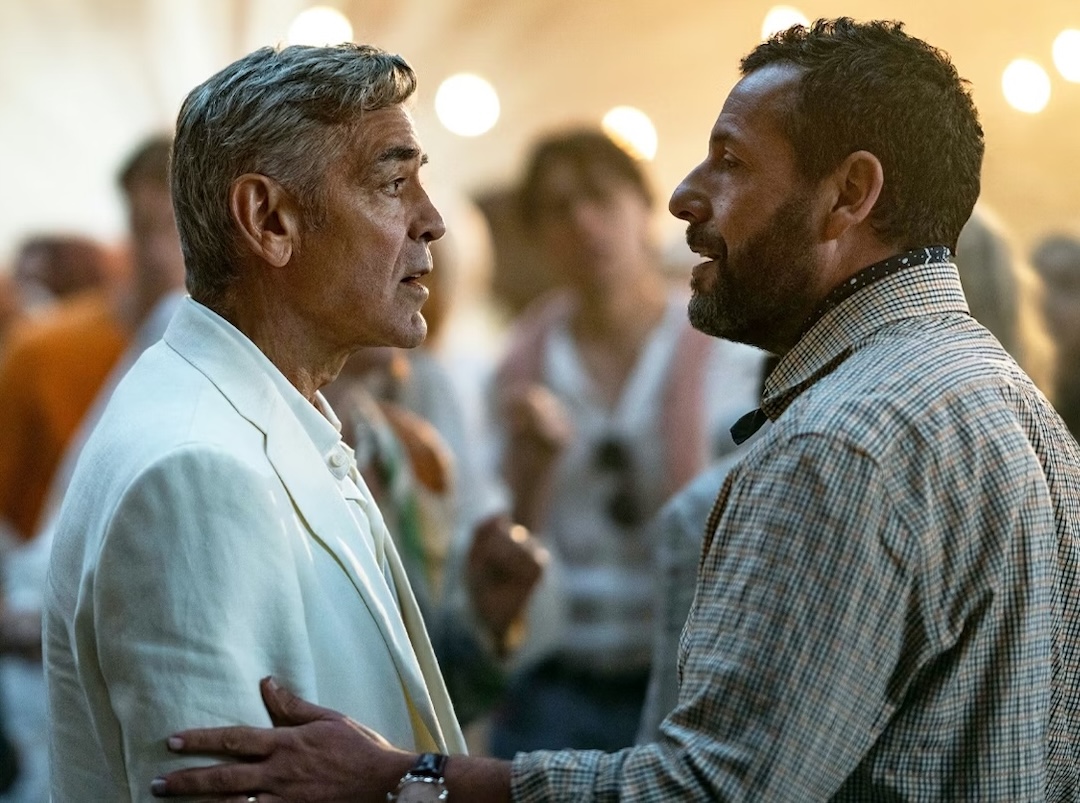
If Netflix has its way, the communal theatrical experience that its new movie Jay Kelly eulogizes is certain to go extinct. (Netflix)
Jay Kelly is the latest from director and Barbie cowriter Noah Baumbach currently streaming on Netflix after a very limited theatrical release — just enough to be Academy Award eligible of course. The movie opens with a Sylvia Plath quote revealed through smoke in order to emphasize its ephemeral quality: “It’s a hell of a responsibility to be yourself. It’s much easier to be somebody else or nobody at all.”
While you’re mulling that over, a five-minute tracking shot ensues showing a big Hollywood movie production in full swing. It’s the last scene for the star, Jay Kelly (George Clooney), and it’s a death scene. Lots of manly emoting, with a gunshot wound and a loyal little dog and all. And then, Jay Kelly is “wrapped out,” with such emotion that you wonder if he’s being “wrapped out” forever, the last shot of Jay’s last film, though there’s no reason given why that should be. He’s sixty, true, and he’s about to plunge into a period of messy crisis in his personal life. But he also appears to be such a Teflon-coated star, his popularity undented, there’s nothing stopping him from carrying on as before.
Jay Kelly is proving to be quite a popular dramedy on Netflix. Presumably because it’s so lavishly made and such a smooth, creamy consumable, while at the same time flattering audiences that we’re all at long last really giving this whole film-stardom phenomenon a big think. Jay Kelly comes to the solemn realization that “all my memories are movies,” a dramatic statement suggesting he’s a hollow man, hardly more than a flickering image himself. Meanwhile, he seems quite meaty and substantial, and all of his memories that we do see are of his bruising encounters with the disappointed people in his life.
This is a mild, surprise-free portrait of the title character, a movie star played by a movie star, George Clooney. In fact, the point seems to be that the role was designed to be played by Clooney. Like Clooney, Jay Kelly is a perpetual star with many popular action-oriented movies to his name. He’s known for his high-voltage smile and blinding handsomeness, with members of the general public besotted with memories of his movies over the years. But perhaps the limits on his stardom have had to do with the similarly Clooneyesque problem of having so much charm, such a dazzling surface, that a kind of assumption of shallowness seems to go with it.
Behind the scenes of Jay’s life, though, we get the non-Clooney material, at least if we believe the publicity about Clooney’s loyal long-term friendships, perfect marriage with a highly accomplished human rights attorney, doting fatherhood, and humanitarian work. Jay Kelly, on the other hand, is not the heroic figure he tends to play in action films. He’s spent decades living a life of egocentric selfishness, betraying friends, cheating on wives, neglecting children, all in order to achieve and then maintain his stardom up through his sixtieth year.
Jay’s truest friend is his self-sacrificing manager, Ron Sukenick (Adam Sandler), the rocky bromance at the center of the film. Ron’s convinced that when it comes to Jay’s stardom, “it’s something we did together.” Meanwhile, Jay takes Ron for granted and, during a climactic argument, says that what Ron has done, he’s simply done for the standard 15 percent cut of Jay’s earnings.
Early on, Jay Kelly finds himself having a series of similarly bruising encounters that make him aware of what his celebrity has cost other people. The most scarring one occurs after the funeral of Jay’s first director and longtime mentor, Pete Schneider (Jim Broadbent), whom Jay shafted late in life by refusing to lend his name to Schneider’s last-ditch attempt to get a film made. Jay gets into a conversation with an old college buddy, Timothy Galligan (Billy Crudup), once a talented aspiring actor and now a child psychologist. Over a drink that initially seems friendly, Tim reveals his lifelong hatred for Jay: “You stole my audition and my girlfriend, which at twenty-three, was pretty much all I had.”
In a flashback, we see Young Jay (Charlie Rowe) go after the part Tim was hoping to get, using Tim’s ideas for the character that he’d told Jay about. Thereafter, Jay soared to stardom; Tim’s acting career never got off the ground. A parking lot altercation ensues.
Afterward, sporting a black eye he refuses to explain, Jay takes a stab at making amends to some of the people in his life. His youngest child, daughter Daisy (Grace Edwards), is leaving for a European vacation with her friends before she goes off to college. In order to provide an excuse for his ill-advised trip chasing Daisy through Europe, Jay belatedly accepts an offer from an Italian film festival to stage a tribute to him, complete with garish trophy. It was an event Ron had struggled to set up that Jay had, in fact, turned down repeatedly.
Because it’s all one big impromptu quest to redeem the uglier aspects of his past, Jay’s team has to scramble to find him celeb-appropriate accommodations. This means Jay gets mixed in with the public far more than he normally would in his normally cloistered celebrity existence, such as an interlude on a crowded train in France. The train was actually an elaborately built set, as you can see if you watch The Making of Jay Kelly also streaming on Netflix. Oh, the money that went into this thing!
In keeping with the general opulence, there’s a first-rate cast, including Laura Dern as Jay’s fed-up publicist; Riley Keough as Jay’s disillusioned older daughter, Jessica; Stacy Keach as Jay’s macho, envious, unloving father; Patrick Wilson as a rival actor; Greta Gerwig as Ron’s wife, Lois; and Alba Rohrwacher as Jay’s Italian tour guide. So many names even in small roles are indicative of the film’s prestigious gleam, with all the posh trimmings.
High jinks and intense confrontations alternate in this dramedy before the inevitably sentimental conclusion. The film festival scene involves a Jay Kelly montage of clips from his career that is, of course, also a montage of clips from George Clooney’s career. If The Making of Jay Kelly is to be believed, Clooney apparently had the camera in close-up on his face as he watched the montage for the very first time. His real-life spontaneously teary reaction is the one that made it into the film.
Director Baumbach calls Jay Kelly “a celebration of filmmaking and creativity” that also takes on the issue of an actor’s identity in an industry that inevitably messes with it. Yet the portrait we have of Jay Kelly is a fairly boilerplate one. Who doesn’t know that major stardom fosters both egocentricity and identity slippage and tends to be achieved at the expense of personal relationships? As written by Baumbach along with cowriter actor Emily Mortimer, who also plays Jay’s hairdresser, Jay Kelly is a surprisingly unrevealing movie about stardom and the inner workings of Hollywood. If the gold standard is Billy Wilder’s scathing Sunset Boulevard (1950) — and it is — then where do we slot in this minor work?
Jay Kelly’s tone is elegiac, seeming to evoke the end of something, judging by the elaborate opening scene alone. From the very beginning of his career, George Clooney himself has been considered a “throwback” to older Hollywood stars such as Clark Gable and Cary Grant, and we see Jay Kelly reciting their names while studying himself in a mirror, trying to make “Jay Kelly” sound either more like a real old-time star or a regular human being. In The Making of Jay Kelly, we see that even the film’s score was designed to be deliberately old-fashioned and classical, played by a big studio orchestra and recorded on analog tape for “extra warmth.”
And of course, it’s not a big jump from there to thinking about the end of cinema as we know it, with Netflix looming large as one of the leading cinema-killers today. Jay Kelly was shot on 35mm film, a pointless irony given its extremely limited theatrical release in a few cities before it wound up on TV as yet another title in the vast catalog of Netflix releases.
When it comes to token releases like these that scorn the idea of movies as a mass medium best experienced communally in theaters, Netflix is the leading offender. And its recent purchase of Warner Bros. Discovery seems to represent a final signature on cinema’s death warrant, greeted with justifiable alarm by members of the already ailing industry:
A group of film producers sent a letter to Congress on Thursday stating that they had “grave concerns” about Netflix’s buying Warner Bros. Discovery. The authors of the letter did not sign their names for “fear of retaliation.”
“Netflix views any time spent watching a movie in a theater as time not spent on their platform,” the letter said. “They have no incentive to support theatrical exhibition, and they have every incentive to kill it.”
So perhaps Jay Kelly provides an oblique way to mourn the collapse of an entire system by evoking once more — in a deliberately cozy and familiar way — the fascinations of the movie star itself. The final affirmation of Jay Kelly is that of a system that’s going, going, gone. In his personal life, Kelly was a jerk, yes, but that was all part of being a big star who was part of an even bigger industry. It’s only fitting that at the end he should sit holding hands with his adoring manager, ecstatic to be subsumed in movie imagery running on a big screen in a proper theater with a real-live audience packing the house.
Ironically, if the studio behind Jay Kelly has its way, that experience is certainly on the cusp of extinction.