The Real Reason We’re All Annoyed With Quentin Tarantino

With nothing but a new cut of Kill Bill to offer, Quentin Tarantino has gone into semiretirement right as American cinema is fighting for its very life. And to make matters worse, he won’t stop talking smack.
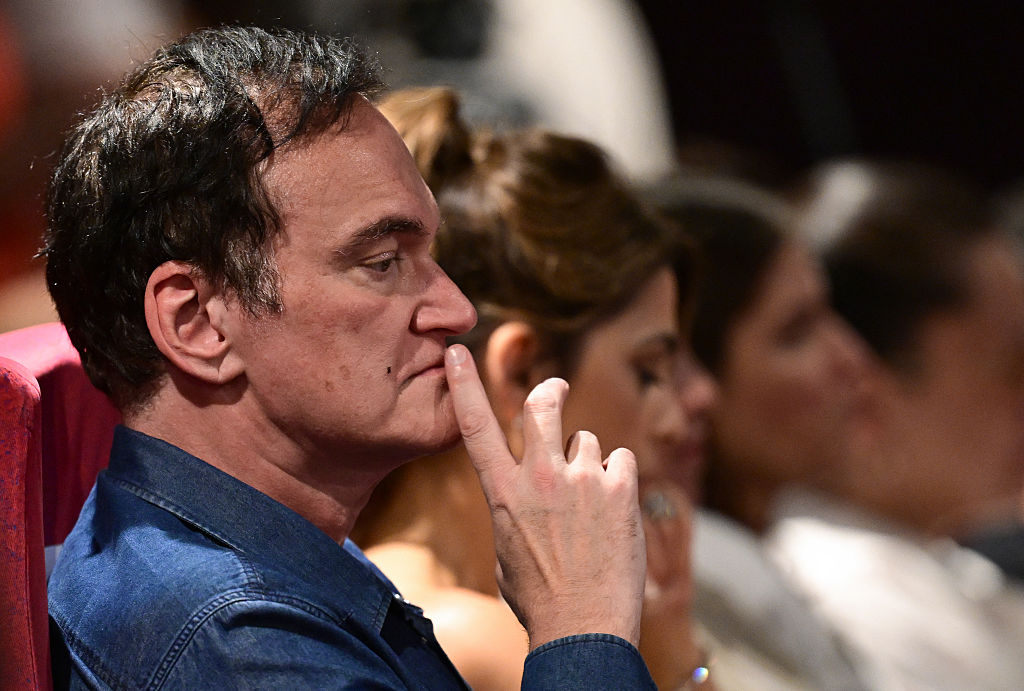
The American movie is in a fight for its life. Quentin Tarantino’s peers have all taken up arms, while he’s opted to sit back, heckling from the sidelines. (Miguel Medina / AFP via Getty Images)

All the glowing reviews for the four-hour-and-forty-one minute version of Quentin Tarantino’s Kill Bill — originally released as two separate films in 2003 and 2004 — are a sickening read if you actually go and see the damn thing, now titled Kill Bill: The Whole Bloody Affair. So little is changed, it’s shocking. It’s essentially the first two installments stuck together with a fifteen-minute intermission in between, an effect you could achieve at home by simply watching both films with a long bathroom break in between.

In case you need a reminder, Kill Bill is the saga of a top assassin named Beatrix Kiddo (Uma Thurman) who emerges from a four-year coma and seeks protracted, gory revenge on her former mentor-lover Bill (David Carradine) and the hit squad who nearly killed her.

When Beatrix finally awakens, it seems she’s also lost the baby she had been carrying. This is yet another vital reason that, in the list of revenge killings she plans to do, written down neatly in a notebook, she puts the death of the baby’s actual father last after the planned murders of hit squad members Vernita Green (Vivica A. Fox), O-Ren Ishii (Lucy Liu), Elle Driver (Daryl Hannah), and Bill’s brother Budd (Michael Madsen). Then finally, she declares, “I am going to kill Bill.”

There are really only four primary changes in this new cut. First, Tarantino has doubled the length of the anime sequence, laying out the backstory of formidable yakuza boss O-Ren Ishii. Second, the black-and-white gore in the extraordinarily bloody Tokyo nightclub sequence has been restored to full, crimson color. Third, some “segue” material from the opening of Kill Bill: Vol. 2, shot in black-and-white in imitation of certain French New Wave films, now plays behind the end credits. Fourth, the brief coda at the end of Kill Bill: Vol. 1, which featured Bill’s voice-over revealing that Beatrix’s baby did not die in the wedding party massacre after all, is now gone.

In the glowing reviews, you’ll read about how Kill Bill: The Whole Bloody Affair can only now be fully appreciated as the masterpiece it is. This is the familiar auteur-worshipping take that sells every “director’s cut” as revelatory, once it’s freed from the vile influences of interfering, money-grubbing producers and studio executives. And sometimes, director’s cuts are revelatory. But sometimes, they’re overlong and clotted with unnecessary material that obscures the impact of the films you already love. Or, as in this case, they make very little difference.

The original decision to split Kill Bill into two separate releases, over Tarantino’s objections, was made by producer Harvey Weinstein of the then-thriving studio Miramax Films. And given what’s happened in the years since, with Weinstein convicted of rape and sexual assault and serving a sixteen-year prison sentence, nobody wants to side with Weinstein about anything. But it must be acknowledged that almost any producer would’ve opted for exactly the same two-part release, purely for practical reasons. More standard-length screenings mean more audience members and greater profits. Even for a “special event” film like Kill Bill: The Whole Bloody Affair, it’s tough to get people who aren’t ardent cinephiles to commit to an almost five-hour running time.

Tarantino’s own legacy has been considerably tainted since his Kill Bill heyday — and it’s worth noting that even then he was an obnoxious personality who just happened to have undeniable filmmaking skills. But since the original release of Kill Bill, more unsavory aspects of Tarantino’s career have come to light. In his long association with Harvey Weinstein, he admitted he “knew enough to do more than I did” about Weinstein’s vile predatory habits. This is especially striking considering his intense creative friendship with Uma Thurman during the making of Kill Bill. She was one of the many women in Hollywood struggling to fend off Weinstein’s aggressive sexual advances.

Thurman went public with her charges against Weinstein in 2018, and in the same interviews, she also had serious complaints to make about Tarantino’s behavior during the making of Kill Bill. Though Tarantino included a credit on Kill Bill indicating their creative “Q and U” collaboration, he also indulged in sadistic acts aimed at Thurman that were designed to make it into the film. During the Crazy 88s fight sequence, for example, when teen assassin Gogo (Chiaki Kuriyama) is strangling Beatrix with a chain, causing her face to redden and her eyes to protrude, it was actually Tarantino pulling on the chain just out of camera frame. When Budd appears to spit tobacco juice in Beatrix’s face, it was Tarantino doing the spitting off camera. And most seriously, Tarantino insisted that Thurman drive a rickety car herself, ignoring her request that a stuntwoman do it:

“Quentin came in my trailer and didn’t like to hear no, like any director,” she says. “He was furious because I’d cost them a lot of time. But I was scared. He said: ‘I promise you the car is fine. It’s a straight piece of road.’” He persuaded her to do it, and instructed: “ ‘Hit forty miles per hour or your hair won’t blow the right way and I’ll make you do it again.’ But that was a deathbox that I was in. The seat wasn’t screwed down properly. It was a sand road and it was not a straight road.”

The resultant car crash gave Thurman a serious concussion as well as neck and knee injuries. Tarantino refused to allow Thurman access to the footage of the car crash until fifteen years later, in what he considered an act of atonement for an incident he regretted. Noted Thurman, “Not that it matters now, with my permanently damaged neck and my screwed-up knees.”

Recently, during the theatrical rerelease Kill Bill: The Whole Bloody Affair, Tarantino has been back in the news with a sudden burst of unsolicited commentary attacking actors he dislikes. In a widely quoted interview, Tarantino claimed that Paul Thomas Anderson’s There Will Be Blood would be even better if it weren’t for Paul Dano, who was “the weakest actor in SAG,” not strong enough to play opposite Daniel Day-Lewis and make the film the “two-hander” it should have been: “He is weak sauce, man. He’s a weak sister.”

Tarantino added to the list of actors he scorns Owen Wilson and Matthew Lillard. Lillard cogently pointed out that Tarantino was singling out actors lacking power in the current star rankings: “You wouldn’t say that to Tom Cruise. You wouldn’t say that to somebody who’s a top-line actor in Hollywood.”

But Tarantino seems to court controversy recently as he evinces less and less interest in actually making movies. His strong support for Israel since marrying his Israeli wife Daniella Pick and moving to Tel Aviv with their two children, has reportedly included touring a military base “to boost IDF morale,” supporting the troops currently waging war and committing genocide in Palestine.

Pick has proudly declared in a recent interview that Tarantino never considered leaving Israel for safety as bombs fell. He’s even quoted as saying, “Well, whatever. Like if something happens, I’ll die as a Zionist.”

Meanwhile, he’s aborted his tenth and possibly last film because of a realization he had after writing the script that he had no particular interest in actually filming it. “Every Tarantino title promises so much, except The Movie Critic,” he explained. “Who wants to see a movie called The Movie Critic?” There are still rumors that Tarantino will make a different and perhaps final film, just not immediately. Instead, Tarantino claims to be “really juiced about live theater now.”

Increasingly, the shine is off Quentin Tarantino among many film fans who admire his undeniable cinematic talents but are fed up with his tiresome, would-be macho acting out in his public conduct. But he maintains his reliable following among the dudebro contingent who worship his geeky loudmouth aggressivity and defend him against all social media backlash.

And Tarantino’s legacy of high-octane hits makes him bulletproof in Hollywood, where it’s clear he’d always be welcome to make a splashy comeback, no matter how long he stays away. But now semiretired from the film industry, Tarantino’s got nothing good to say about its current state of operations, which is fair enough. As he argues in a recent interview, talking about why he’s deserted filmmaking for the stage:

That’s a big f—ing deal, pulling [a play] off. . . . But making movies? Well, what the f— is a movie now? . . . What? Something that plays in theaters for a token release for four f—ing weeks? All right, and by the second week you can watch it on television. I didn’t get into all this for diminishing returns.

He’s right about the state of Hollywood. But it’s a further irritant that such an aggressive bigmouth is talking smack from the sidelines when what we really need from our top directors — especially the ones, like Tarantino, with the most leverage — is to join the front lines in the existential battle for American cinema.

Steven Spielberg, who is nearly twenty years older than Tarantino, is jumping right back into the fray with a big original sci-fi film, Disclosure Day. Martin Scorsese, at age eighty-three, is about to start filming What Happens at Night. Earlier this year, Tarantino’s friend Paul Thomas Anderson made a huge push to revive big non-IP theatrical movies for adults with One Battle After Another. Christopher Nolan not only just wrapped principal photography on the enormously ambitious The Odyssey, but — as the newly elected president of the Directors Guild — was the genesis behind the DGA’s unprecedented but very welcome public statement of “concerns” about the prospective Netflix purchase of Warner Bros.:

We believe that a vibrant, competitive industry — one that fosters creativity and encourages genuine competition for talent — is essential to safeguarding the careers and creative rights of directors and their teams. We will be meeting with Netflix to outline our concerns. . . .

And then there’s Tarantino — one of the last filmmakers in Hollywood who can snap his fingers and mobilize talent and financing for non-IP projects — reclining in the back row and shooting spit-wads, refusing to get back to work. Instead, he’s recycling his twenty-plus year-old movie with minimal additions or edits and calling it something new. If I had to guess, I’d say this is perhaps the overarching reason that Tarantino is vastly more grating than usual these days.

Because right now, the American movie is in a fight for its life. Tarantino’s peers have all taken up arms — challenging themselves like never before with hugely ambitious projects specifically for the big screen (and, hopefully, big audiences).

It’s time Tarantino once again joins the front lines and makes a last-ditch effort to save this medium we all love. Do that, Quentin, and you can talk all the smack you want, I promise.