The Invisible Costs of Upward Mobility
Elite colleges are making a greater effort to recruit working-class students. But flinging open these institutions’ doors won’t end class inequality, and the burdens of working-class entrance into rarefied social circles are often heavier than they seem.
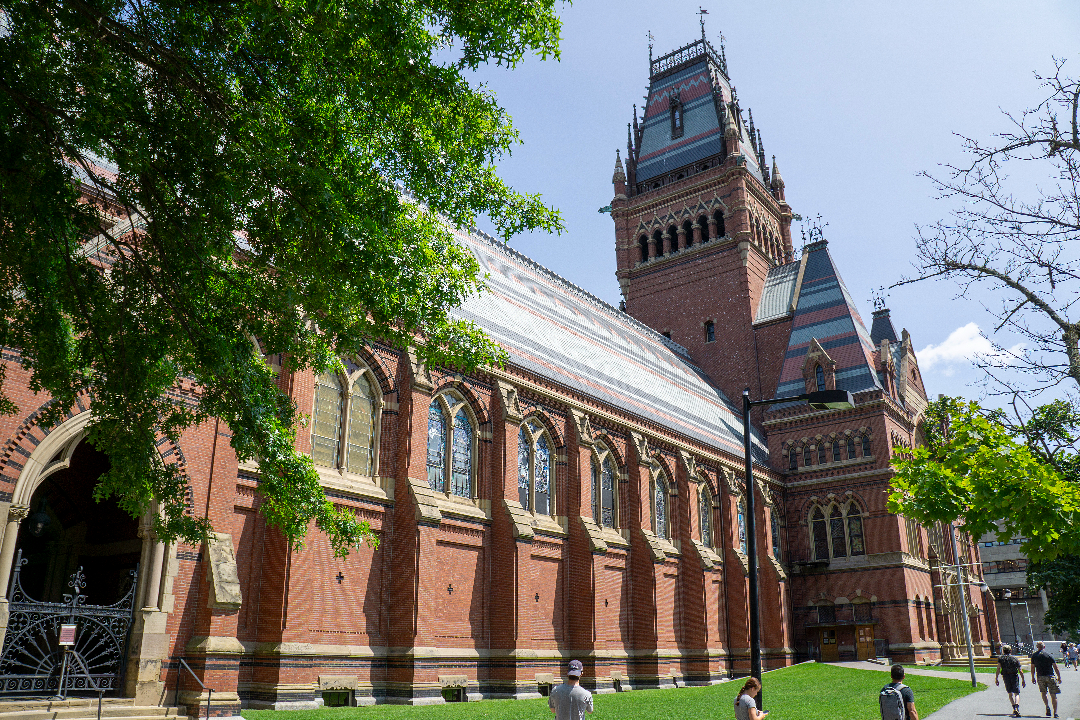
A photograph of Annenberg Hall (foreground) and Memorial Transept, Memorial Hall, at Harvard University in Cambridge, Massachusetts. (Spencer Grant / GHI / UCG / Universal Images Group via Getty Images)
Below the coffered ceiling of Washington University’s stately Holmes Lounge, I gather with other faculty for a lecture by visiting scholar Melissa Osborne. A sociologist from Western Washington University, Osborne is here to present their first book, Polished: College, Class, and the Burdens of Social Mobility, as an apt corrective to the myths we tell ourselves within these wood-paneled walls. Professors (and teaching faculty like me) tend to think that higher ed paves the way to more reflective, enriching lives, regardless of background. We also tend to assume that social mobility invariably brings greater happiness. These truisms are comforting, and we rarely open them up to scrutiny.
Osborne is not a typical academic, and for reasons that have little to do with their appearance — gingham button-down, inked forearms, silver undercut. Osborne was a first-generation, low-income student at an elite private college and earned a doctoral degree from an even more elite private university. At a time when over 20 percent of tenure-track faculty have at least one parent with a PhD and academia is increasingly dominated by those from elite class backgrounds, Osborne is about as rare as a Donald Trump voter at a Chappell Roan concert.
“Colleges are people-changing institutions,” Osborne asserts from the podium before an audience that is used to hearing praise along these very lines. “As educators and as scholars, we usually focus only on how these changes are a good thing, especially for low-income and first-gen students.” Then Osborne throws us a curveball: “What we tend not to think about are the negative effects of these changes, and who is most affected.”