Student Divestment Campaigns Can Work
Student activists demanding disclosure and divestment of their universities from Israel have been demonized and attacked. That’s because there’s recent historical precedent for divestment campaigns working, as they did against apartheid South Africa.
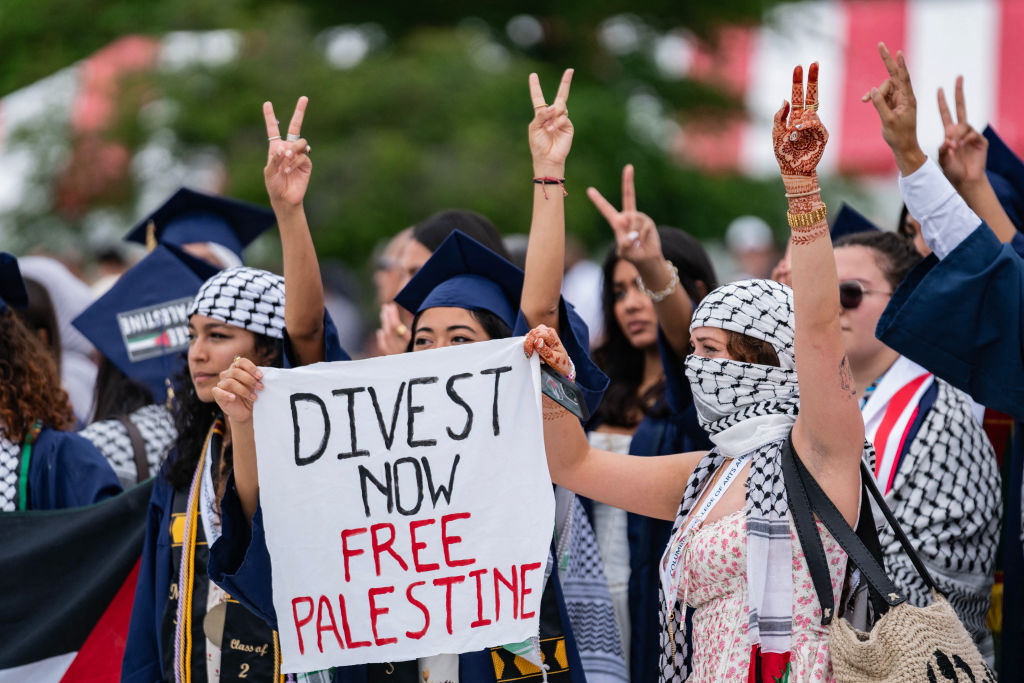
Graduating students protest in support of Palestinians during George Washington University’s graduation ceremony on the National Mall on May 19, 2024 in Washington, DC. (Andrew Thomas / AFP via Getty Images)
President Joe Biden evoked echoes of previous Republican presidents when he suggested that anti-genocide student protesters occupying college campuses across the United States this past semester and demanding divestment from Israel were engaged in violence. Misrepresenting their actions, he asserted in May, “Vandalism, trespassing, breaking windows, shutting down campuses, forcing the cancellation of classes and graduations, none of this is a peaceful protest.”
It’s hard not to hear Biden’s comments and be reminded of Ronald Reagan and Richard Nixon in the 1970s, who referred to antiwar student protesters as “trash” and “bums,” respectively. While it took years for politicians and public consciousness to realize the imprudence of the Vietnam War, history proved those students right. Similarly today, opponents of student efforts to stand in solidarity with Palestinians in Gaza have violently attacked them, summoned police to brutally clear their camps, misrepresented their intentions and goals, and tried to force them to abandon their movement.
One of the many ways college officials and critics have sought to delegitimize the student movement is to call the students’ demands for divestment from investments in Israel and companies profiting from its occupation as impractical, too complicated, or idealist. These students stand in a long history of the Palestinian Boycott, Divestment, and Sanction (BDS) movement, which is modeled on the 1970s and 1980s South Africa divestment movement.