Raphaël Glucksmann Won’t Unite the French Left
France’s Parti Socialiste is on the rise ahead of the EU elections, under lead candidate Raphaël Glucksmann. He’s appealing to disappointed Macron voters — but his campaign is also squarely aimed at killing off the alliance of France’s left-wing parties.
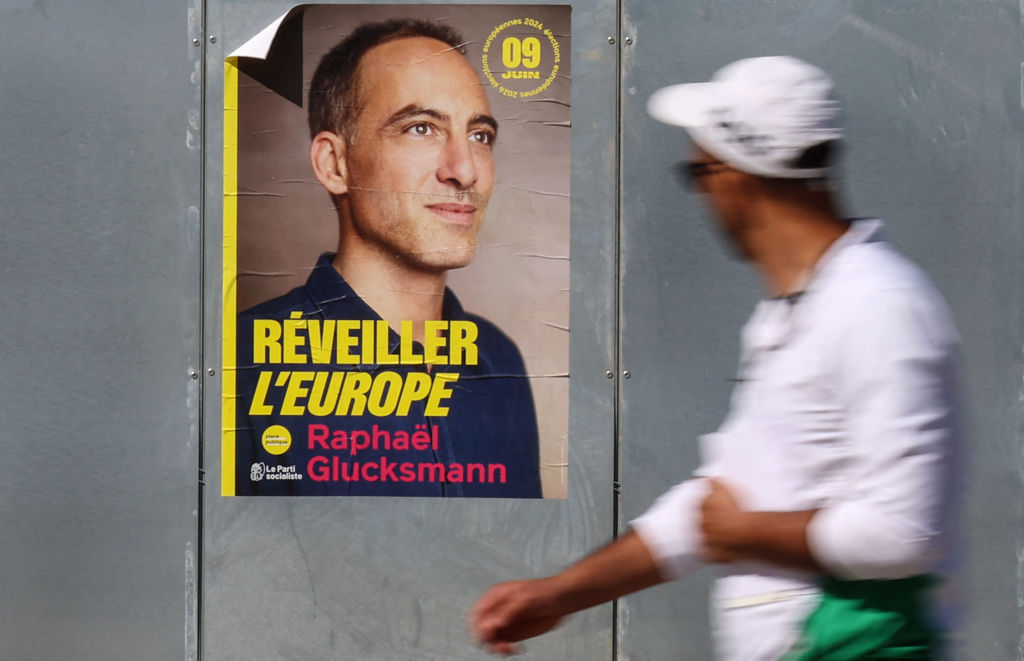
An official campaign poster of Parti Socialiste lead candidate for the upcoming EU elections, Raphaël Glucksmann, in Montpellier, France, on May 28, 2024. (Pascal Guyo / AFP via Getty Images)
Less than two weeks before voters across the European Union go to the polls, France’s far right appears to be sailing toward an historic victory. Lording it over a fragmented political landscape, Marine Le Pen’s Rassemblement National is credited with as much as 32 percent support going into the June 9 vote. Led in this contest by the twenty-eight-year-old Jordan Bardella — an incumbent member of the European Parliament (MEP) and the Rassemblement National’s official president since 2022 — the far-right party has a cozy double-digit lead over the other seven tickets that register in opinion polls. Most tellingly, the Rassemblement National looks ready to trounce Valérie Hayer’s list representing the party of President Emmanuel Macron, which hovers in the mid-to-high teens in most estimates.
While the scale of the Rassemblement National’s success will only be known after the votes are counted, all signs point to a major defeat for the president. Macron is entering the final quarter of his presidency in arguably his weakest position yet, without a majority in the National Assembly and increasingly isolated in Europe. “I’m not the one who chose the far right as my political opposition,” Macron said on May 26, fine-tuning his own alibi. Others will argue that EU elections are usually unenthusiastic affairs, even in an era of chronically declining voter turnout. Often dominated by the chance to air either a nationalist protest vote, or else the pro-EU identity of the upper-middle classes, it could be said that these elections provide a poor bellwether of the actual balance of French politics. Many will thus be tempted to downplay the significance even of a considerable Le Pen victory.
Yet this election is also a chance to settle other, sometimes petty scores and win other political battles ahead of the 2027 presidential election. In close third place after Hayer’s list — and salivating at the possibility of besting the president’s force — Raphaël Glucksmann is again leading the Parti Socialiste (PS) list. After being initially courted by Macron, Glucksmann founded the center-left party-cum-personal electoral vehicle Place Publique in late 2018. An essayist and political consultant, he was chosen to lead the PS’s European campaign the following year when he was first elected as an MEP to Strasbourg. It’s a post from which Glucksmann has sought to cultivate a reputation as a nonpartisan and thoroughly pro-EU progressive, an advocate of human rights causes such as the plight of the Uyghurs in China, and a staunch critic of Vladimir Putin’s invasion of Ukraine.