Vinson Cunningham’s Great Expectations Retells the Obama Era
Vinson Cunningham’s debut novel, Great Expectations, follows a staffer working for a magnetic young black senator making a bid for the US presidency. It’s a book about the emptiness of political symbols and the comforts and dangers of blind faith.
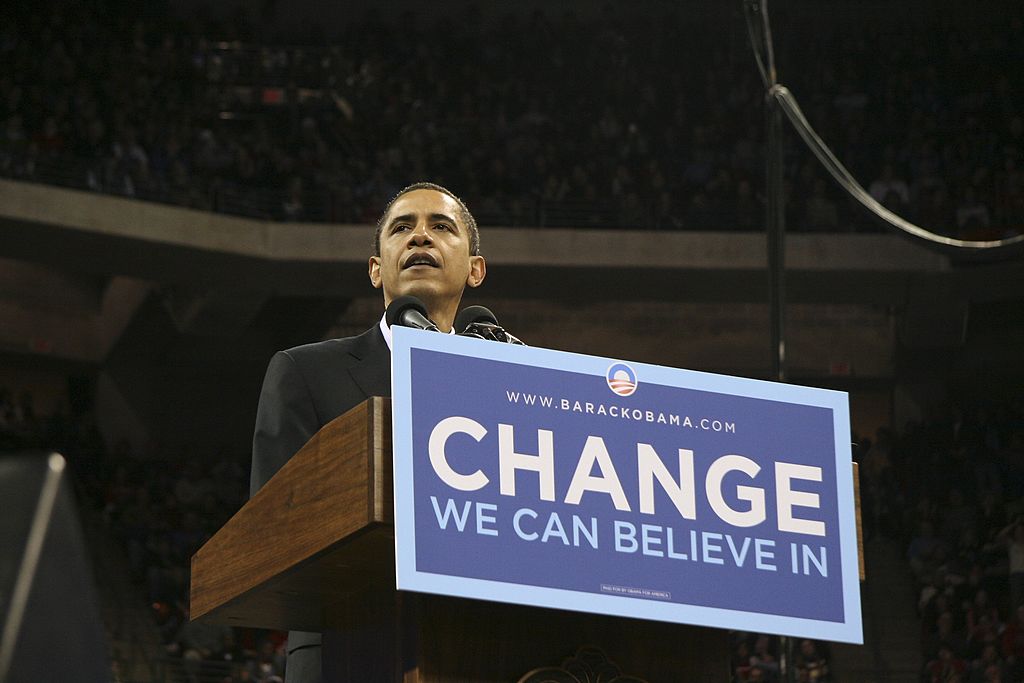
Barack Obama speaks at a rally after winning primaries in Virginia, Maryland, and the District of Columbia in Madison, Wisconsin, on February 12, 2008. (Bruce Bernstein / NBC NewsWire via Getty Images)
In 2007, the New Yorker staff writer Vinson Cunningham was in his early twenties, working as a tutor in Manhattan. These were exciting times for the liberal public sphere: the iPhone, Tumblr, and Nancy Pelosi had just made debuts, the latter as the first woman speaker of the House of Representatives. Through luck, or fate, or divine intervention, Cunningham’s tutoring connections drew him into the orbit of a charismatic black senator from Illinois making a bid for the presidency. Working on Barack Obama’s campaign, he called potential donors, collected checks, clutched a clipboard at the entrance to the apartments of the rich and famous — the kind of work that inspires and requires jaded cynicism. Cunningham has lent his own potted biography to the protagonist of his debut novel, Great Expectations. Like its namesake, this is a story about searching for identity, but race, religion, and political disillusionment in early 2000s America take the place of Charles Dickens’s class-inflected Victorian romance.
Great Expectations follows David Hammond, a black man, also in his early twenties, over the eighteen months he spends working for the senator’s campaign. One character jokes about the similarity between his and the name of the artist David Hammons, whose work has dealt ironically with symbols of race and power in the United States (“magical things happen when you mess around with a symbol,” he told the critic Kellie Jones in 1986). Cunningham’s novel, much like Hammons’s art, explores the hollowness and malleability of symbols. At its center is the unnamed senator, referred to throughout as simply “the candidate” but clearly more than inspired by Barack Obama.
When the novel opens, David is a twenty-two-year-old college dropout with a child he didn’t plan for and a whole lot of promise he’s afraid he has squandered. The campaign takes him into a world of BlackBerry phones and sensible heels, cocktail parties thrown by liberals with good tailoring and Park Avenue mansions. He has affairs, takes some drugs, has a brush with financial scandal. This is a bildungsroman for the West Wing generation.