Despite Worker Militancy, Union Rates Are Still Down
Despite an apparent upsurge in labor militancy, unions made no gains in their share of the workforce last year. Something needs to change — and fast.
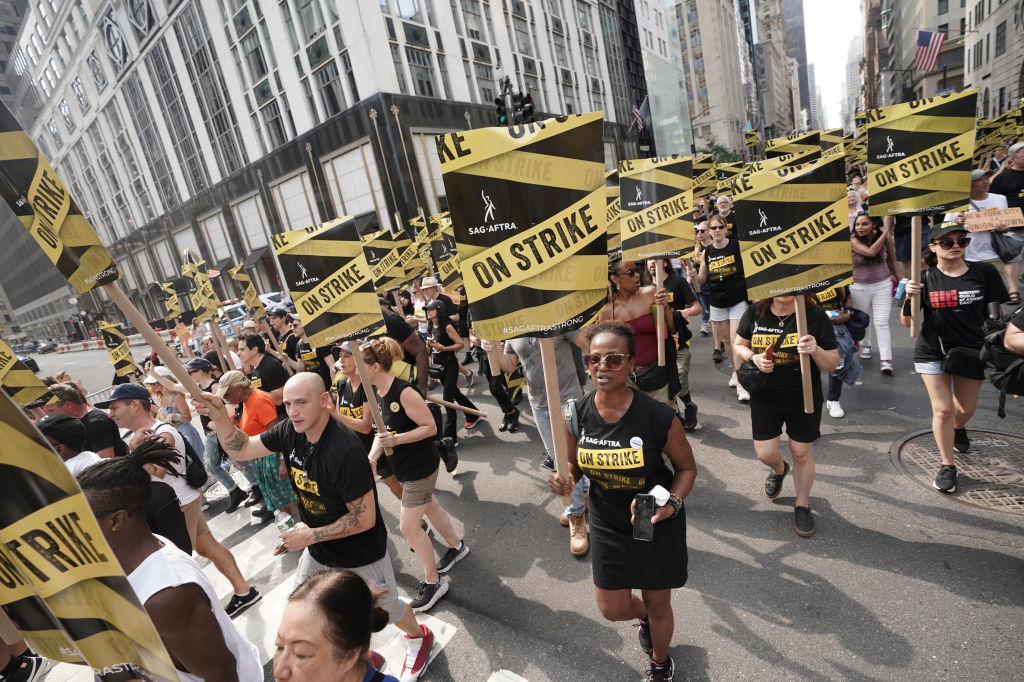
SAG-AFTRA members march on Labor Day in Manhattan, New York. (Barry Williams / New York Daily News via Getty Images)
Despite an apparent upsurge in labor militancy, unions made no gains in their share of the workforce last year. According to newly released figures from the Bureau of Labor Statistics (BLS), in 2023, 10.1% of the workforce belonged to a union, unchanged from the previous year and down 0.2% from 2019. There was a spike in union density in 2020, as more nonunion workers left the workforce than their organized counterparts in the early COVID days, but that was quickly reversed in 2021.
Since 1965, union density has risen only four times from one year to the next; it’s fallen in forty-five. Although long-term comparisons are dangerous — definitions, coverage, and methods can change radically over time — it looks like the private sector union share today is lower than it was in 1900.
The public sector, once the brighter spot in the union picture, has lately been leading the way down. Since 2011, the decline in public sector density has been four times that of the private sector. The Right’s war on public sector unions has taken a serious toll. The grim story is graphed below.