How a Young Communist Won and Lost Power in Postwar Japan
Today marks a decade since the death of Japanese communist Toshiko Karasawa. Her courageous life is a testament to the revolutionary potential of anti-imperialism, but also the difficult choices faced by the Left in US client states.
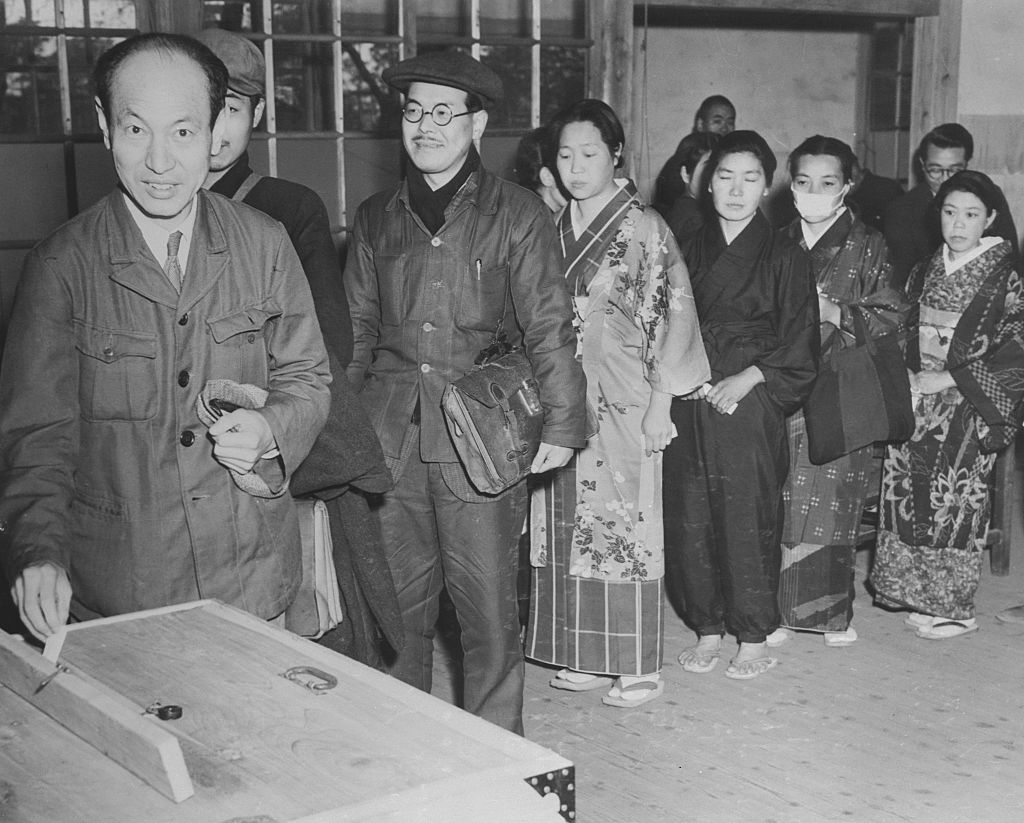
Japanese communist leader Kyuichi Tokuda places his ballot in an election box, April 16, 1946. Several of his supporters stand behind him. (Bettmann / Getty Images)
In 1946, the New York Times reported that Toshiko Karasawa, a thirty-six-year-old typist, was leading miners into battle against bosses in the coal pits of Hokkaido, a prefecture on the northernmost tip of Japan’s main island chain. Erroneously, the paper framed the movement behind Karasawa as a product of democratic reforms mandated by the US military occupation. But this confusion was not without some basis in reality. Japan’s Communists, of which Karasawa was one, were motivated by their opposition to their country’s imperialism, which they believed kept in place a reactionary elite whose grip on power was weakened by America’s military might.
Despite her brief renown in the early postwar days, Karasawa, who died ten years ago today, has now been almost completely forgotten. Remarkable for her courageous confrontation with fascism and big business, Karasawa became a symbol of the tragic role of the Japanese Communist Party, which was unable to reconcile its attempts to increase worker power with its opposition to the reactionary elements of its society and US imperialism.
The Meiji Road to Militarism
By the middle of the nineteenth century, Japan’s ruling class became worried about the threat of colonization by the west. China’s humiliation at the hands of Great Britain during the opium wars and the American naval officer Mathew Perry’s demand that Japan should open itself up to trade to the West in 1853 pressed home the need to exert influence within the region.