Direct Elections for Labor Leaders Make for More Militant Unions
From the UAW to the Writers Guild, this year’s biggest contract victories have been won by unions in which members directly elect their leaders. That’s a right denied to most US union members — but it may be the key to unleashing broader labor militancy.
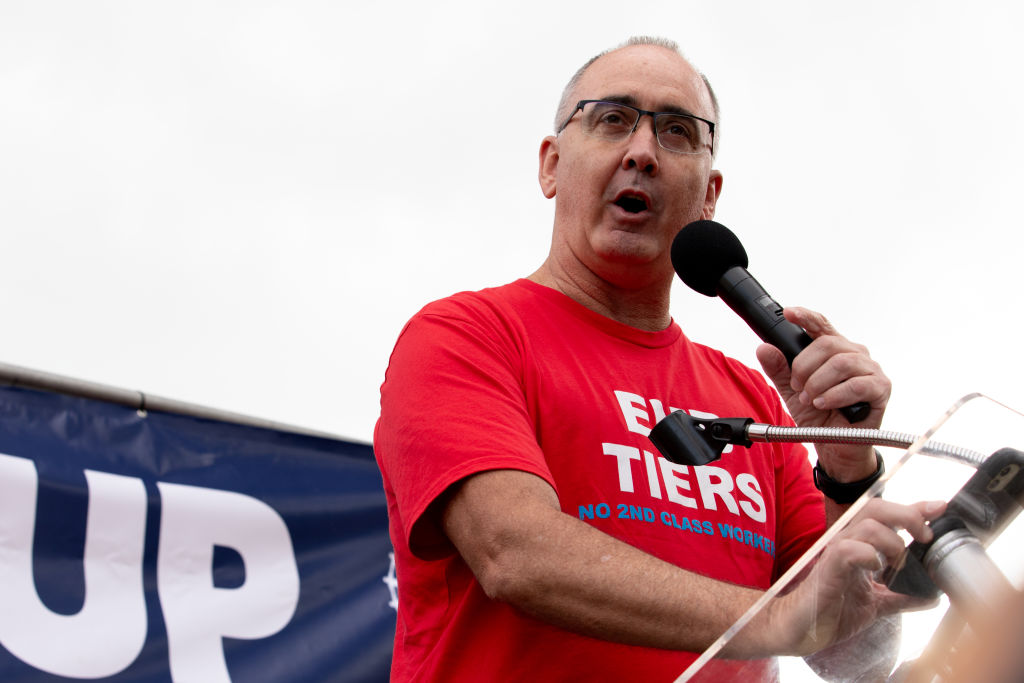
UAW president Shawn Fain, elected directly by union membership, speaks at a rally in Detroit, Michigan, September 15. (Emily Elconin / Bloomberg via Getty Images)
The labor movement is rightfully celebrating recent contract victories by the United Auto Workers, Teamsters, SAG-AFTRA and the Writers Guild of America, which together cover nearly 650,000 workers. An essential thread uniting the campaigns is that the top union officers were all directly elected by the members, a basic democratic right denied to many union members in the United States. As other unions seek to learn lessons from these historic contract fights, a key takeaway is that a vibrant democratic process — “one member, one vote” — is crucial to a revitalized labor movement.
A robust democratic process certainly played a major role in the United Auto Workers (UAW) contract fight with the Big Three automakers and the International Brotherhood of Teamsters (IBT) campaign against UPS. Leading up to their contract expirations, both the UAW and Teamsters had highly competitive and contested elections for their top leadership positions, directly engaging the membership in debates about the union’s negotiation strategy with employers and concessionary contracts, improvements in strike benefits, and the removal of antidemocratic obstacles. For example, at the Teamsters’ convention, delegates removed a constitutional provision that previously allowed union officers to impose a contract even if a majority of members voted against it. Injected with the energy of a contested election, the recent UAW and Teamster conventions were marked by spirited debates about union strategy, engaging members for the upcoming contract fights.
But a review of the constitutions of the twenty largest unions in the United States shows that “one member, one vote” is a right denied to most union members. Of the top twenty unions — representing approximately 13.3 million members and 83 percent of all US union workers — only six have direct elections. Only 20 percent of all union members, or 2.7 million, have the right to directly elect their top officers. In contrast, 80 percent of members, or 10.6 million workers, have no such right.