Ursula Le Guin Has Given Us a New Posthumous Collection of Writings
Legendary science fiction writer Ursula Le Guin has a new posthumous collection out called Space Crone. Sometimes polemical and often hilarious, it discusses feminism and radical alternatives on an intergalactic scope.
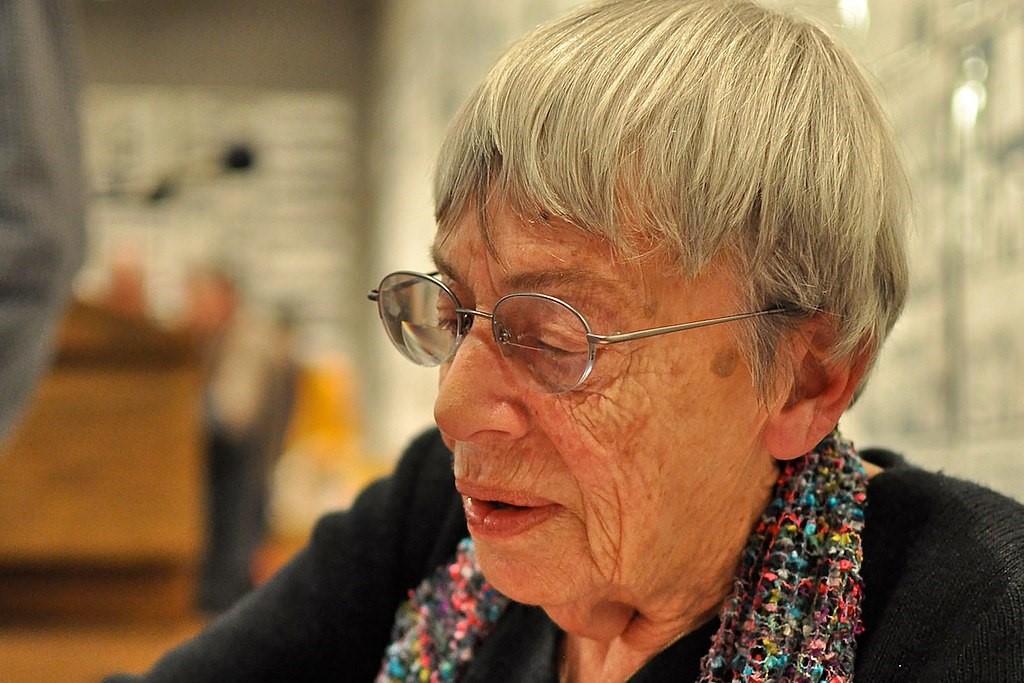
Ursula K. Le Guin signing a book in 2013. (K. Kendall / Wikimedia Commons)
In Greta Gerwig’s Barbie, Margot Robbie plays the titular character as a kind of young, sheltered woman whose world is thrown into turmoil by sudden thoughts of death. As elements of human reality seep into Barbieland, patches of cellulite appear on her plastic thighs (in Barbieland, there is no death and certainly no cellulite). Later, having departed Barbieland for the real world, Barbie sits next to an old lady on a bench and declares how beautiful she is. In Gerwig’s movie, the real world with its achy, breaky, wrinkly people is almost as unreal as Barbie’s pink plastic paradise. Wrinkles and cellulite figure as the physical counterparts to the emotional messiness the film associates with the profundity of the human condition, a cloying world filled with flesh and feelings.
“I am not sure anyone has invented old women yet, but it might be worth trying,” Ursula K. Le Guin declares in “Introducing Myself,” a performance piece from 1992. In Space Crone, a new collection of sometimes polemical and often hilarious fictional and nonfictional writings on feminism and gender by the late science fiction author, the figure of the crone appears in various places in the context of discussions of gender roles, women’s writing, and feminism.
In the essay “Space Crone” (1976), Le Guin imagines a spaceship visiting earth that can take only one exemplary passenger back in the hopes of understanding the human condition. Though she expects most people would suggest sending a young man, Le Guin would prefer to send a woman over sixty, ideally someone just randomly pottering around Woolworths. Le Guin argues that this wise woman with little formal education has spent her life working hard at “small, unimportant jobs . . . like cooking, cleaning, bringing up kids, selling little objects of adornment or pleasure.” Now her feet ache. She imagines that the woman would be reluctant to act as an emissary for the human race, yet insists that only she has “experienced, accepted, and acted the entire human condition.”