UAW Members Are Striking Against Corporate Power — and Americans Overwhelmingly Back Them
United Auto Workers president Shawn Fain has said, “We fight for the good of the entire working class,” and Americans seem to believe him. In massive numbers, they tell pollsters they back the UAW over the Big Three auto companies.
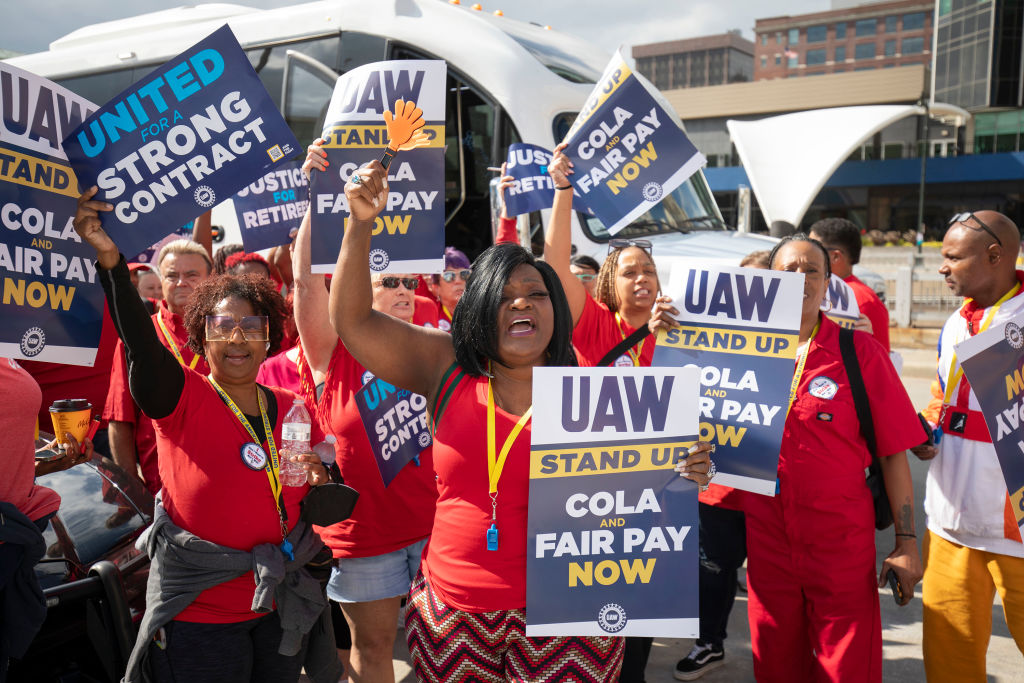
United Auto Workers members attend a solidarity rally as the UAW strikes the Big Three automakers on September 15, 2023, in Detroit, Michigan. (Bill Pugliano / Getty Images)
Early this morning, for the first time in its nearly ninety-year history, the United Auto Workers (UAW) commenced a strike at all three of America’s largest automakers. The union’s posture is a bold one, and the rhetoric of its new, reform-minded leadership — elected in a historic vote earlier this year — has sounded equally militant. Among the UAW’s demands are an end to discriminatory wage tiers, improved health care and retirement benefits, and a 40 percent pay increase.
Echoing the best of America’s labor tradition, President Shawn Fain has not been shy about presenting the strike as a broader action on behalf of all workers against corporate power. “If they’ve got money for Wall Street they sure as hell have money for the workers making the product,” he recently remarked. “We fight for the good of the entire working class and the poor.” Fain certainty isn’t wrong: over the past ten years alone, the Big Three automakers (Ford, General Motors, and Stellantis) have taken in about a quarter of a trillion in profits — much of it over the past four years, which have seen those numbers jump an eye-popping 65 percent.
And in massive numbers, Americans seem to agree with Fain. In recent years, general support for trade unions has risen significantly, with Gallup registering a fifty-six-year high in public approval back in 2021 and remaining roughly comparable today. It’s an astonishing turn of events considering the record-low approval unions received as recently as 2009, and it’s doubtless among the reasons the Biden White House has felt more comfortable making positive noises about strikes like the current one than its most recent Democratic predecessor.