Australia’s Public Sector Union Is in Decline Thanks to Its Labor-Aligned Leadership
For decades, the leadership of Australia’s public sector union has promised members that once a Labor Party government comes to power, it will lift wages and fix staffing shortfalls. The Albanese government is now refusing these demands.
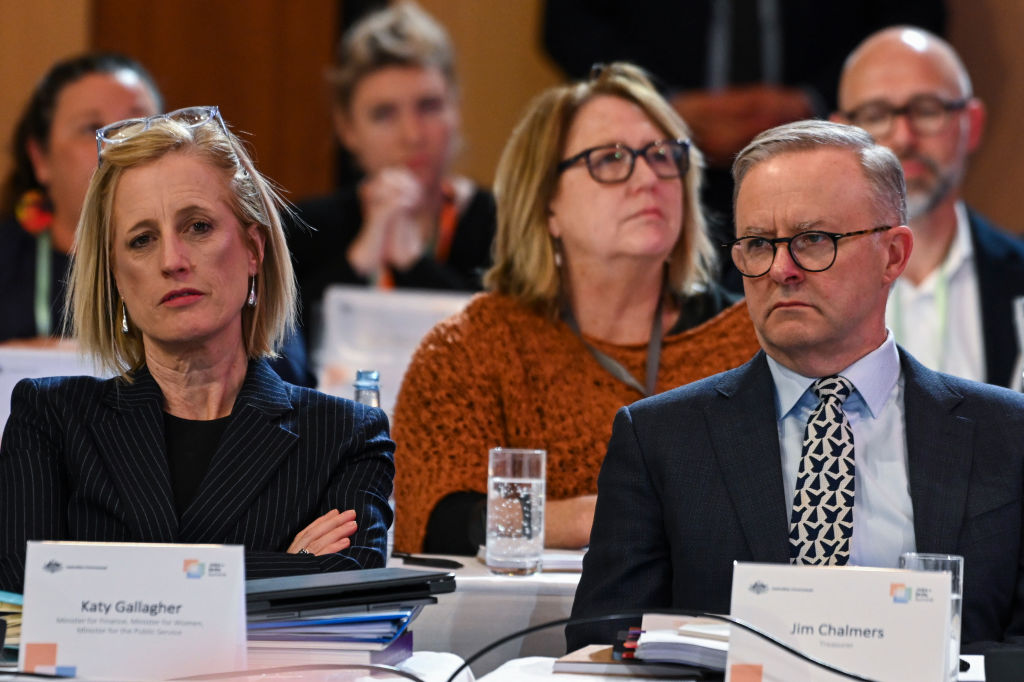
Australian prime minister Anthony Albanese and minister for finance and former CPSU organizer Katy Gallagher attend a jobs and skills summit at Parliament House in September 2022, Canberra, Australia. (Martin Ollman / Getty Images)
Australia’s public sector union, the Community and Public Sector Union (CPSU) PSU Group is in a vexed position. It has spent the last decade watching its membership decline severely while earnestly campaigning for an Australian Labor Party (ALP) government in the hope that it will bargain in good faith.
Now the limits of this strategy are playing out. Labor is in office, and bargaining over pay and conditions in the public service is in full swing — and the government is not delivering. Former CPSU organizer and now minister for finance and the public service Katy Gallagher is refusing the union’s claims, calling them “impossible.” The government’s initial pay offer was about half the CPSU claim, which, adjusted for inflation, amounts to a pay cut. Gallagher is also signaling that the government won’t be able to afford to boost staffing numbers in future budgets. These cries of poverty are belied by Labor’s commitment to the former Coalition government’s $368 billion AUKUS arrangements and $243 billion stage three tax cuts.
So far, the CPSU leadership has responded tepidly, all but guaranteeing a second lowball pay offer from the government. They have only led a single one-hour strike and other small actions designed to frustrate management without impacting public service delivery. And these were limited to just one agency with high union membership; most CPSU members have not had the opportunity to take any action at all.