The Hard Right Is Ascendant in Argentina
Argentina’s recent presidential primaries were a major win for the far right, with the anarcho-capitalist Javier Milei placing first. Between Milei and another hard-right candidate, the extreme right accounted for almost half of the electorate.
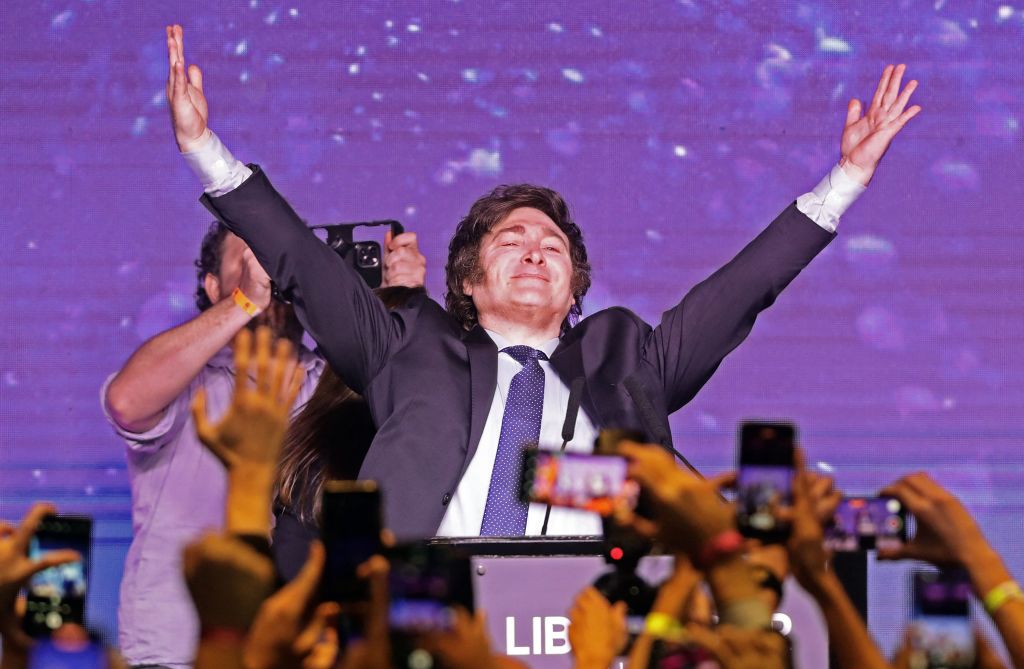
Argentine far-right libertarian economist and presidential candidate Javier Milei celebrates the results of the primary elections at his headquarters in Buenos Aires on August 13, 2023. (Alejandro Pagni / AFP via Getty Images)
The Argentine election brought a seismic shift on Sunday, August 13. The extreme right-wing libertarian candidate — and outsider of traditional politics — Javier Milei won first place, with 30 percent of the votes. The liberal-conservative opposition came second, with fewer votes than expected at 28 percent, and Peronism, for the first time in history, came in third, with 27 percent.
The open, simultaneous, and mandatory primaries (known as the PASO) constitute a kind of sui generis election: in theory, they allow each party to choose its candidates, but in practice, since the whole electorate votes, they are a pre–first round that sets the climate for the real election that will take place on October 22. Therefore, the PASO has two implications: on the one hand, determining who wins each internal election (if there is competition), and on the other hand, revealing the correlation of forces between the different parties and coalitions.
Regarding the former, the victory of former security minister Patricia Bullrich over the mayor of Buenos Aires, Horacio Rodríguez Larreta, from the party Juntos por el Cambio (JxC), stands out. It is a victory, in short, of the “hawks” against the “doves” in the main opposition force; of Bullrich’s “If it’s not everything, it’s nothing” against Rodríguez Larreta’s gradualist proposals. Bullrich’s campaign was endowed with all the ingredients: it simultaneously had a matter-of-fact style and a strong emphasis on deploying an iron fist against both insecurity and social protest. Her triumph in the internal elections provided Bullrich with a good chance of reaching the Casa Rosada. A militant of revolutionary Peronism of the 1970s, Bullrich later turned to the hard-line right. She maintains, however, liberal positions in other areas, reflected in her support for the decriminalization of abortion and approval of marriage equality.