Dockworkers in Canada Have Shut Down the Country’s Critical West Coast Ports
Longshore wages and job security have declined while profits for terminal operators on Canada’s west coast have soared. Now 7,400 workers from the International Longshore and Warehouse Union are striking across 30 ports, fighting against job and wage cuts.
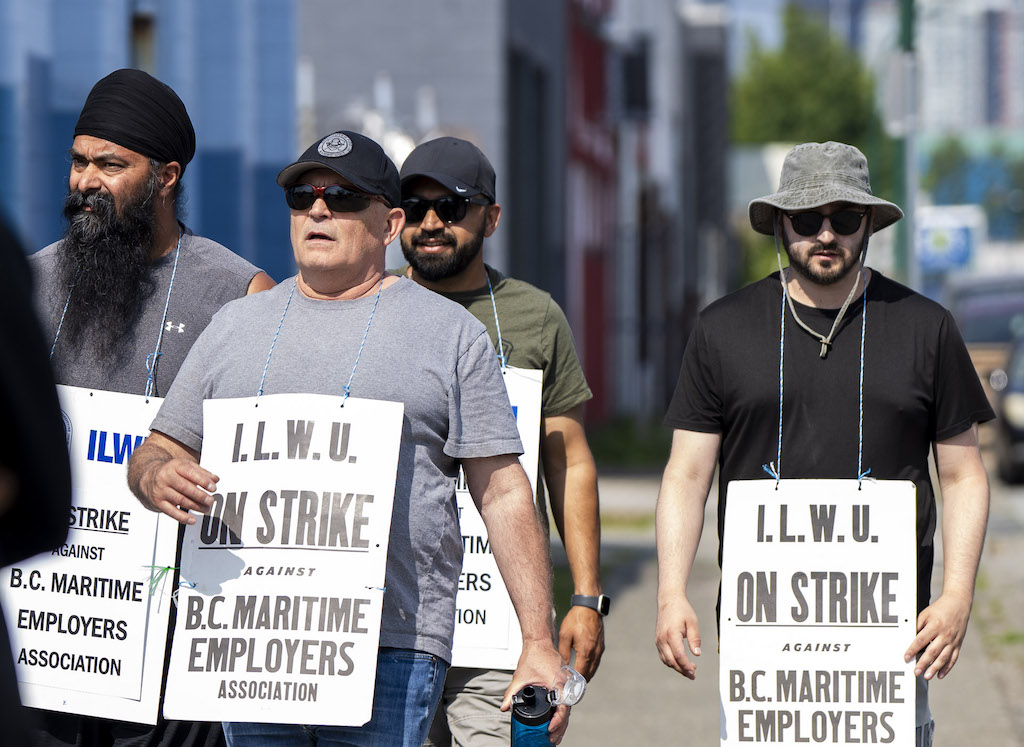
A picket line at the dispatch center during a dockworkers strike in Vancouver, British Columbia on July 5, 2023. (Jimmy Jeong / Bloomberg via Getty Images)
A strike is underway in British Columbia, with seventy-four hundred workers from the International Longshore and Warehouse Union (ILWU) representing thirty ports. The strike is against the British Columbia Maritime Employers Association (BCMEA). Combined, the workers have the potential to shut down over one-third of Canada’s export-led economy.
In the union’s last agreement, from 2018–22, the general wage for the port workers rose 12.5 percent from $42.85 to $48.23 per hour. While the deal for portworkers may have been comparatively better than that of many other workers, the Bank of Canada’s calculator notes that inflation totaled 13.87 percent during that same period.
Meanwhile, the port owners have raked in a fortune. According to the BCMEA’s own financial statement, its revenues rose steadily over the same period from $268,087,975 in 2018 to $330,333,797 in 2022. And the ILWU reports that the top five companies represented by the BCMEA collectively earned over $100 billion in profit in 2022, marking a 1,500 percent increase since 2019. In spite of these outsize gains, management is looking to cut staffing.