When Congress Helped Free a Fascist Archbishop
Archbishop Aloysius Stepinac collaborated with the fascist regime in Croatia, whose atrocities shocked even the Nazis. The US Congress then spent years attempting to free him in the name of anti-communism.
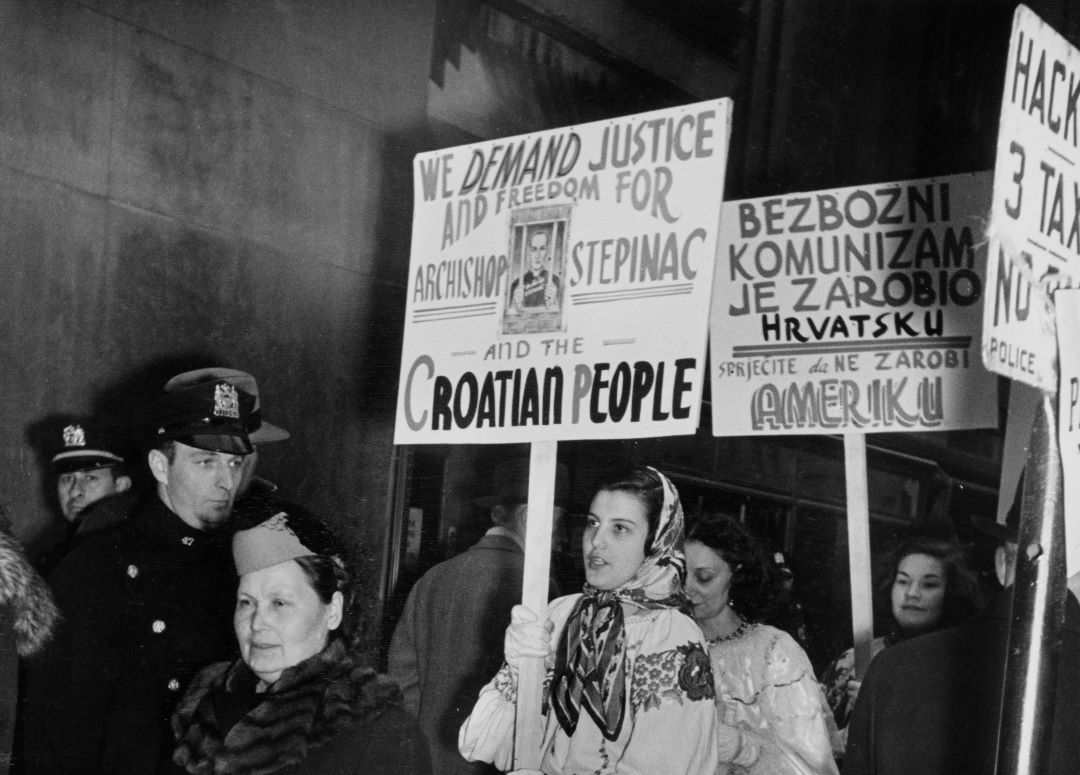
A woman holding a placard that reads “We demand justice and freedom for Archbishop Stepinac and the Croatian People” at a protest against the incarceration of Croatian archbishop Aloysius Stepinac, United States, circa 1946. (FPG / Archive Photos / Getty Images)
“The times are such that it is no longer the tongue which speaks but the blood with its mysterious links with the country,” Aloysius Stepinac, the archbishop of Zagreb and the head of the Croatian Catholic Church, wrote to his bishops on April 28, 1941. “Who can reproach us if we also, as spiritual pastors, add our contribution to the pride and rejoicing of the people, when full of devotion and warm thanks we turn to Almighty God?”
The occasion for Stepinac’s joy was the creation of the Nezavisna Država Hrvatska (NDH), the Independent State of Croatia, installed by the Nazis after their invasion and occupation of Yugoslavia. The NDH regime would soon become infamous for its brutality, even in the eyes of the Nazis themselves. Its persecution of Jews, Roma, and, above all, Orthodox Serbs — for whom the NDH adopted a policy of “convert a third, expel a third, and kill a third” — rivaled the crimes of any fascist regime. The most notorious NDH death camp, Jasenovac, was the third-largest in Europe during the war. More than half a million Serbs, thirty thousand Jews, and sixteen thousand Roma were murdered, while around 250,000 Serbs were expelled and 200,000 forcibly converted to Catholicism. The Waffen-SS, not known for its squeamishness, described the NDH’s atrocities as “bestial.”
The Croatian Catholic Church — led by Stepinac — was deeply entangled with the NDH regime. However, after it was overthrown by the communist partisans in 1945 and Stepinac was imprisoned for treason and wartime collaboration, anti-communists in the United States rebranded him as an innocent and courageous martyr. The US government soon fought for his release and began a wide, long-term campaign across the Western world on behalf of clerical fascism in the Balkans.