Searching for an Alternative to Neoliberalism and Right-Wing Nationalism
From Brexit to Donald Trump and Joe Biden’s anti-China policies, elites are offering their own challenges to the free-trade consensus — just as they did during the early 20th century’s pushback against “globalism.”
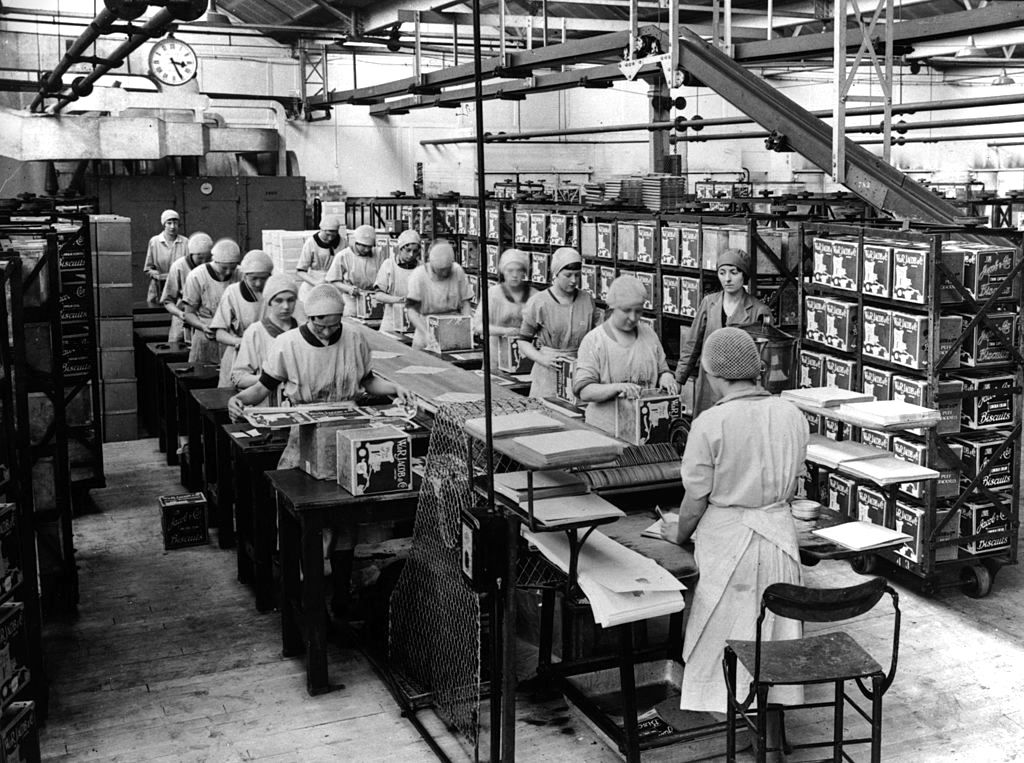
Workers label tins at the Jacob’s Biscuit factory in Aintree, Liverpool, 1926. (Topical Press Agency / Getty Images)
Among the many things the tumultuous last half decade has demonstrated is that “deglobalization” — the reduction of ties between regions of the world — is a traumatic process. Whether in a willful form like Brexit or through the temporary quarantines of the pandemic era, unstitching political communities from global networks of trade and commerce has had dramatic effects: inflation, political chaos, stalled factories, empty shops, and increased poverty.
That Great Britain has become the most salient contemporary example of this is, of course, deeply ironic. For it was Britain that was at the forefront of the great wave of European and US imperialism that oft-violently stitched our globalized world together in the first place. This was what the English historian A. G. Hopkins aptly described as the “enforced globalization” of empire. Its memory has tarred subsequent attempts at globalization, even those unaided by gunboats. Hostility toward globalization is compounded by the fact that, though planetary divisions of labor and networks of exchange have created great wealth in the aggregate, these gains are so maldistributed that a relative few see most of the benefits. Meanwhile, globe-spanning hierarchies of wealth and power undercut democracy, even in the wealthiest countries, spawning a resentment that often manifests as xenophobia and other dangerous forms of political reaction.
If there is a bright side to these seemingly insuperable difficulties, it is that they are not new. As Tara Zahra’s superb new book, Against the World: Anti-Globalism and Mass Politics Between the World Wars, reveals, the past century provides no shortage of examples of people and communities — well-intentioned and otherwise — wrestling with just these problems. Though nothing like a map of the way forward, her history of the twentieth century certainly shows many paths to avoid.