Alain Badiou Is the World’s Leading Philosopher of Communism
While many radicals of the 1968 generation shifted to the right, French philosopher Alain Badiou maintained fidelity to the revolutionary communist project.
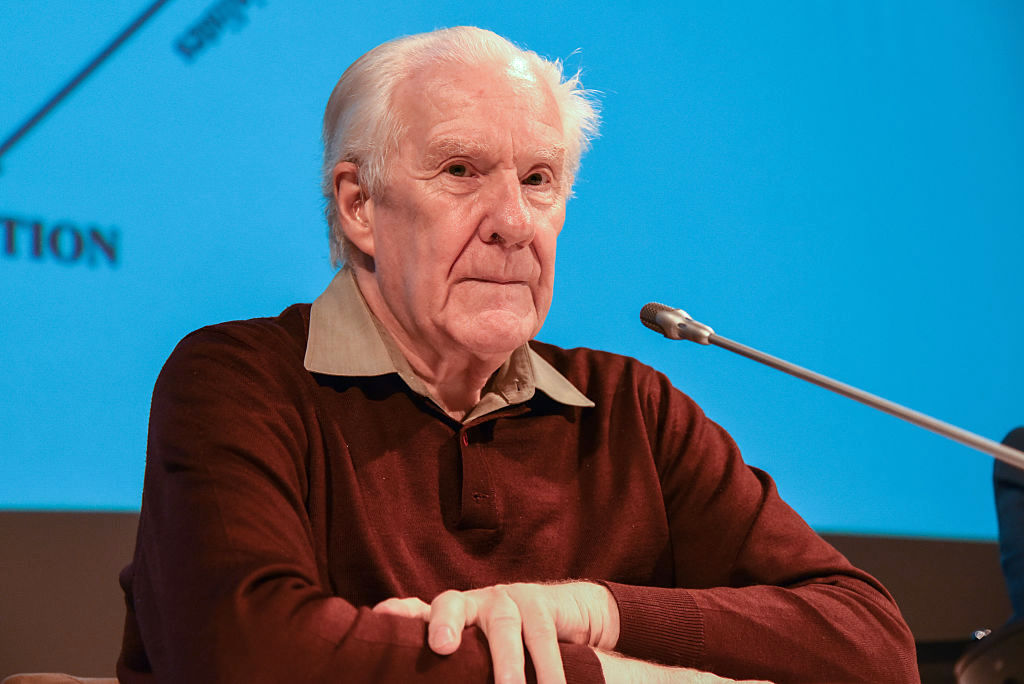
Alain Badiou speaking on May 5, 2016. (Wassilios Aswestopoulos / NurPhoto via Getty Images)
For leftists today, it’s common to regard the idea of communism with skepticism, or to view events like the Chinese Cultural Revolution and the Paris Commune as failures. For French philosopher Alain Badiou, however, the fact that these moments of revolutionary upheaval did not absolutely overturn the status quo is no reason to discard them — or, for that matter, the idea of communism.
Badiou likens the communist project to a theory that mathematician Pierre de Fermat first proposed in the seventeenth century. In 1994, after three hundred years of failed attempts, English mathematician Andrew Wiles finally substantiated Fermat’s “Last Theorem.” For Badiou, the example is instructive: the communist hypothesis is true, even if it remains to be proved. “Failure is nothing more than the history of the proof of the hypothesis,” he writes, “provided that the hypothesis is not abandoned.”
It’s this lifelong commitment to radical philosophy that marks Badiou out among intellectuals of his generation. In his youth, he interviewed philosophers such as Michel Foucault, Jean Hyppolite, and Georges Canguilhem for a TV show L’Enseignement philosophique. Today, at eighty-five years of age, Badiou continues to interrogate the relationship between politics and philosophy with his monthly seminar series, which begun in 2021, titled “How to live and think in a time of absolute disorientation?”