Pelé Tried to Be an Apolitical Icon
Pelé rose to fame during the height of Brazil’s military dictatorship. He matched his brilliant play on the field with a careful avoidance of crossing the powerful.
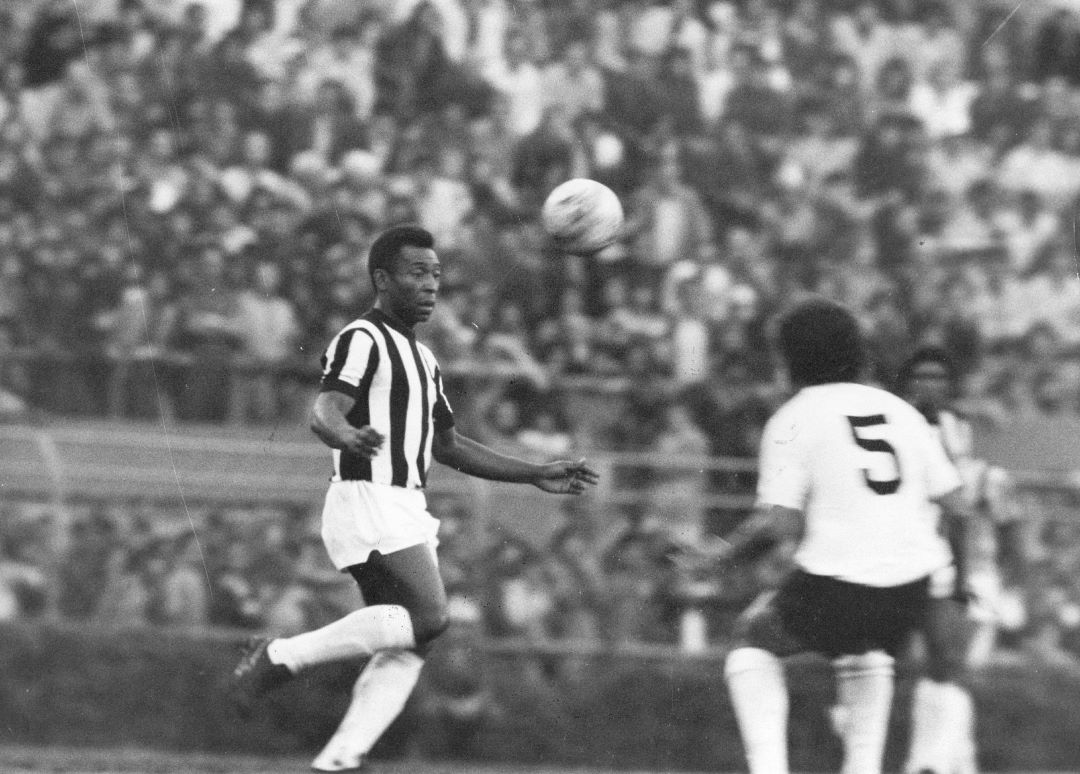
Brazilian footballer Pelé in 1974. (Lemyr Marvins / Getty Images)
On November 19, 1969, Pelé calmly walked up to the penalty spot and scored his thousandth career goal from a set piece. In an emotional press conference, he dedicated his feet to the children of Brazil; in congress, a senator stood up to read a poem in his honor; local newspapers, which everywhere else in the world were fixated on the Apollo 12 moon landing, turned their attention to Pelé. The excitement that surrounded him seemed to transcend politics, but this was only superficial. In reality, Pelé negotiated and flourished within a Brazil ruled for decades by right-wing military dictatorships and walked a tight rope between avoiding antagonizing the powerful and advancing his own career.
In the lead-up to World War II in which Brazil fought on the side of the Allies, the country embarked on a project of national reinvention, distancing itself from associations with European fascist nations such as Italy and Germany and embracing a multicultural vision of its national culture, nominally inclusive of Afro-Brazilians. Football, the most diverse of the nation’s sports, was at the heart of this project. Starting with the leadership of the populist authoritarian Getúlio Vargas, who in 1948 oversaw the construction of the Maracanã Stadium in Rio de Janeiro, at the time the world’s largest, a series of military dictatorships and anti-communist governments were the backdrop of Pelé’s illustrious career and some of the best years of Brazilian football.
As with most great modern athletes, barring exceptional figures like Muhammad Ali or Kareem Abdul-Jabbar, Pelé tiptoed around politics. His ability to avoid committing himself to any truly divisive positions while remaining a celebrated public figure was perhaps a product of the magic of sport, which is often able to hold people together by conjuring up apolitical collective feelings. While covering the 1982 World Cup, the far-right novelist Mario Vargas Llosa observed that: