The Czech Left Faces a Long Road to Recovery
This weekend’s Czech election shows the weakness of a Left that was once among Europe’s strongest. As the socially conservative base of the old Communist and Socialist Parties withers, a revived left has to relate to the modern working class.
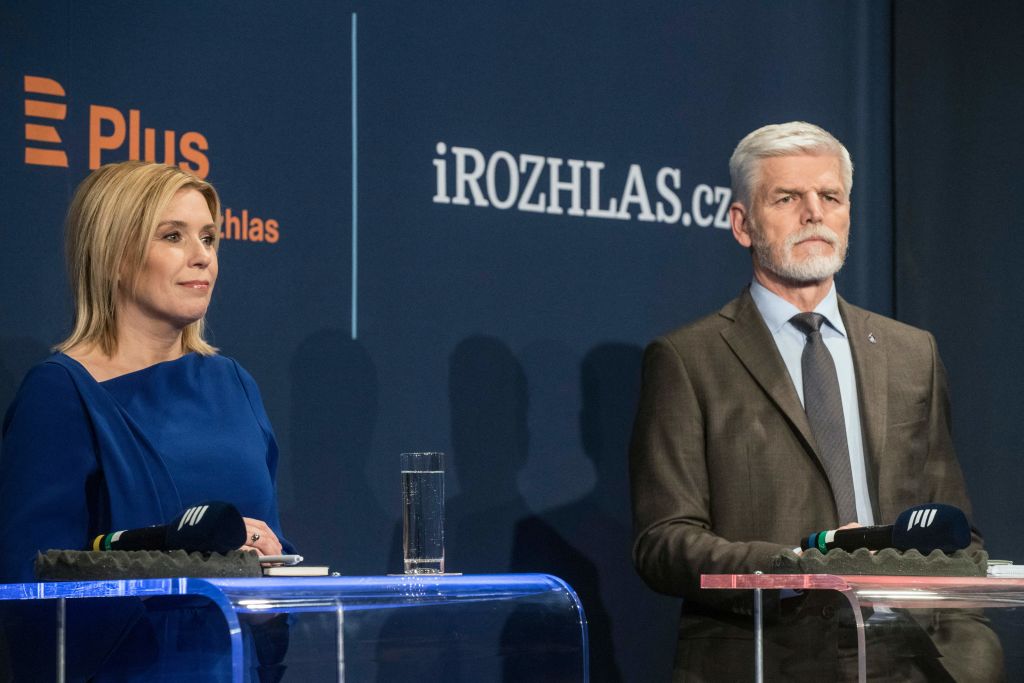
Presidential candidates Danuse Nerudova (L) and Petr Pavel prior to a political debate at Czech Radio in Prague on January 13, 2023, ahead of the first round of the presidential elections. (Michal Cizek / AFP via Getty Images)
Entering this weekend’s Czech presidential election, the country’s left is in a sorry state. Left-wing parties are absent from parliament and the leading presidential candidates fall between the center and populist right.
Compared to its political highs, the Left’s collapse has been staggering. In the five fair and free Czechoslovakian elections held before one-party rule started in 1948, left-wing parties — ranging from social-democratic to Marxist — averaged 45 percent of the popular vote. By 1946, nearly one in eleven Czechoslovaks was a member of the Communist Party, and it swept that year’s election — a postwar anomaly.
Even after the resumption of democracy in the early 1990s, left-wing parties remained strong. A communist successor party, the Communist Party of Bohemia and Moravia (KSČM), routinely earned above 10 percent, while the Czech Social Democratic Party (ČSSD) led the government from 1998 to 2006 and then again from 2014 to 2017.