Biden Is Still Refusing to Give Railworkers Paid Sick Leave
If he wanted to, Joe Biden could give railworkers the sick days they’re seeking withoutany need for Senate approval. He is choosing not to.
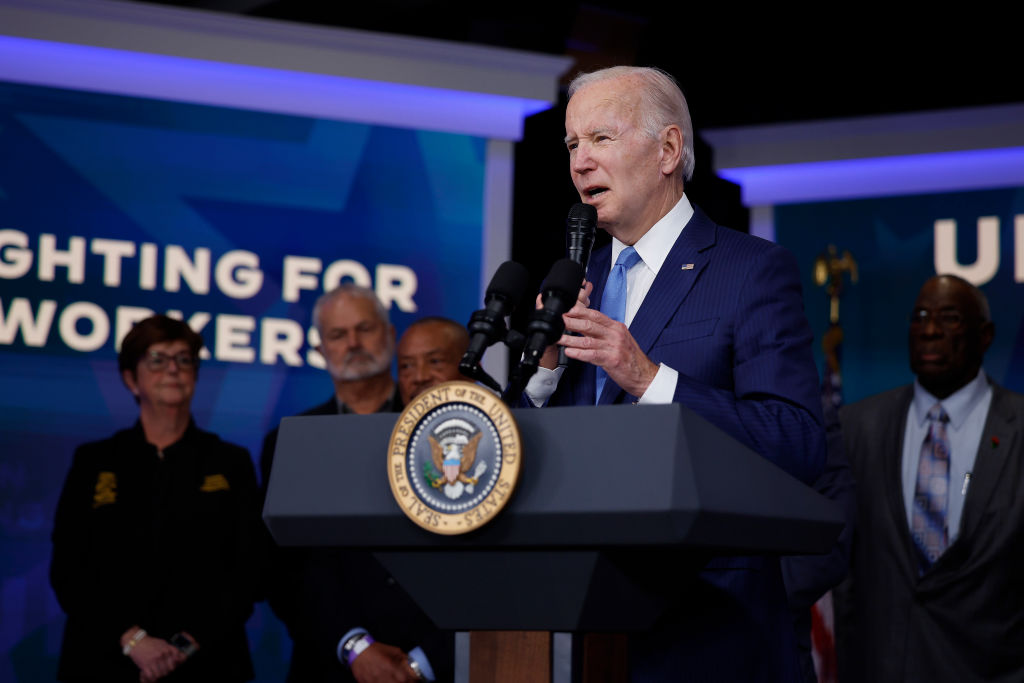
President Joe Biden delivers remarks on unions and pensions the week after calling on Congress to impose a contract on railworkers. (Chip Somodevilla / Getty Images)
This past month’s wrangling over a looming strike on America’s railways saw Democratic leaders toe an extremely strange, and characteristically incoherent, line. Any strike, as statements from the likes of Joe Biden and Nancy Pelosi made explicitly clear, was to be avoided at all costs — even if that meant imposing a contract on railworkers that failed to address their key demand for paid sick days. At the same time, and often in the same breath, the likes of Biden, Pelosi, and Transportation Secretary Pete Buttigieg insisted that workers deserved the very thing their own chosen course was leaving them without.
In the wake of recent events, the official position of the Biden White House continues to be that railworkers should indeed be afforded the paid sick time they had been set to strike for. That’s notable because, as commentators like the American Prospect’s David Dayen (and, as of last Friday, numerous members of the House and Senate as well) have pointed out, a clear avenue for doing exactly that remains open — one that bypasses the arcane rules of the Senate entirely. As an open letter signed by Bernie Sanders and some seventy-one other representatives points out, Biden has at his disposal the power to issue an executive order mandating federal contractors to provide their workers with paid sick days.
Such an action, though almost certain to be challenged in court, would have both precedent and democratic legitimacy on its side. Majorities in both houses of Congress, after all, have actually voted for sick days already. Moreover, a 2015 executive order issued by Barack Obama that extended them to roughly three hundred thousand workers employed by federal contractors provides a clear template. That order, as detailed by Rebecca Burns, Julia Rock, and Matthew Cunningham-Cook, included certain concessions demanded by various actors in the business lobby and, as a result, railworkers (and a number of others) were indefensibly excluded.