Harold Washington’s Legacy Still Hangs Over Chicago
A new documentary shows how Mayor Harold Washington upended politics as usual in 1980s Chicago. What goes unsaid is how quickly Washington’s legacy was undone after his untimely death.
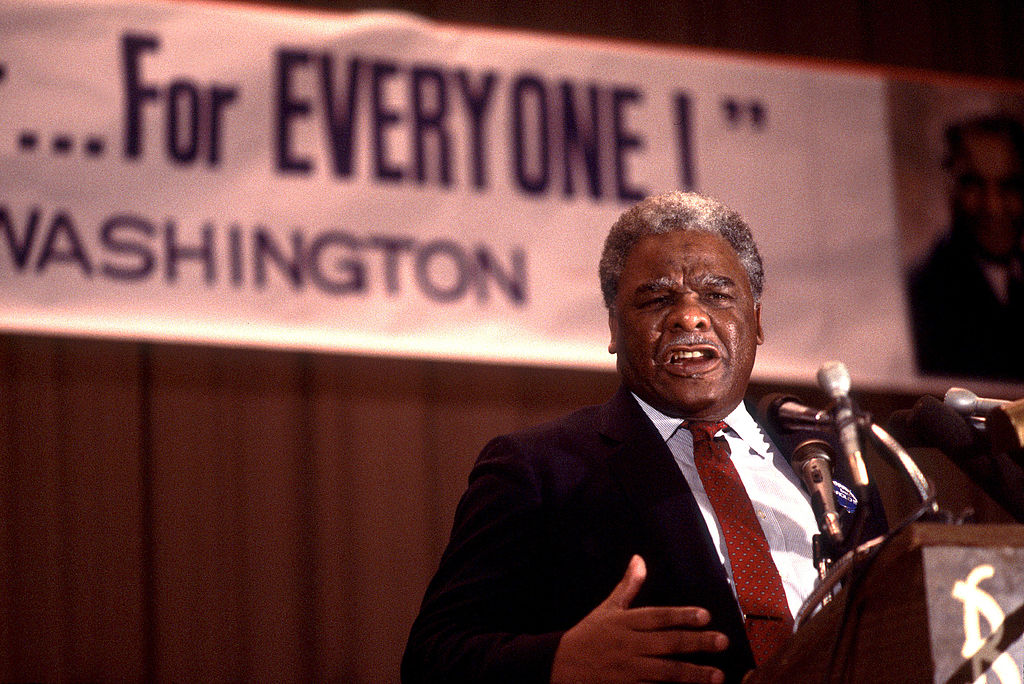
Chicago mayor Harold Washington at his second inaugural party at the Bismarck Theater, Chicago, Illinois, December 14, 1986. (Paul Natkin / Getty Images)
On November 13, 1979, Birmingham, Alabama elected its first black mayor: Richard Arrington, Jr. He would serve five terms over twenty years, presiding over an expansion and modernization of the city that won over even many white voters in the deeply racist city. To my grandmother and many members of my family who lived in Birmingham, though, his ascension to the leadership of the city signaled the Apocalypse. To my family — white, working-class, and for the most part, deeply immersed in Southern-style white supremacy — it meant only one thing: whites had lost power in Birmingham forever. Blacks would run riot and exact a terrible revenge on whites for their perceived mistreatment. It wasn’t just a new political era — it was the end of the world.
Four years later, a similar scenario would play out in Chicago, the city I later called home. But the unlikely, almost miraculous election of Harold Washington to the mayor’s office of what was then the second-largest city in America was even more shocking to the white establishment. Washington, the most remarkable figure in the already remarkable history of Chicago politics, reluctantly volunteered to fill the void left by another mayor who had served for twenty years and multiple terms: the notorious Richard J. Daley. Daley was the head of a machine that ruled every aspect of the city, and under that rule, Chicago somehow managed to be even more segregated than Birmingham. Daley’s participation in the 1919 race riot set the tone for how he would govern the city as mayor, and the idea that a black man would take his seat was unthinkable to the establishment he built.
This is the story told to mixed effect by a new documentary, Punch 9 for Harold Washington. Directed by Joe Winston (who also helmed the film version of Thomas Frank’s What’s the Matter With Kansas?) and produced by a diverse group that includes comic and actor Craig Robinson, NBA star Derrick Rose, and Josh Braun (a producer of Peggy Guggenheim: Art Addict and Wild Wild Country, among many others), the film largely succeeds in its own aspirations. It uses a broad range of archival footage combined with interviews and historical context to tell the story of Washington’s gripping and often astonishing win over an entrenched political machine, an electorate galvanized along racial lines, and various interest groups paralyzed by infighting over who would get how much of Chicago’s power structure.