Canada’s Liberals Expect the Working Class to Bear the Brunt of the Economic Downturn
Other than suspending student loan interest, Canada’s fall economic statement promises next to nothing for workers. Bloodless technocratic tinkering is never enough, but during times of crisis, leaving structural change off the table is indefensible.
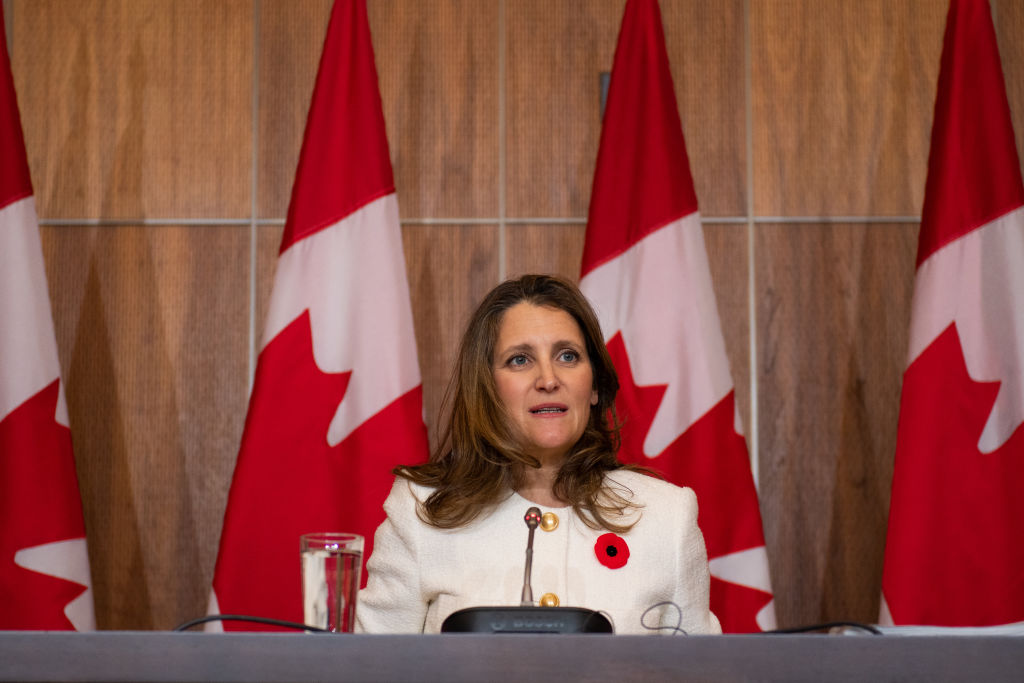
Chrystia Freeland, Canada’s deputy prime minister and finance minister, speaks during a press conference before tabling the fall economic statement in Ottawa, Canada, on November 3, 2022. (James Park / Bloomberg via Getty Images)
No one expected the Liberal government’s fall economic statement to be transformative — and Finance Minister Chrystia Freeland delivered on that anticipated lack of ambition. While the budget update wasn’t an austerity plan — and while a handful of measures ought to be welcomed — the thrust of the statement was business as usual at a time that begs for doing things differently in a big way. “We are keeping out powder dry,” Freeland said of the insipid statement in a speech that warned of a looming recession, should the potential downside of the country’s economic projections come to pass.
As you’d expect in a suite of Liberal priorities, the economic update had a handful of tax measures and retraining funds to encourage and facilitate investment here and there, with a focus on greening the economy. As ever, the party’s running assumption is that we can tinker our way out of climate catastrophe with a tax credit. The statement also promised to facilitate easier access to the Canada workers benefit through advance payment to previous qualifiers, which is good. Such programs should be low-barrier and easy to access.
Freeland is also promising to move beyond the government’s pandemic measure of freezing student and apprentice loan interest to permanently eliminating it beginning in April 2023. As senior economist with the Canadian Centre for Policy Alternatives David Macdonald puts it, the move is “literally the very least the government could do for students.” Indeed. Tuition rates are up in Canada and student debt is crushing those who choose to pursue postsecondary education, especially in the midst of an affordability crisis.