Yes, Europe Needs a Minimum Wage
A proposed minimum wage for the European Union promises to end the race to the bottom on pay — and instantly improve 25 million workers’ conditions. Faced with a cost-of-living crisis, the move is a welcome step to support incomes.
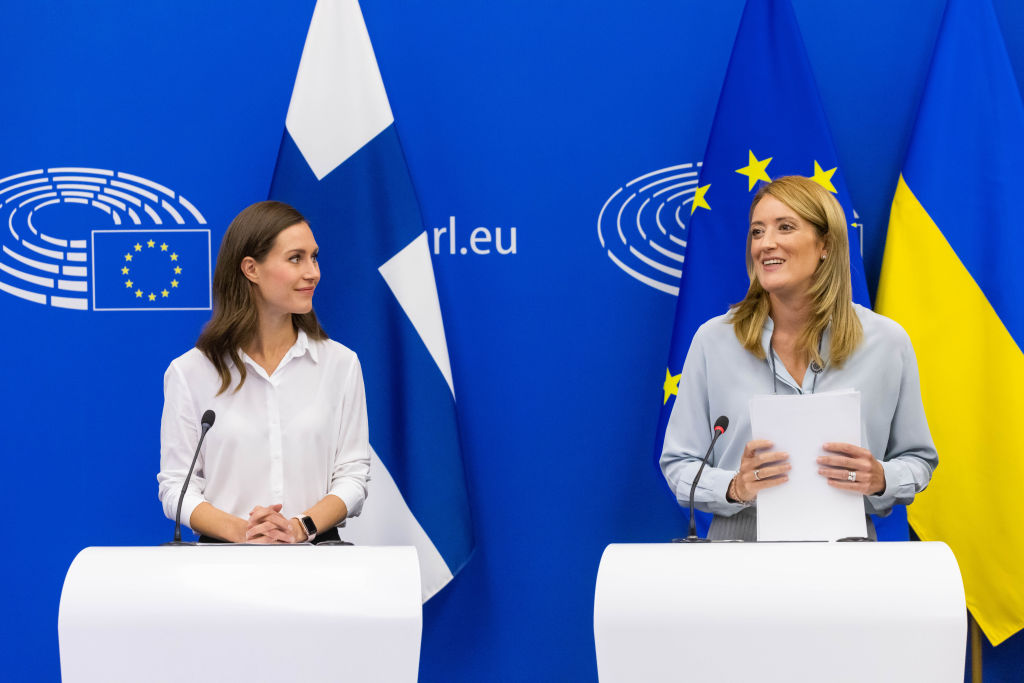
Sanna Marin (L), prime minister of Finland, and Roberta Metsola (R), president of the European Parliament, discussing a European minimum wage in the European Parliament building on September 13, 2022 in Straßburg, France. (Philipp von Ditfurth / picture alliance via Getty Images)
Today, the European Parliament adopted the Directive on Adequate Minimum Wages in Europe. The move is an enormous success for labor, as it provides not only a European framework for the establishment of adequate minimum wages, but also the promotion of sectoral collective agreements, identified as an essential tool in the fight against poverty and inequality. The directive thus marks a paradigm shift in European labor policy.
Debates on a European minimum wage are about as old as the European project itself. The right to a “fair” wage was already enshrined in the Social Charter adopted in 1961. However, initiatives to harmonize wages or improve mechanisms for determining wages remained unsuccessful. The discussion only really gained momentum with the introduction of the single European market at the start of the 1990s. Debate ignited around the project’s basic neoliberal assumption holding that a common market would lead to an automatic equalization of wages and a fair distribution of wealth. As against this assumption, the French left and the European Trade Union Confederation in particular advocated a European minimum wage to mitigate the common market’s negative pressure on wages and to pull up the incomes of lower earners.
Proposals varied. Some argued for a uniform minimum wage encompassing all EU member states, others for varying rates for different groups of countries, or else a harmonization of relative minimum wages, with each member state setting a rate relative to its own median income. The latter proposal seemed easiest to implement at the European level, also considering the economic inequality among EU member states.