Amazon Is the Largest Employer in California’s Inland Empire. Workers There Want a Union.
Ten years ago, Amazon operated zero facilities in California. It now operates close to 40 facilities in the Inland Empire alone, making it the region’s largest employer. Workers essentially live in a company town — which may be why many want to unionize.
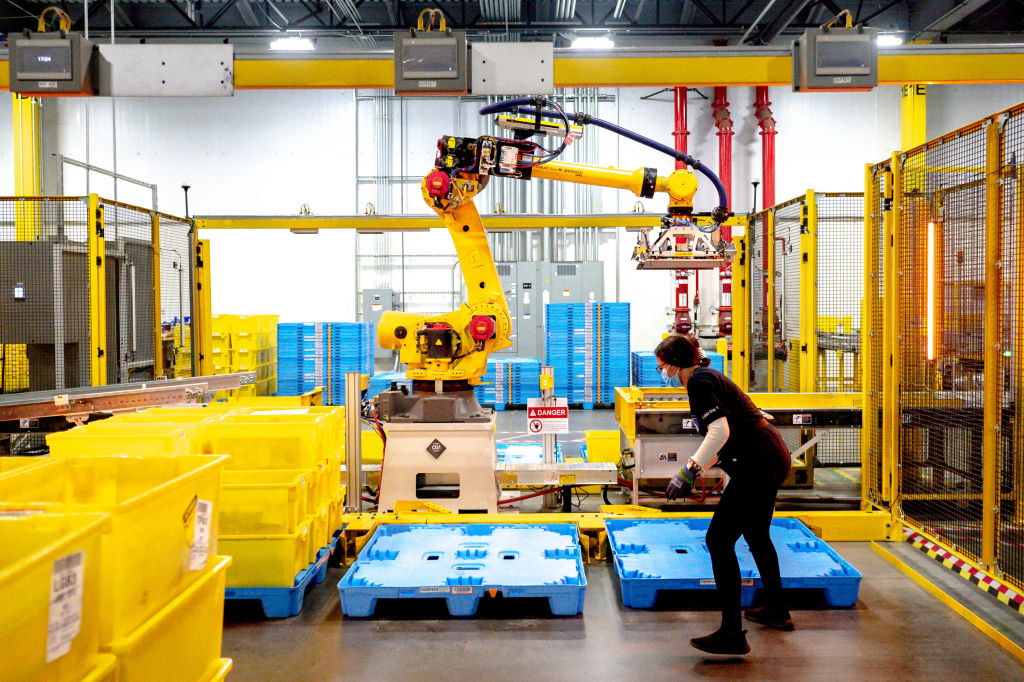
A robot sorts and stacks bins at an Amazon fulfillment center in Eastvale, California. (Watchara Phomicinda / MediaNews Group / The Press-Enterprise via Getty Images)
It was a Monday afternoon in Moreno Valley, California, and Nannette Plascencia was sitting at a table outside of an Amazon warehouse in high winds and pouring rain engaging in the riskiest activity of her career: encouraging her colleagues to sign union cards.
Plascencia has worked at the Moreno Valley facility for seven and a half years, nearly its entire existence, as a vendor receive, scanning and sorting items that come into the warehouse from the company’s many vendors. She said she’s never been disciplined by warehouse management, and does “good work” with a group of colleagues she enjoys. She’s in some ways an unlikely organizer of her coworkers at the Moreno Valley warehouse, who are in the early days of their attempt to become the second Amazon facility in the country to successfully unionize with the Amazon Labor Union.
But Plascencia has plenty of reasons to organize. Not only does Amazon have proficiency requirements that vendor receives must meet, a rate at which they must complete their work, but the company’s computers also track how much time it takes each vendor receive to scan each item that comes into the facility and how frequently they are scanning items. Even if they meet their overall proficiency requirement, if a worker is not scanning items at stringent intervals they are threatened with discipline. Plascencia said that the algorithm makes no allowance for the time that she and her colleagues spend dealing with items that are damaged or any of the spills and broken glass they see on a daily basis. Nor does it factor in time for workers to use the bathroom, which results in workers skipping bathroom breaks.