The Amazon Union Success Shows Why the Left Needs to Focus on Labor
The establishment of the first Amazon union in the US is a historic breakthrough for organized labor. The successful union drive shows how the Left can best build real grassroots power: by organizing in the workplace.
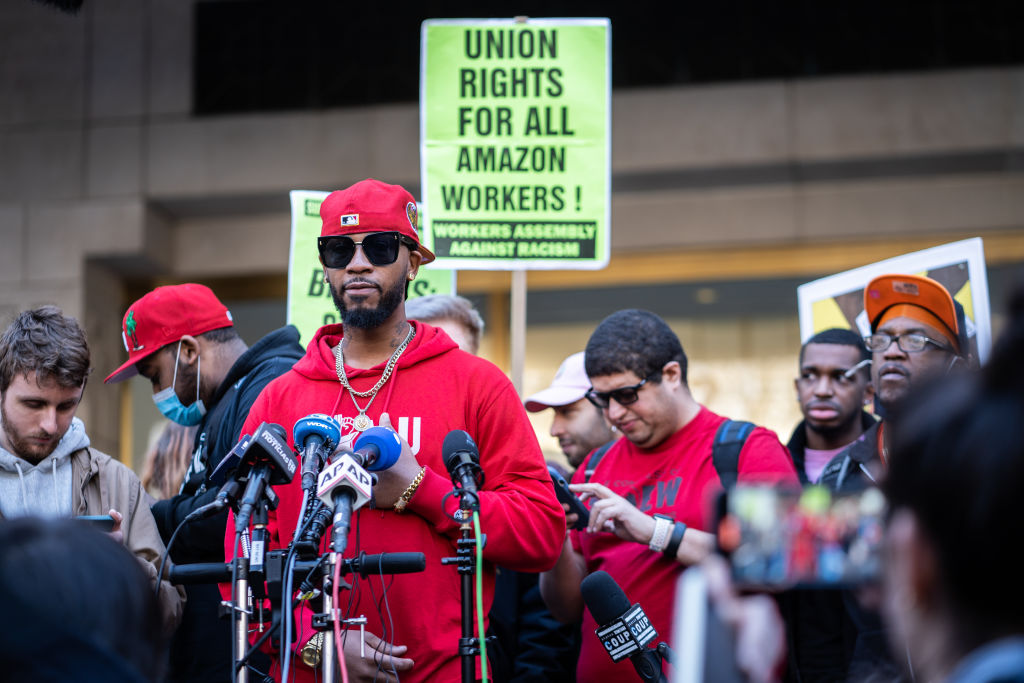
Christian Smalls, founder of the Amazon Labor Union (ALU), speaks during a news conference outside the National Labor Relations Board offices in Brooklyn on April 1, 2022. (Jeenah Moon / Bloomberg via Getty Images)
Outside the offices of the National Labor Relations Board in Brooklyn, the fists of the leaders of the Amazon Labor Union (ALU) were raised in celebration. Amazon, the United States’ second-largest private employer, had finally seen the establishment of its first-ever American union in its twenty-seven years of operation.
This momentous occasion necessitates a reappraisal of the labor movement and its relationship with the Left in the United States and elsewhere. It’s true that barriers to this relationship aren’t new. The rapid growth of organized labor during the postwar era was fiercely opposed by the state and the capitalist class. The Taft-Hartley Act of 1947 and the Red Scare instigated a ferocious witch hunt against the Left, particularly communists, who were subsequently ousted from unions.
Neoliberal capitalism has further transformed the contours of the labor movement. Traditional industries declined, service sectors expanded, and employment became highly insecure. Unionization received a major blow. In 1980, total union membership was around 23 percent of the workforce, with over 20 million workers in unions. In 2021, union membership hit a historic low of 10.3 percent of the workforce. Numbers are even worse for younger workers age sixteen through twenty-four, among whom union density is barely over 4 percent. The pandemic exacerbated these trends: the number of workers in unions declined by 240,000 between 2020 and 2021.