Bernard-Henri Lévy Is the Leading Intellectual of French Anti-Socialism
Bernard-Henri Lévy has made a name for himself as the patron philosopher of France’s neoliberal elite. Here’s how an ex-Maoist become Europe’s leading anti-socialist.
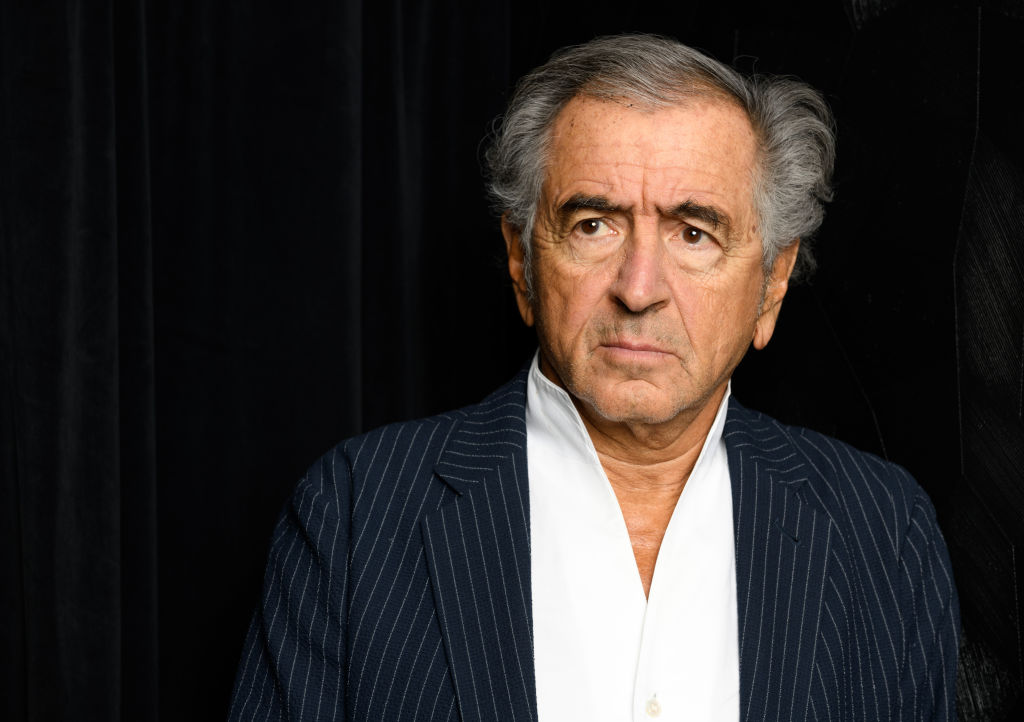
Public intellectual Bernard-Henri Lévy attends the Los Angeles Jewish Film Festival in California on April 30, 2022. (Amanda Edwards / Getty Images)
Bernard-Henri Lévy, or “BHL,” as he is known in France, is the closest thing there is to a rock star intellectual. While he is the author of many books and writes a weekly column in Le Point, one is far likelier to see Lévy — debonair and photogenic — than read him. On the nightly news, he is reporting from a war zone, dressed in a flak jacket while intoning against the latest form of “barbarism;” in the lifestyle magazines, he is lounging poolside at his villa in Marrakesh or glad-handing with presidents; and in the tabloids he is undergoing a messy divorce from a leading French actress. Though it is tempting to write off Lévy as an attention-hungry opportunist, his celebrity reveals something essential about the role of the intellectual in the neoliberal era. Thus, it is worth recalling how he rose to prominence, and how he has acted as a key power broker.
Anti-Marxism With a Human Face
Lévy was born in 1948 to a Sephardic Jewish family in Oran, Algeria. The Lévys, one of the richest families in France, made their fortune in the lumber business after World War II. When Lévy’s father died, the company was estimated to have sold for seven hundred fifty million francs (more than a hundred million euros), resulting in a huge windfall for Bernard-Henri.
With this kind of wealth, he is able, for example, to charter his own planes when necessary. In his youth, Lévy attended France’s most prestigious academies, and studied philosophy at the École Normale Supérieure (ENS), where he was taught by Louis Althusser and Jacques Derrida. Lévy was caught up in the student radicalism of the late 1960s, and though he never joined a political organization, he sympathized with the Maoist currents running through the ENS and the gauchiste movements more broadly.