Rikers Island Has Made Us All Prisoners
New York City’s infamous jail on Rikers Island is one of the most brutal institutions of incarceration in America. Its conditions are the product not just of “tough-on-crime” policies but also of the best intentions of liberal criminal-justice reformers.
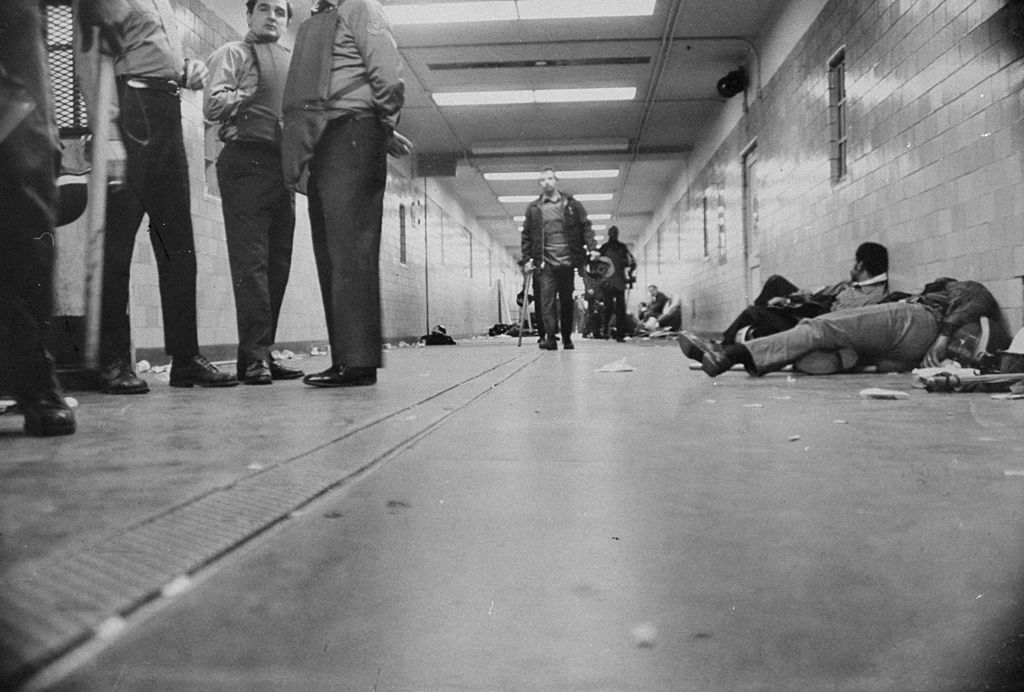
Prisoners sit handcuffed on the ground along the hallway after riots at Rikers Island on November 25, 1975. (Leonard Jackson / NY Daily News Archive via Getty Images)
In 2014, a young man named Jarrod Shanahan arrived at Rikers Island, the infamous spit of land that houses New York’s primary jail complex. Shanahan had been arrested during a violent state crackdown on anti-police uprisings that characterized the beginning of the Black Lives Matter movement. For the next several weeks, he “beheld and experienced the degrading treatment to which tens of thousands of New Yorkers are subjected each year by guards who answer to nobody,” he later reflected.
The guards harassed, intimidated, and outright assaulted prisoners and visitors alike; they ignored prisoners’ medical emergencies and sought to bait them into fights; boredom characterized the hours that were free of violence. It was frightening, demoralizing. Yet Shanahan also began to hear talk of a campaign to close down the penal complex, an organizing effort that a year later would expand greatly following the suicide of Kalief Browder, who had spent three wretched years at Rikers (half that time in solitary confinement) despite not having been convicted of a crime.
Over the course of his forty-five-day sentence, Shanahan decided to learn more about the institution in which he was caged. Five years later, his research had become a doctoral dissertation at the CUNY Graduate Center; three years after that, it has become his first book, Captives: How Rikers Island Took New York City Hostage. It is a vivid, vital, and terrifying volume.