With $10 Trillion in Assets, BlackRock Has Set a New Benchmark for Corporate Power
Megafirms like BlackRock now play a huge role in shaping investment decisions, yet they’ve attracted remarkably little scrutiny. Despite claims that “passive investing” empowers small investors, the trend is driving a dangerous concentration of economic power.
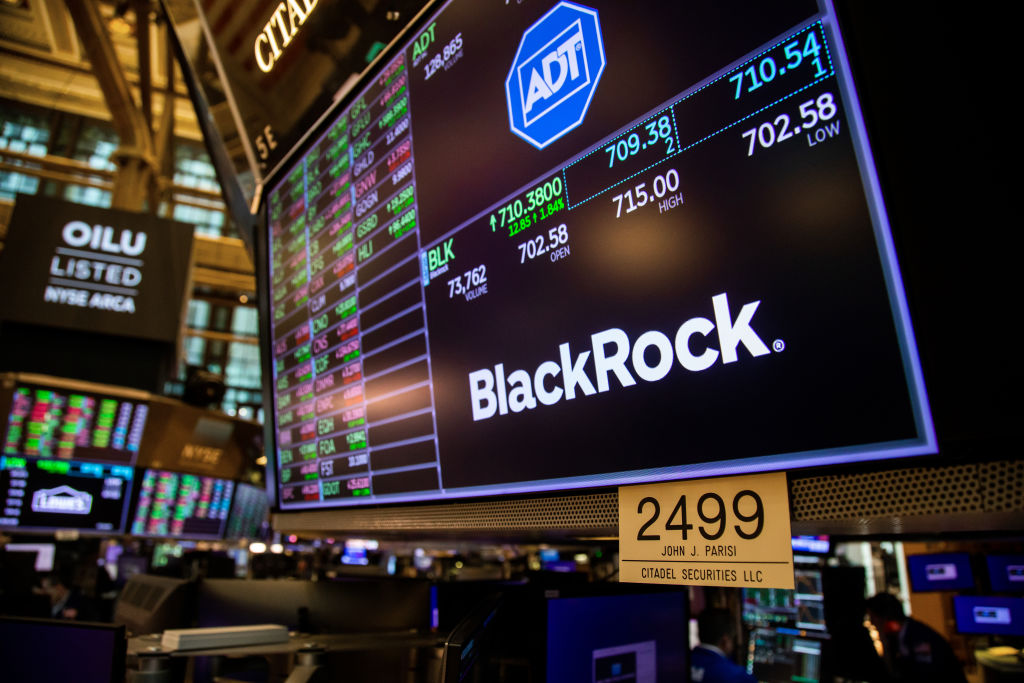
A monitor with BlackRock signage on the floor of the New York Stock Exchange in New York, New York, on Tuesday, March 15, 2022. (Michael Nagle / Bloomberg via Getty Images)
At the end of last year, asset management firm BlackRock broke a new record: it surpassed $10 trillion in the assets it manages. To put that sum in context, it’s larger than the pre-pandemic GDP of Germany and Japan combined.
Yet BlackRock isn’t the only behemoth asset manager in operation today. They’re followed closely by Vanguard, with just over $7 trillion in assets, and a small cohort of peers including Fidelity and State Street in the $4 trillion range. BlackRock and Vanguard alone control enough assets to buy every company listed in the London Stock Exchange at least three times over.
Indeed, the combined $20 trillion in assets of the two firms represents a full fifth of the assets of an entire $100 trillion global industry spanning thousands of firms. This is a profound degree of concentration in a vast and powerful industry. It’s also a recent phenomenon, whose implications for political and economic power and the operating logics of contemporary capitalism we’ve barely begun to recognize, let alone address.