Keep Capitalists Off the Moon
Libertarian think tanks are already gearing up to make the dystopian case for extending private property rights to the moon. It’s a blueprint for expanding the power of the world’s plutocrats on a scale never seen before.
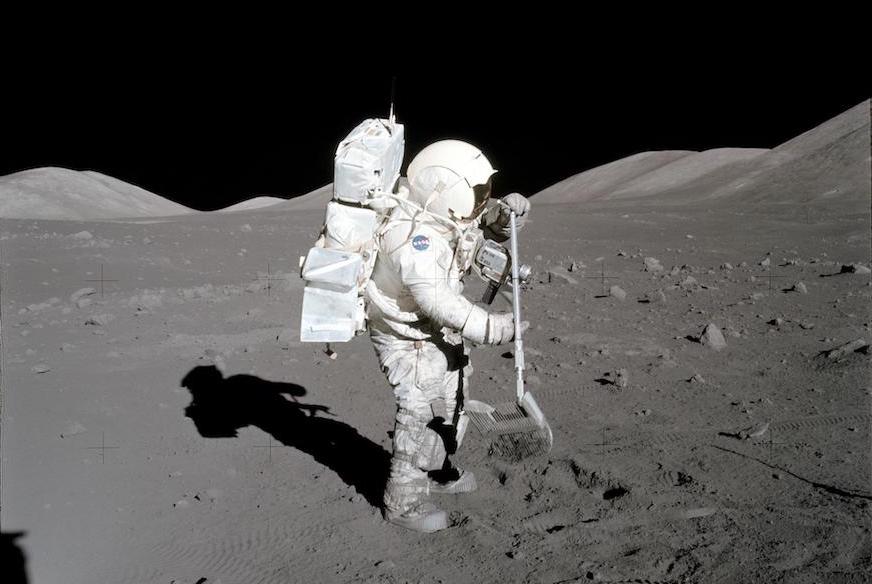
Astronaut Harrison “Jack” Schmitt collects lunar rake samples from the moon on the Apollo 17 mission in December 1972. (NASA)
At its best, futurist thinking represents a flourishing of the human imagination. Emboldened by the invention of new technologies, artists at the turn of the twentieth century envisioned a world largely free of everyday toil, in which the work of machines would allow ordinary people to live fuller and happier lives without the grinding poverty and tedium associated with industrialization. This vision may have reflected a kind of misplaced techno-utopianism, but it was also a genuine expression of progressive thinking in a world of growing class consciousnesses and democratic militancy.
Today, what passes for futurist optimism is often more a sign of civilizational paralysis and economic stagnation — the increasingly absurd billionaire space race offering us a counterfeit vision of utopian promise in the form of climate-destroying vanity flights and dystopian fanfiction about Martian colonies. Unlike earlier iterations of futurism, this plutocrat-manufactured version substitutes the transcendence of earthly inequalities for their extension into the solar system, imagining a century of space exploration planned and carried out by a tiny handful of the world’s wealthiest people. This makes sense insofar as it reflects both the prevailing logic of a top-heavy and decadent global economy and a political order incapable of accommodating real alternatives to the status quo. When a system looks exhausted but reforming it also seems impossible, the only option left is to scale up and hope it yields a better result.
Something like this is at least the implicit premise of a new report from the neoliberal Adam Smith Institute entitled Space Invaders: Property Rights on the Moon, which mounts a Lockean case for the ownership of land off-world. To researcher Rebecca Lowe’s credit, the argument is intellectually quite rigorous and represents a philosophically consistent application of classical liberal thinking. Noting that earlier, more universalist frameworks for the exploration of space feel less viable today than they did in the 1950s or ’60s, Lowe proceeds to consider an approach that is neither nationally or globally based and would instead see individuals “to attain morally-justified property rights in space.”