How Chile’s Left Won
Gabriel Boric’s victory in Chile is a vindication of the mass movement that took to the streets in 2019 — and points toward a country ready to bury Pinochet’s legacy and neoliberalism for good.
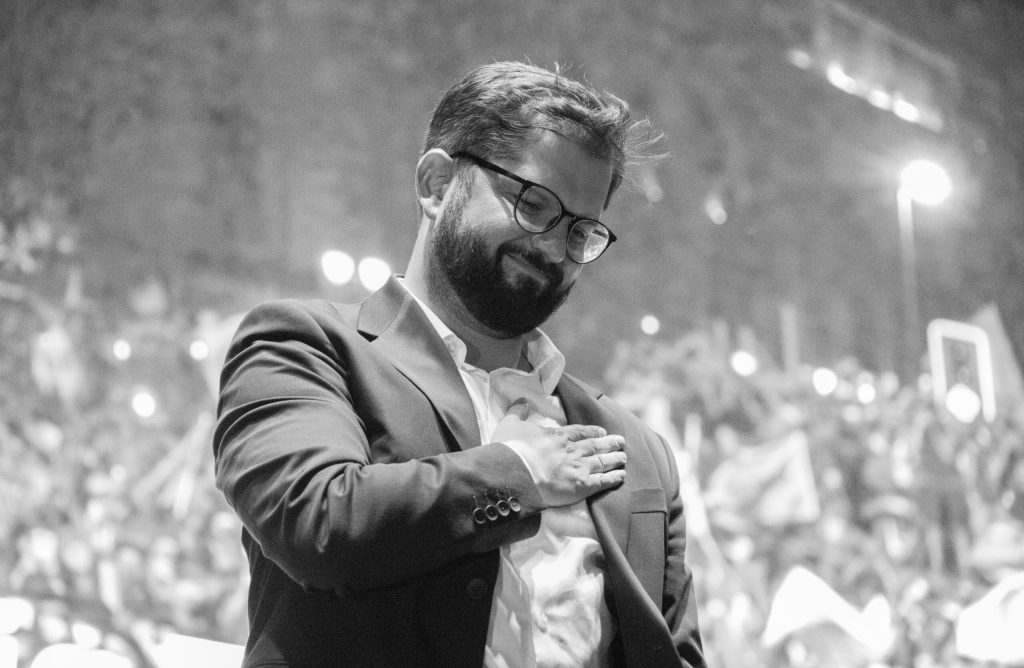
Gabriel Boric after becoming Chile’s youngest president on December 19, 2021. (Paulo Slachevsky / KPFA)
A few weeks ago, when neofascist candidate José Antonio Kast was winning the first round of the country’s presidential elections, Chile’s 2019 rebellion aimed at burying neoliberalism appeared to be at an end. But it’s been reinvigorated with the landslide victory of the Apruebo Dignidad (“I Vote For Dignity”) candidate Gabriel Boric Font, who obtained 56 percent of the vote in the second round — nearly five million votes, and the largest majority in the country’s history. At thirty-five, Boric is the youngest president ever.
That result would have been greater had it not been for the policy of transport minister Gloria Hutt Hesse, who deliberately offered almost no public transport services, especially buses to the poor barrios, in the hope of forcing Boric voters to give up and go back home. On Election Day, there were constant reports in the mainstream media featuring people throughout the country, and particularly in Santiago, complaining about having to wait for two or even three hours for buses to polling centers. There were therefore justified fears that the election would be rigged — but the determination of poor voters was such that the move failed.
Kast’s campaign, with the complicity of the Right and the mainstream media, was one of the dirtiest in the country’s history, reminiscent of the US-funded and US-led “terror propaganda” mounted against socialist candidate (and eventual president) Salvador Allende in 1958, 1964, and 1970. Through innuendo and the use of social media, the Kast camp spewed out crass anti-communist propaganda, charged Boric with assisting terrorism, and suggested that he would install a totalitarian regime in Chile. The campaign sought to instill fear primarily in the petty bourgeoisie by repeatedly predicting that drug addiction, crime, and narco-trafficking would spin out of control if Boric became president, and even implying that Boric himself takes drugs. The mainstream media also assailed Boric with insidious questions about Venezuela, Nicaragua, and Cuba, to which he did not produce the most impressive answers.