The Chilean Right Has Turned Today’s Election Into an Anti-Communist Crusade
Far-right candidate José Antonio Kast casts today’s Chilean election as a battle to save “sacred property rights.” His campaign’s insistence that neoliberal dogmas belong to an unshakeable national essence highlights the antidemocratic impulses at the heart of the Chilean right.
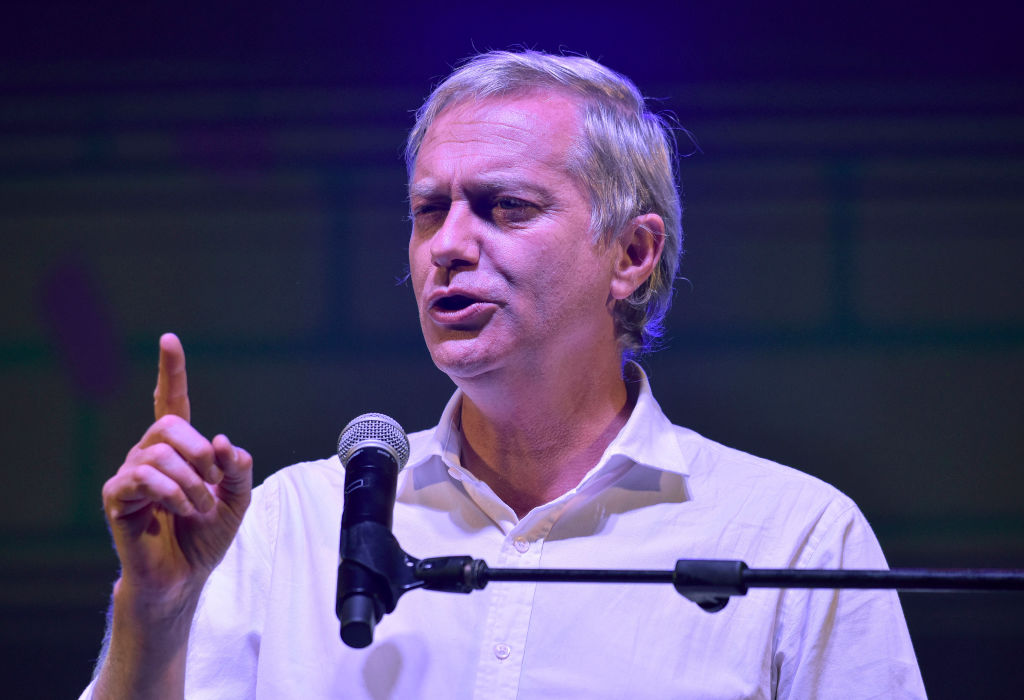
José Antonio Kast, presidential candidate for Chile’s Republican Party, speaks to supporters during his final campaign rally in Santiago on December 16. (Claudio Santana / Getty Images)
Today, Chileans vote in the second round of presidential elections in what the Economist has dubbed a “contest between extremes.” On the one hand is the left-wing candidate Gabriel Boric, and on the other, right-winger José Antonio Kast. This portrayal is, to put it mildly, a distortion.
In the panorama of the international left, nothing would mark out Boric’s program as “extreme.” As for Kast, it is a different story. A fringe candidate until not too long ago, his rhetoric and tactics showcase Latin American right-wing populism at its worst. Like his friend and ally Brazilian president Jair Bolsonaro, his electoral campaign has mixed influences ranging from conservative moralism and neoliberal dogmas to elements that seem plucked from Steve Bannon’s playbook of political lying.
No doubt, Gabriel Boric is not a normative center-left candidate. Having begun his political career as the leader of Chile’s 2011 student movement, he has sustained his image of a fist-raising, street-fighting revolutionary ever since. God forbid — his opponents allege — he has even smoked pot. Still, Boric appears particularly concerned to cater to what can be loosely defined as Chile’s social democratic middle class while still wanting to be recognized as an outsider to the political establishment. His party’s polling-based platform prioritizes the institution of public pension, health care, and education systems. These public services exist in one form or another in almost all highly developed countries, but have been stripped from Chileans during forty years of neoliberalism.